
By a Tea Industry Correspondent | Sonitpur, Assam | May 2026
I have been following Assam’s tea industry for nearly a decade, visiting estates from Dibrugarh to Sonitpur, sitting in auction halls thick with the scent of freshly brewed samples, and watching buyers lean in close to sniff the dry leaf. Nothing quite prepared me for what happened at the Guwahati Tea Auction Centre recently — a single lot of Deckiajuli tea selling at Rs 800 per kilogram, a price that stopped the room cold and rewrote a small but significant page of history for one of India’s most beloved exports.
What Really Happened at the Guwahati Tea Auction Centre
The Guwahati Tea Auction Centre (GTAC) is no stranger to competitive bidding. Deckiajuli Tea Rs 800 Per Kg Record Guwahati Tea Auction one of the largest tea auction venues in the world, it handles hundreds of lots each week, connecting estates across Assam, Meghalaya, and Arunachal Pradesh with buyers from Mumbai, Kolkata, Dubai, and beyond. Most lots sell within predictable ranges. Premium teas occasionally surprise. But Rs 800 per kg for a single orthodox lot from Deckiajuli Tea Estate, owned by Parry Agro Industries Limited, was the kind of moment that makes hardened auction veterans put down their clipboards.
Deckiajuli Tea Estate sits in Sonitpur district — a lush stretch of land flanked by the foothills of the Eastern Himalayas and watered by the seasonal fury of Assam’s monsoon. The estate has a long reputation for producing bold, bright-liquoring teas that carry the unmistakable character of the upper Brahmaputra Valley. But even by Deckiajuli’s own high standards, this lot was exceptional.
What made it record-worthy? Industry insiders point to a combination of artisanal orthodox processing, exceptional first-flush leaf quality, and the growing premium the global market now places on traceable, origin-specific Indian teas. The Rs 800 price tag is not an accident — it is the result of decades of expertise meeting a moment when the world finally caught up to what Assam growers have always known.
Why This Record Matters Beyond the Auction Hall
Assam’s tea industry employs over 700,000 workers directly and supports the livelihoods of millions more through ancillary industries. It is the economic backbone of entire districts. When a lot of Assam tea fetches Rs 800 per kg at auction, the ripple effect matters — it raises the perceived floor for quality Assam tea across all categories, it attracts investment into better processing and sustainability practices, and it sends a clear message to international buyers: Indian tea can command luxury-tier pricing.
This is significant because the global specialty tea market has been evolving rapidly. Buyers in Europe, Japan, the United States, and the Gulf are no longer content with blended, commodity-grade tea. They want provenance. They want handcrafted. They want a cup with a story attached — a specific estate, a specific elevation, a specific season. Deckiajuli’s Rs 800 per kg moment is precisely the kind of story the international market responds to.
Chief Minister Himanta Biswa Sarma Responds
Himanta Biswa Sarma, Chief Minister of Assam, was quick to acknowledge the achievement, stating that Assam Tea is “brewing new records for the world.” His words were carefully chosen. The Assam government under Sarma has made the revival and global promotion of the state’s tea industry a policy priority — and this record validates that direction.
The Chief Minister’s response points to a broader government strategy that includes:
- Stronger global branding for Assam’s Geographical Indication (GI) certified teas
- Policy support to encourage estate owners to invest in premium orthodox and specialty production
- Export promotion initiatives targeting high-value markets in Europe and East Asia
- Support for small tea growers to improve quality and access auction markets directly
Sarma’s framing of this as part of a “200-year-old industry” is also deliberate. Assam’s tea heritage stretches back to 1837, when the first commercial batch of Assam tea was auctioned in London. That history is a selling point in a global market that prizes authenticity and legacy. The Rs 800 record is not a break from tradition — it is the latest chapter in a very long story.
The Science Behind What Makes Deckiajuli Tea Worth Rs 800
Assam sits between roughly 24 and 28 degrees north latitude, in a bowl carved by the Brahmaputra River and sheltered by the Himalayas to the north. The combination of high humidity, alluvial soil rich in minerals, intense rainfall during the monsoon, and hot summers creates growing conditions that coax a level of complexity out of the Camellia sinensis var. assamica plant that cannot be replicated elsewhere.
Deckiajuli, located in Sonitpur at around 200 meters elevation, benefits from slightly cooler night temperatures than the lower valley estates, which slows leaf growth during key flushes. Slower growth means denser, more concentrated flavour compounds — the same principle that makes high-altitude teas from Darjeeling or Taiwan command premium prices.
Beyond the terroir, what separates a Rs 800 lot from an Rs 200 lot at auction is craftsmanship in processing:
- Withering must be controlled precisely to reduce moisture without losing volatile aromatics
- Rolling shapes the leaf and initiates enzymatic oxidation — the step that creates black tea’s characteristic flavour
- Fermentation (oxidation) duration determines the tea’s depth and brightness
- Firing locks in the flavour profile and determines shelf stability
At Deckiajuli, workers with decades of experience manage these steps by hand and instinct as much as by instrument. That human skill, accumulated over generations, is what a buyer is paying for when they bid Rs 800 per kg. It is irreplaceable.
The Guwahati Tea Auction Centre’s Rising Global Profile
The GTAC deserves its own moment of recognition here. Established in 1970, it has grown into one of the world’s premier tea auction venues, handling approximately 170 million kilograms of tea annually. It has consistently outpaced Kolkata — historically the dominant Indian auction centre — in terms of volume and, increasingly, in terms of premium pricing for specialty teas.
The centre’s growing importance reflects a strategic shift in Assam’s tea ecosystem. Rather than shipping raw leaf to Kolkata for processing and auctioning, more estates are now finalizing their products locally and bringing them directly to GTAC. This keeps more value in Assam, gives buyers direct access to estate-specific lots, and allows for the kind of transparent, origin-verified trade that modern premium buyers demand.
The Rs 800 Deckiajuli lot is, in this context, a GTAC success story as much as an estate success story.
What Premium Tea Buyers Are Looking for in 2026
Having spoken to tea importers and specialty buyers over the past several months, a consistent picture emerges of what drives premium pricing in today’s market:
Traceability and Transparency — Buyers want to know the exact estate, the flush, the processing method, and ideally the names of the people who made the tea. The days of anonymous “Assam TGFOP” blends commanding serious money are fading.
Orthodox and Whole-Leaf Processing — The global market is moving away from CTC (crush-tear-curl) production for premium segments. Orthodox whole-leaf teas carry more of the leaf’s natural oils and aromatics, producing a cup with real complexity.
Sustainability Credentials — European and Japanese buyers in particular are paying close attention to environmental practices, worker welfare, and certifications like Rainforest Alliance or Organic India. Estates that invest in sustainability are finding it translates directly into price premiums.
Limited Availability — Scarcity drives value. Small, carefully managed lots from specific harvests create the auction tension that produces records like Rs 800 per kg.
Deckiajuli’s record lot checked every one of these boxes.
A Proud Moment Rooted in Real Work
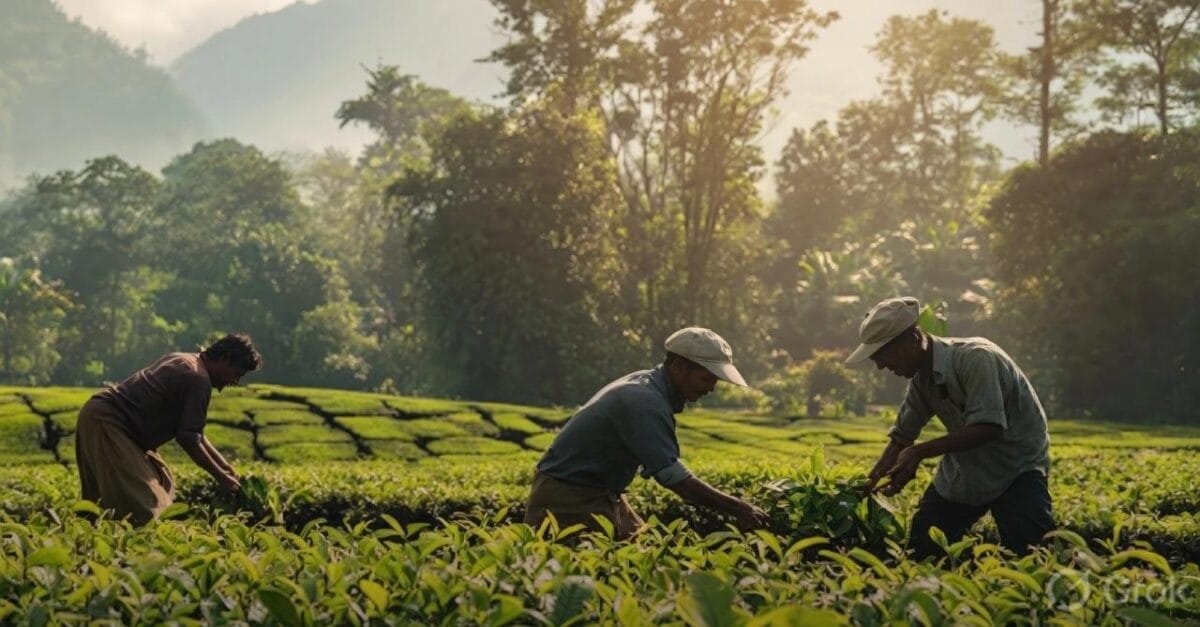
Deckiajuli Tea Estate, that story belongs to the estate managers who calibrated the withering troughs on humid April mornings, the workers who hand-plucked the two-leaves-and-a-bud standard that premium orthodox demands, and the generations of families who have worked this land and passed their knowledge forward.
India’s tea industry sometimes gets reduced in public conversation to export statistics and government press releases. The Rs 800 per kg record is a good opportunity to remember that behind every remarkable cup of Assam tea is an unremarkable working day — long, physical, skilled, and largely invisible to the people who eventually drink it.
That work is what the market is finally pricing correctly.
FAQ Section
Q: Is Deckiajuli tea available for retail purchase? Yes. It is sold under the Parry Agro brand through online platforms like Amazon and specialty tea stores, typically ranging ₹300–₹600 for retail packs.
Q: What makes Assam tea different from other Indian teas? Assam tea is made from the Camellia sinensis var. assamica plant. Its tropical, humid climate along the Brahmaputra valley produces teas that are malty, bold, and full-bodied — quite distinct from the floral, lighter Darjeeling teas.
Q: How many cups of tea per day help with blood pressure? Research suggests 3–4 cups daily is optimal. The blood-pressure-lowering effect was observed in those who consumed tea consistently for more than 12 weeks. University of Utah Health
Q: Is Da Hong Pao available to buy? Commercial-grade Da Hong Pao is available at far lower prices (₹2,000–₹10,000/100g for quality versions). The million-dollar price refers only to tea from the original ancient mother trees, which is essentially unavailable to the public.
Q: Which Assam tea estate holds the all-time Indian auction price record? Manohari Gold Tea from Manohari Tea Estate in Dibrugarh holds the record at ₹99,999 per kg, set in December 2021. Nenews
Q: Does caffeinated or decaf tea have the same effect on blood pressure? According to research cited by the University of Utah, both caffeinated and decaffeinated teas appear to have similar blood-pressure effects, as the benefit comes primarily from flavonoids (catechins), not caffeine.
Looking Ahead: Can Assam Tea Break More Records?
Global demand for premium Indian tea is accelerating. The specialty tea segment is growing at over 8% annually in key markets. The Assam government’s investment in branding and export infrastructure is beginning to show results. Estates that have invested in orthodox processing, sustainability, and workforce training are positioned to benefit enormously from this trend.
Whether Deckiajuli’s Rs 800 record holds for long is almost beside the point. What matters is the direction of travel — and for Assam’s tea industry in 2026, that direction is unmistakably upward.
Assam’s tea gardens have been producing excellence for nearly 200 years. The Guwahati Tea Auction Centre record is a reminder that the best may still be ahead.
Tags: Assam Tea | Deckiajuli Tea Estate | Guwahati Tea Auction Centre | Parry Agro Industries | Himanta Biswa Sarma | Premium Indian Tea | Assam Tea Record 2026 | Orthodox Tea | Specialty Tea India