
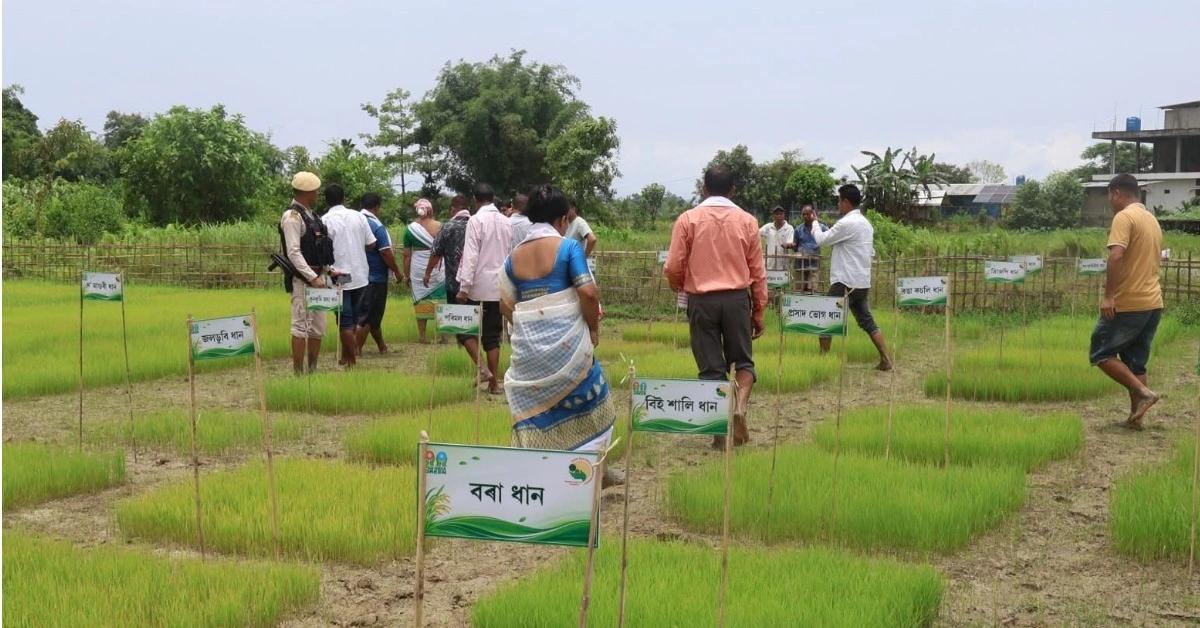
Dibrugarh, Assam — In the lush paddy fields of Borpathar in Dibrugarh district, something quietly remarkable is taking root. Among the rows of green shoots spreading across the landscape, an ancient grain is making a comeback — the indigenous Betguti rice variety, once nearly forgotten, is now at the heart of a transformative agricultural revival in Assam. This initiative, backed by the Assam State Rural Livelihoods Mission (ASRLM) and driven under the broader agricultural vision of Chief Minister Himanta Biswa Sarma, represents far more than a farming experiment. It is a conscious act of cultural preservation, ecological responsibility, and rural empowerment.
Roots of a Revival
The story of Betguti rice’s revival is one of modest beginnings and extraordinary promise. The initiative started with just 10 kilograms of Betguti rice seeds — sourced from Titabor in Jorhat district — planted at Borpathar with the goal of testing the viability of indigenous varieties in a modern farming context. What began as a small-scale pilot has since blossomed into an expansive intercropping system, where Betguti rice now grows alongside 27 other traditional paddy varieties, forming a living library of Assam’s rice diversity.
This is not merely an agricultural project. It is a recognition that indigenous seeds carry within them centuries of accumulated wisdom — genetic adaptations to local soils, monsoon patterns, and pest pressures that no laboratory-engineered variety can fully replicate. Betguti rice, like many traditional Assamese varieties, was cultivated by farming communities long before the Green Revolution introduced high-yielding but genetically uniform crops. The Green Revolution’s efficiency came at a cost: the gradual erosion of biodiversity and the displacement of traditional knowledge systems that sustained rural communities for generations.
Climate-Smart Agriculture as a Framework
What makes the Dibrugarh initiative particularly significant is its integration of climate-smart agricultural principles. The paddy intercropping system employed at Borpathar is designed not just for productivity, but for resilience. By cultivating multiple rice varieties together, farmers reduce the risk of total crop failure from a single disease, pest, or extreme weather event — a vulnerability that monoculture farming inherently carries.
Assam is one of India’s most climate-vulnerable states. Recurrent floods, erratic monsoons, prolonged droughts in certain regions, and shifting seasonal patterns are becoming increasingly common. In this context, indigenous varieties like Betguti hold a distinct advantage. Traditional rice strains have typically evolved over centuries to withstand the specific climatic stresses of their region. Many are naturally flood-tolerant, drought-resistant, or adapted to low-input farming conditions — qualities that make them invaluable assets in the age of climate change.
Agricultural experts increasingly argue that the future of food security lies not in abandoning traditional knowledge but in integrating it with modern agronomy. The Borpathar model is a practical demonstration of this philosophy: using indigenous seeds within a scientifically structured intercropping framework to achieve both ecological balance and sustainable yields.
Women at the Center of Change
A defining feature of this agricultural renaissance is the central role played by women farmers and self-help groups (SHGs) supported by ASRLM. Across Assam, women have historically been the custodians of seed diversity — preserving, selecting, and exchanging seeds across generations. By placing women at the forefront of the Betguti revival, the state is not only acknowledging their traditional expertise but actively investing in women-led rural livelihoods.
ASRLM’s involvement ensures that the initiative is embedded within a broader socio-economic framework. Women participating in the project gain access to training in sustainable farming practices, market linkages for indigenous produce, and institutional support that strengthens their economic agency. This model of women-led agricultural innovation has the potential to become a replicable blueprint for other districts across the state.
Biodiversity as a Strategic Asset
The cultivation of Betguti rice alongside 27 other traditional paddy varieties at Borpathar creates what agricultural scientists call an agrobiodiversity hotspot. Each variety in this diverse ecosystem contributes its own genetic traits — some may be naturally resistant to blast disease, others may mature early or late, some may perform better in waterlogged fields, and others on elevated terrain. Together, they form a resilient, self-sustaining agricultural system.
Preserving this diversity is not merely a sentimental endeavor. It is a strategic necessity. Global crop failures in recent decades have repeatedly demonstrated the dangers of over-reliance on a narrow genetic base. Assam’s traditional rice varieties represent an irreplaceable gene pool that could prove critical in developing future crop varieties capable of withstanding new diseases or climate extremes.
A Model for Assam
The Betguti rice initiative in Dibrugarh is a microcosm of a larger vision for Assam’s agricultural future — one that honors the past while building toward a more sustainable and equitable rural economy. If successfully scaled, this model could be extended to other indigenous crops across the Brahmaputra and Barak valleys, transforming Assam into a national leader in agrobiodiversity conservation.
There is growing national and international recognition of the value of indigenous seed systems. Movements like community seed banks, farmer-led variety trials, and geographical indication (GI) tagging for traditional crops are gaining momentum across India. Assam’s Betguti revival aligns well with these trends and positions the state to benefit from premium markets for heritage rice varieties among health-conscious and environmentally aware consumers.
As the paddy shoots sway in the Assam breeze at Borpathar, they carry with them the weight of history and the promise of a resilient future — one seed, one field, one community at a time.Dibrugarh rice cultivation 2026
Sources: Assam State Rural Livelihoods Mission (ASRLM); Government of Assam agricultural initiatives under Chief Minister Himanta Biswa Sarma.