Writer by Sanjoy gorh/3.02 PM Published
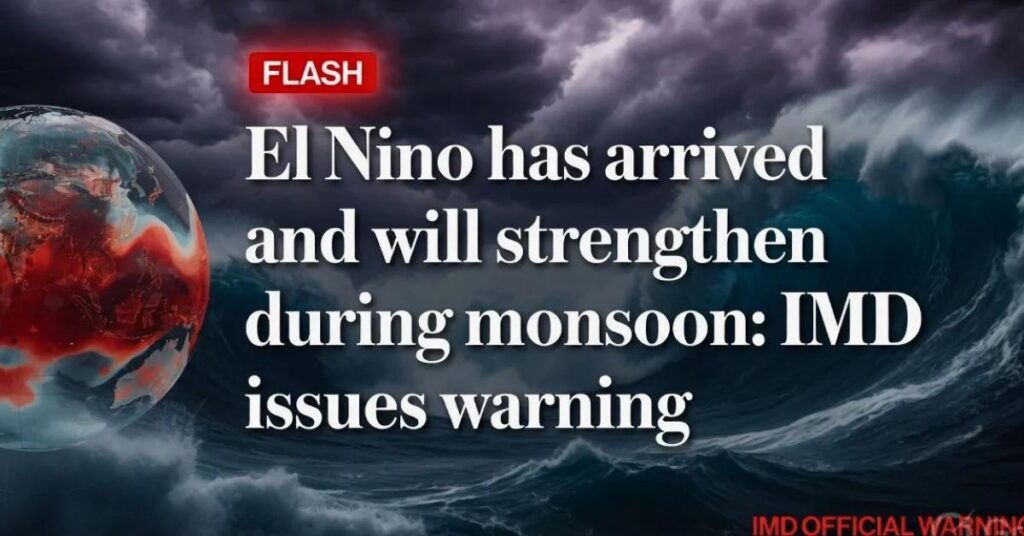
If you live in India and you’ve been watching the sky lately, wondering why the monsoon feels different this year — you are not imagining it. The India Meteorological Department (IMD) has issued an El Niño monsoon warning, and forecasters around the world are calling this one of the most significant climate events in recent memory. Here is everything you genuinely need to know, explained clearly and honestly.
What Is El Niño
El Niño is not just a weather buzzword that scientists toss around. It is a real, measurable warming of the central and eastern tropical Pacific Ocean that changes weather patterns across the entire planet. When Pacific sea surface temperatures rise unusually high, they alter the jet streams, shift rainfall belts, and disrupt the monsoon systems that billions of people — including more than a billion Indians — depend on for their water supply, agriculture, and daily survival.
The 2026 El Niño event has officially arrived, and it is not a mild one. The U.S. National Oceanic and Atmospheric Administration (NOAA) and IMD have both confirmed that sea surface temperatures in the Niño 3.4 region are running well above normal thresholds. Early models suggest this could rank among the strongest El Niño events on record — and some forecasters are using the term “Super El Niño” to describe its projected intensity.
For India, this matters deeply. El Niño years historically correlate with weaker, erratic, and below-normal monsoon rainfall across the subcontinent. The 2023 El Niño, for instance, contributed to delayed monsoon onset and patchy rainfall in several states. This time, IMD has moved early, issuing warnings and updated seasonal forecasts so farmers, water managers, and policymakers can prepare.
Weak, Strong, or “Super”? Understanding El Niño Categories
Not all El Niño events are the same, and the distinction matters enormously for how your region’s weather will behave.
Weak El Niño occurs when Pacific sea surface temperatures rise between 0.5°C and 0.9°C above average. Effects are subtle — slightly drier conditions in some areas, mild disruption to monsoon timing, but nothing dramatic.
Moderate El Niño (1.0°C to 1.4°C above average) begins to noticeably affect Indian rainfall patterns. Historically, moderate events have led to below-average monsoon seasons in central and peninsular India, with rainfall deficits of 10 to 20 percent in vulnerable zones.
Strong El Niño (1.5°C to 1.9°C above average) is where the risk becomes serious. The 1997–98 El Niño, one of the strongest ever recorded, caused devastating droughts across South and Southeast Asia, Australia, and eastern Africa. In India, strong El Niño years often bring delayed monsoon onset, prolonged dry spells in June and July, and irregular rainfall in the Deccan plateau, Rajasthan, Gujarat, and Maharashtra.
Super El Niño — a term that is not yet formally standardized but widely understood — refers to events where sea surface temperature anomalies exceed 2.0°C to 2.5°C, sustained over several months. The 2015–16 event came close to this category and triggered one of India’s worst agricultural droughts in decades.
The 2026 event is currently tracking in the strong-to-super range. IMD has classified it as a significant El Niño episode with high confidence, and forecasters are watching closely to see whether it peaks at levels that could make it historic.
What IMD’s El Niño Monsoon Warning Actually Means for India
The India Meteorological Department does not issue El Niño warnings casually. When IMD uses the phrase “El Niño monsoon warning,” it signals a formal alert within the country’s seasonal forecasting framework — one that has direct implications for crop planning, reservoir management, drought preparedness, and disaster risk reduction.
Here is what IMD’s 2026 forecast indicates, broken down region by region:
Northwest India (Rajasthan, Punjab, Haryana, Delhi): These regions, already prone to heat stress, face elevated risk of below-normal pre-monsoon and early monsoon rainfall. Groundwater recharge, which depends heavily on June–July rains, may be compromised.
Central India (Madhya Pradesh, Vidarbha, Marathwada): This belt is historically the most sensitive to El Niño-driven drought. Deficient rainfall here directly impacts kharif crop sowing — particularly soybean, cotton, and pulses.
Peninsular India (Karnataka, Andhra Pradesh, Telangana, Tamil Nadu): The southwest monsoon typically weakens in El Niño years. However, the northeast monsoon (October–December) often compensates partially for Tamil Nadu and coastal Andhra. Even so, cumulative annual rainfall may fall short.
Northeast India and West Bengal: These regions generally receive above-normal rainfall even in moderate El Niño years due to Bay of Bengal moisture dynamics. IMD’s current forecast suggests relatively normal to near-normal rainfall here.
Kerala and Coastal Karnataka: The onset of the southwest monsoon over Kerala — traditionally around June 1 — may be delayed in 2026. A late onset is a classic El Niño signature and has cascading effects on the entire country’s monsoon progression.
The Real Human Impact: What Farmers, Cities, and Households Will Face
This is not an academic exercise. El Niño’s effects are felt in school tiffins, in the price of onions at your local market, in the water pressure from your tap in August.
India’s kharif agriculture — which includes rice, cotton, sugarcane, pulses, and oilseeds — is almost entirely rain-fed. If the monsoon delivers 90 percent or less of normal rainfall across the Indo-Gangetic Plain and Deccan plateau, crop yields drop, farm incomes fall, and food prices rise. The 2009 El Niño drought, which produced only 77 percent of normal monsoon rainfall nationally, sent food inflation above 15 percent.
Urban India is not insulated. Cities like Bengaluru, Hyderabad, Pune, and Chennai depend on reservoirs that refill with monsoon rain. In El Niño years, reservoir levels entering October are often dangerously low, leading to water rationing and supply cuts that affect millions of households.
Heat waves become more intense and prolonged when the monsoon is delayed. Without the thermal relief that monsoon clouds and rain provide in June, temperatures in large parts of India can remain above 40°C well into July — a serious public health crisis, particularly for outdoor workers, the elderly, and children.
How This El Niño Compares to History’s Worst
The 1997–98 El Niño remains the benchmark — it was the strongest ever measured at the time, with Pacific sea surface temperatures peaking nearly 3°C above average. It caused widespread disruption to the Indian monsoon, contributed to severe droughts across Southeast Asia, and triggered devastating floods in South America and East Africa.
The 2015–16 event surpassed 1997–98 in peak intensity by some measures, making it the strongest on record at the time. India experienced its second-consecutive drought year in 2015, with Maharashtra declaring drought in over 150 talukas.
The 2026 event is being watched with the same level of concern. While peak intensity projections still carry uncertainty — climate models have wide confidence intervals at this lead time — the probability of this being a strong or very strong event is now assessed at above 75 percent by most major forecasting centers.
What You Can Do: Practical Steps Based on Real Experience
People who have lived through strong El Niño seasons in India know certain truths that no government advisory fully captures.
Store water early. If you are in a region with water scarcity risk, fill overhead tanks and storage containers before municipal supply begins to tighten. Municipalities are often slow to announce rationing, but the signs come early in reservoir levels.
Farmers should consult IMD’s district-level forecasts — not just national headlines — before finalizing crop choices. In drought-risk years, drought-tolerant crops like bajra, jowar, and certain pulses outperform water-intensive crops like paddy in rain-shadow zones. State agriculture departments in Maharashtra, Karnataka, and Rajasthan typically release El Niño advisory bulletins for farmers.
Track the monsoon’s real-time progress. IMD’s official website and app provide daily rainfall data at the district level. In an El Niño year, rainfall can be highly uneven — some districts receive floods while neighbors face drought — so national averages can mislead.
Stay informed about heat wave alerts. The National Disaster Management Authority (NDMA) and IMD issue Heat Action Plan advisories during extreme heat periods. Following these — especially around school hours, work schedules, and outdoor activity — is not overreaction; it is genuinely protective.
The Science Behind El Niño and India’s Monsoon: A Plain-Language Explanation
India’s southwest monsoon is powered by temperature contrast. In summer, the land heats up faster than the Indian Ocean, creating low pressure over the subcontinent that draws in moisture-laden winds from the sea. This is the monsoon machine.
El Niño disrupts this machine by warming the central and eastern Pacific, which strengthens the Walker Circulation — the large-scale east-west atmospheric circulation over the tropics — in ways that weaken the moisture flow toward South Asia. It also shifts the position of the subtropical jet stream, which can suppress the convective activity that generates heavy monsoon rainfall.
In simple terms: El Niño makes it harder for moisture to travel from the ocean to India, and harder for the atmosphere to produce the heavy, sustained rainfall events that refill reservoirs and irrigate fields.
Indian meteorologists at IMD have spent decades refining models that account for El Niño effects. Today, seasonal forecasts incorporate Pacific sea surface temperatures, Indian Ocean Dipole (IOD) conditions, snow cover over Eurasia, and other predictors. A positive IOD — warmer-than-normal western Indian Ocean — can partially counter El Niño’s drying effect on India, which is why IMD watches both simultaneously.
The Bottom Line: Take This Warning Seriously, But Not Fatally
El Niño does not automatically mean catastrophe. India has managed strong El Niño seasons before, and with good preparation, the damage can be substantially reduced. IMD’s early warning is itself a sign of institutional progress — in past decades, these forecasts came later and with less precision.
What the 2026 El Niño monsoon warning asks of all of us is attention. Pay attention to IMD forecasts in the weeks ahead. Pay attention to water use. Pay attention to heat warnings. And if you are a farmer, a water manager, or a policymaker — pay attention to the district-level data that tells a far more precise story than national headlines.
The Pacific is warmer. The monsoon will feel it. And so will we.
Sources: India Meteorological Department (IMD) seasonal forecasts; NOAA Climate Prediction Center El Niño advisory; historical monsoon rainfall data 1950–2025. For the latest updates, visit imd.gov.in.