
Writer by Sanjoy gorh Guwahati | January 25, 2026
Introduction
Assam’s tea gardens have powered the state’s economy for nearly two centuries, yet the workers who pluck the leaves day after day have historically received little direct financial recognition from the government. That changed in January 2026, when Assam Chief Minister Himanta Biswa Sarma launched the Mukhya Mantrir Eti Koli Duti Paat Scheme — a flagship welfare initiative aimed squarely at the men and women who keep Assam’s tea industry running.
If you or someone in your family works in a tea estate in Assam, this scheme could put ₹5,000 directly into your bank account. In this guide, we break down everything you need to know: who is eligible, what documents you need, how to apply, and what benefits you can expect — all in one place.
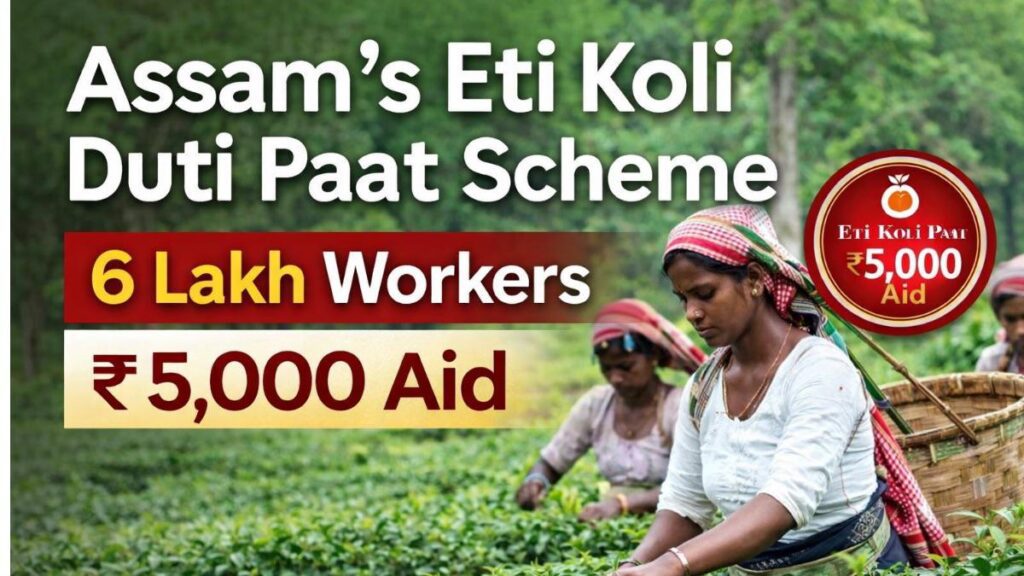
What Is the Eti Koli Duti Paat Scheme?
The Mukhya Mantrir Eti Koli Duti Paat Scheme (মুখ্যমন্ত্ৰীৰ এটি কলি, দুটি পাত) — also known as the Assam Tea Garden Workers’ Financial Assistance Scheme — is a welfare program launched by the Government of Assam to honour the contribution of tea garden workers to the state’s tea industry.
The Chief Minister officially launched the scheme at Doomdooma in Tinsukia district. The launch coincided with celebrations marking 200 years of Assam’s tea industry, a milestone the government used as the occasion to roll out direct financial support for the workforce that has sustained the sector for two centuries.
The scheme name itself — “Eti Koli, Duti Paat,” meaning “one bud, two leaves” in Assamese — refers to the traditional method of plucking tea, the very labour the scheme seeks to honour.
Objective of the Scheme
The core objective is straightforward: provide direct, one-time financial assistance to registered tea garden workers across Assam, while also improving overall welfare infrastructure in tea garden areas. Alongside the cash assistance, the government also rolled out mobile creches and mobile toilet facilities in tea garden regions, aimed at improving childcare, hygiene, dignity, and safety — particularly for women workers.
The Chief Minister described the launch as the fulfilment of an election promise, framing it as part of a broader push for inclusive development across Assam’s tea belt.
Key Highlights of the Scheme
| Particulars | Details |
|---|---|
| Scheme Name | Mukhya Mantrir Eti Koli Duti Paat Scheme |
| Launched By | Assam CM Himanta Biswa Sarma |
| Launch Location | Doomdooma, Tinsukia District |
| Launch Year | 2026 |
| Financial Assistance | ₹5,000 (one-time) |
| Total Outlay | Over ₹300 crore |
| Beneficiaries | 6+ lakh tea garden workers |
| Coverage | 836 tea gardens, 27 districts, 73 Assembly constituencies |
| Mode of Payment | Direct Bank Transfer (Aadhaar-linked) |
| Worker Type Covered | Permanent and casual (temporary) workers |
Eti Koli Duti Paat Scheme Eligibility
To qualify for the Mukhya Mantrir Eti Koli Duti Paat Scheme, applicants generally need to meet the following eligibility criteria:
1. Residency Requirement
The applicant must be a permanent resident of Assam, currently residing within the state.
2. Employment Requirement
The applicant must be a registered worker or employee at an officially recognised tea estate or tea garden in Assam. This includes:
- Permanent tea garden workers
- Casual (temporary) tea garden workers
Both categories of workers are fully eligible under the scheme — there is no exclusion based on employment type, as long as the worker is officially registered with a recognised tea garden.
3. Bank Account Requirement
Applicants must hold an active, Aadhaar-linked bank account with a scheduled commercial bank. This is essential because the entire disbursal process is designed around direct bank transfers for transparency and to promote financial inclusion.
4. Exclusions
It’s important to note that the financial assistance is meant for tea garden workers and employees, not estate management or ownership. The scheme specifically targets the labour force — those who work in the gardens and factories — rather than administrative or managerial staff.
Age and Income Criteria
many welfare schemes that impose strict age brackets or income ceilings, the Eti Koli Duti Paat scheme’s eligibility centres primarily on employment status within a recognised tea garden, rather than a specific age band or income threshold. The defining qualifier is being an active, registered tea garden worker — not a separate income or age test.
Benefits Under the Eti Koli Duti Paat Scheme
1. Direct Financial Assistance
The headline benefit is a one-time cash grant of ₹5,000 credited directly to the eligible worker’s Aadhaar-linked bank account. With more than six lakh workers expected to benefit, the state government has earmarked over ₹300 crore for the scheme.
2. Wide Coverage Across the State
The benefit isn’t limited to a single district — it spans 836 tea gardens across 27 districts and 73 Legislative Assembly constituencies, making it one of the most geographically extensive welfare disbursals targeted specifically at Assam’s tea community.
3. Recognition of Tea Tribe Contribution
Beyond the monetary component, the scheme carries symbolic weight: it is designed to formally recognise the historic and ongoing contribution of tea tribes and indigenous communities to Assam’s economy, an industry whose products are consumed globally but whose labour force has often remained invisible in policy terms.
4. Complementary Welfare Measures
Alongside the cash benefit, the government has introduced:
- Mobile creches for childcare support in tea garden areas
- Mobile toilet facilities to improve hygiene and safety, especially for women workers
- Land pattas (ownership rights) for workers residing in labour lines, allowing long-term residents to finally gain ownership of land after generations of residence
- Job reservation of 3% for tea tribe communities in government employment
- New schools and reserved medical seats for tea garden community welfare
This combination of direct cash support and structural welfare reform positions the scheme as part of a broader, long-term commitment to the Assam tea garden welfare scheme ecosystem, rather than a one-off gesture.
Documents Required for Eti Koli Duti Paat Scheme
Based on the application process and eligibility framework, applicants/workers should keep the following documents ready:
- Aadhaar Card — mandatory, since disbursal is Aadhaar-linked
- Bank Account Details — active account in a scheduled commercial bank, linked to Aadhaar
- Proof of Residence — to confirm Assam residency
- Employment/Worker Identity Proof — confirmation of registration as a worker at a recognised tea garden (typically maintained and verified through the tea garden management/employer records)
- Passport-size Photograph — for verification and record purposes
- Other certificates, if specifically requested by the District Level Implementation Committee (DLIC) during verification
Since the process largely runs through tea garden management and government verification systems rather than individual document uploads, workers should primarily ensure their Aadhaar and bank details are accurate and updated with their employer/garden management.
How to Apply for Eti Koli Duti Paat Scheme — Step-by-Step Process
many welfare schemes where individuals apply directly online, the Eti Koli Duti Paat scheme follows a structured, garden-management-led verification process:
Step 1: The tea garden/estate management compiles a list of eligible tea workers in the prescribed format (commonly referred to as Annexure A) and submits it to the District Level Implementation Committee (DLIC).
Step 2: This list is uploaded onto the relevant state government digital portal (the Department’s Digitization and Information system, sometimes referred to as the DIDS portal).
Step 3: Aadhaar number verification is carried out for each worker on the list.
Step 4: Based on Aadhaar verification, the DLIC reviews and either approves or rejects individual beneficiary entries.
Step 5: The approved list moves forward for digitization as per the next prescribed format (Annexure B).
Step 6: Once digitized, the payment is processed and the ₹5,000 assistance is credited directly to the worker’s bank account.
What Workers Should Do
Since the application is largely management-driven rather than individual self-application, the most important action an eligible worker can take is to:
- Confirm with garden management/HR that their name is included in the eligible workers’ list
- Ensure their Aadhaar details and bank account information are correct and updated
- Follow up with garden administration or local government offices for payment status updates
Eti Koli Duti Paat Scheme: Latest Updates (2026)
As of early 2026, the scheme has already disbursed one-time financial assistance to more than six lakh tea garden workers across Assam, with payments reaching workers in 836 tea estates spanning 27 districts. Alongside the cash transfer, the state government has also moved to grant land pattas to tea garden workers living in labour lines — a step described by officials as transformative in securing long-term housing rights for a community that has lived on garden land for generations without formal ownership.
(FAQs)
Q1. What is the Eti Koli Duti Paat scheme?
It is a welfare scheme launched by the Government of Assam to provide a one-time financial assistance of ₹5,000 to registered tea garden workers, recognising their contribution to the state’s 200-year-old tea industry.
Q2. What is the monthly payment of Orunodoi 3.0 beneficiaries?
Orunodoi 3.0 is a separate Assam government welfare scheme that provides monthly direct cash assistance to eligible women beneficiaries from economically weaker households. It is distinct from the Eti Koli Duti Paat scheme, which provides a one-time ₹5,000 payment specifically to tea garden workers rather than a recurring monthly transfer.
Q3. What is the ₹10,000 scheme in Assam?
Assam runs several welfare schemes with varying amounts; the Eti Koli Duti Paat scheme itself provides ₹5,000 as a one-time benefit to tea garden workers. If you’ve come across a reference to a ₹10,000 scheme, it likely refers to a different state welfare program, so it’s worth checking the specific scheme name with official Assam government sources to avoid confusion.
Q4. Which Indian state launched the Mukhya Mantrir Eti Koli Duti Paat scheme to support tea garden workers?
Assam launched this scheme. It was unveiled by Chief Minister Himanta Biswa Sarma at Doomdooma in Tinsukia district as part of celebrations marking 200 years of the state’s tea industry.
Q5. Who is eligible for the Eti Koli Duti Paat scheme?
Permanent residents of Assam who work as registered permanent or casual workers/employees at a recognised tea garden, and who hold an active Aadhaar-linked bank account, are eligible.
Q6. Is there an online application portal for individual workers?
The process is largely managed through tea garden management, which submits worker lists to the District Level Implementation Committee for verification, rather than individual online self-applications. Workers should coordinate with their garden management to confirm inclusion in the beneficiary list.
Conclusion
The Mukhya Mantrir Eti Koli Duti Paat Scheme marks one of Assam’s most significant direct welfare interventions for its tea garden workforce in recent years. With over ₹300 crore disbursed to more than six lakh workers, alongside complementary measures like land pattas, job reservations, and improved childcare and sanitation infrastructure, the scheme represents a substantial — if largely symbolic — step toward formally recognising the labour behind Assam’s globally recognised tea industry.
If you work in a tea garden in Assam, the best step you can take right now is to confirm with your garden management that your name and bank details are correctly registered, since the disbursal process runs primarily through employer-led verification rather than individual applications.