
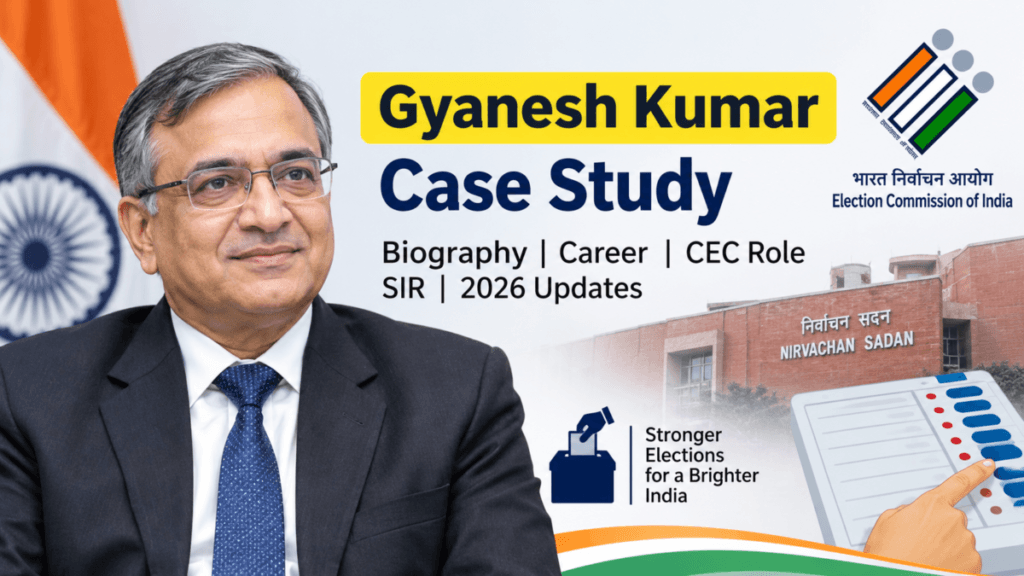
Gyanesh Kumar is the 26th Chief Election Commissioner (CEC) of India and has been at the centre of several important developments in India’s electoral administration since taking charge of the Election Commission of India (ECI) in February 2025. His tenure has included major Assembly elections, electoral-roll revision, international election-management engagement, technology initiatives and continuing public debate about the functioning of the Election Commission.
This detailed case study examines Gyanesh Kumar’s career, appointment, responsibilities, major initiatives, the Special Intensive Revision (SIR) of electoral rolls, the 2026 elections and the institutional questions that have emerged during his tenure.
Who is Gyanesh Kumar?
Gyanesh Kumar is a retired 1988-batch Indian Administrative Service (IAS) officer of the Kerala cadre. According to the Election Commission’s official biography, he studied Civil Engineering at IIT Kanpur and later studied Business Finance at ICFAI and Environmental Economics at Harvard University.
Before joining the Election Commission, he held several administrative positions in Kerala and the Government of India.
His Kerala assignments included positions such as Sub Collector of Adoor, Municipal Commissioner of the Corporation of Cochin, District Collector of Ernakulam, Managing Director of the Kerala State Cooperative Bank and Resident Commissioner of Kerala House in New Delhi.
At the Union government level, he worked in the Ministry of Defence, Ministry of Home Affairs, Ministry of Parliamentary Affairs and Ministry of Cooperation.
He retired from government service on 31 January 2024 and was subsequently appointed an Election Commissioner. (Election Commission of India)
Appointment as Election Commissioner
The Union government announced the appointment of Gyanesh Kumar and Sukhbir Singh Sandhu as Election Commissioners in March 2024. The appointments took effect from the date they assumed office. (Press Information Bureau)
Gyanesh Kumar formally took charge as an Election Commissioner on 15 March 2024.
His period as Election Commissioner coincided with the 2024 Lok Sabha election and elections to the Legislative Assemblies of Jammu and Kashmir, Haryana, Maharashtra, Jharkhand and the National Capital Territory of Delhi. The ECI subsequently appointed him Chief Election Commissioner in February 2025. (Election Commission of India)
When did Gyanesh Kumar become Chief Election Commissioner?
Gyanesh Kumar assumed charge as the 26th Chief Election Commissioner of India on 19 February 2025.
The appointment followed the statutory framework established by the Chief Election Commissioner and Other Election Commissioners (Appointment, Conditions of Service and Term of Office) Act, 2023. The Election Commission’s official biography confirms his date of assumption of office and previous experience as an Election Commissioner. (Election Commission of India)
The 2023 Act provides that the Chief Election Commissioner and other Election Commissioners are appointed by the President. It establishes a Search Committee and a Selection Committee for the appointment process. Under the Act, the Selection Committee consists of the Prime Minister, the Leader of Opposition in the Lok Sabha and a Union Cabinet Minister nominated by the Prime Minister. (India Code)
The Act also provides a maximum term of six years or until the age of 65, whichever is earlier, with no reappointment. Where an Election Commissioner becomes CEC, the aggregate tenure as Election Commissioner and CEC cannot exceed six years. (India Code)
What does the Chief Election Commissioner do?
The Chief Election Commissioner is part of the Election Commission of India, a constitutional authority responsible for administering elections covered by its constitutional mandate.
The ECI conducts elections to the Lok Sabha, Rajya Sabha, State Legislative Assemblies and the offices of the President and Vice-President.
The CEC therefore has responsibilities that extend far beyond polling day. Election management involves preparation and revision of electoral rolls, scheduling elections, appointment and supervision of election personnel, deployment of observers, enforcement of the Model Code of Conduct, expenditure monitoring, logistics, voting technology, counting arrangements and coordination with state administrations.
The scale is enormous. The ECI has described India’s electoral exercise as involving hundreds of millions of electors and large numbers of election personnel and polling staff. (Election Commission of India)
Gyanesh Kumar’s role in the 2026 Assembly elections
One of the most significant responsibilities during Gyanesh Kumar’s tenure has been overseeing preparations for the 2026 Assembly elections.
The ECI’s 2026 election-management records include elections in Assam, Kerala, Tamil Nadu, West Bengal and Puducherry. The Commission’s official election-management portal lists these elections among its current and recent electoral exercises. (Election Commission of India)
The 2026 elections also provided an opportunity for international observers to examine India’s election-management system.
In April 2026, the ECI conducted the International Election Visitors’ Programme. The first phase involved Assam, Kerala and Puducherry, followed by visits covering West Bengal and Tamil Nadu.
According to the ECI, 43 delegates from 23 countries participated in the first phase. Delegates received demonstrations of Electronic Voting Machines (EVMs), observed mock polls and visited election-management facilities. (Election Commission of India)
The programme was presented by the ECI as an international cooperation and knowledge-sharing initiative.
EVMs and election technology
Technology has become an important part of India’s election-management system.
During the 2026 International Election Visitors’ Programme, foreign delegates were shown EVM demonstrations and participated in mock polling. The ECI said the visitors were interested in technological interventions and administrative safeguards used in India’s election process. (Election Commission of India)
This illustrates an important aspect of the CEC’s role: election administration is not limited to political scheduling. It also requires managing voting technology, information systems, polling infrastructure and procedures designed to protect the integrity of the electoral process.
The ECI has also been developing digital platforms. Its publications page lists initiatives including ECINET, described by the Commission as a unified digital platform available on mobile and web. (Election Commission of India)
Special Intensive Revision: the biggest issue of the Kumar tenure
One of the most important developments associated with Gyanesh Kumar’s tenure has been the Special Intensive Revision (SIR) of electoral rolls.
The purpose of electoral-roll revision is to maintain accurate voter lists. The process can involve identifying duplicate entries, deceased electors, people who have permanently moved and other cases requiring verification, while also ensuring eligible citizens are included.
The SIR process became particularly significant after the ECI ordered an intensive revision in Bihar in June 2025.
The Supreme Court later considered the legality of that exercise.
Supreme Court’s 2026 judgment on Bihar SIR
On 27 May 2026, the Supreme Court of India delivered its judgment in Association for Democratic Reforms v. Election Commission of India, concerning the legality of the Bihar SIR.
The Supreme Court’s official summary states that the Court upheld the validity of the Bihar SIR.
The Court examined whether the ECI possessed the authority to conduct the revision, whether the exercise had a legitimate purpose, whether the procedures were proportionate and whether they complied with the Representation of the People Act, 1950 and the Registration of Electors Rules, 1960. (Supreme Court of India)
The Court found that the ECI’s authority to conduct the exercise could be traced to Article 324 of the Constitution read with Section 21(3) of the Representation of the People Act.
The Court also examined the safeguards available to voters whose names were questioned.
Importantly, the Supreme Court described the right to vote as a constitutional right operating within the statutory framework governing electoral registration. It also held that the Commission could conduct a limited inquiry into citizenship for electoral-registration purposes, while distinguishing that process from a formal determination of citizenship under the Citizenship Act. (Supreme Court of India)
This judgment is an important part of understanding the legal background of SIR during Gyanesh Kumar’s tenure.
Expansion of SIR in 2026
Following the Bihar exercise, the ECI expanded SIR preparations and implementation to additional states and Union Territories.
The process involves verification of electoral information, including house-to-house enumeration and examination of voter records.
The stated administrative objective is to improve the accuracy of electoral rolls while allowing eligible electors to participate in the electoral process.
Because electoral-roll revision directly affects who appears on the voter list, SIR has also become an important subject of public and political debate.
This distinction is important: the administrative objective of SIR and the political debate surrounding its implementation are separate questions. The former can be assessed through the ECI’s rules and procedures; the latter includes competing claims from political parties, civil-society groups and commentators.
Controversy and internal disagreements in the Election Commission
As of September 2026, another significant development concerns reported disagreements within the three-member Election Commission.
A September 24, 2026 investigation by The Indian Express reported that Election Commissioners Sukhbir Singh Sandhu and Vivek Joshi had formally raised objections on multiple occasions concerning aspects of the SIR process and electoral-roll administration.
The report said the disagreements concerned issues including voter registration, deletion and restoration of names, changes to Form 6 and the management of electoral-roll databases.
These are reported claims and should be distinguished from established judicial findings. The Indian Express reported that it had reviewed written exchanges between the commissioners and that the Election Commission did not respond to its questionnaire about the issues raised. (The Indian Express)
The existence of such reported internal disagreements makes institutional procedure an important part of any case study of Gyanesh Kumar’s tenure.
Under Section 18 of the 2023 Act, the Commission’s business is, as far as possible, to be transacted unanimously. If the commissioners differ, the Act provides for decision by majority. (The Indian Express)
Therefore, disagreements within the Commission are relevant not merely as political news but also as a question of how a constitutional institution makes decisions.
International role: International IDEA
Gyanesh Kumar’s responsibilities have also extended beyond India’s domestic elections.
In December 2025, he assumed the chairship of the Council of Member States of International IDEA for 2026.
International IDEA is an intergovernmental organisation working on democracy and electoral assistance.
According to the ECI, India’s chairship was organised around the theme “Democracy for inclusive, peaceful, resilient and sustainable world.” Two stated pillars were reimagining democracy for the future and strengthening independent and professional election-management bodies. (Election Commission of India)
The chairship provides another dimension to Kumar’s tenure because it involves international discussion about election administration and democratic institutions.
2026 voter turnout and election participation
The 2026 Assembly elections also generated significant voter-participation data.
For example, Tamil Nadu recorded turnout above 84 percent according to reported provisional figures, with the Election Commission publicly acknowledging the high level of participation. (India)
Turnout figures are useful indicators of electoral participation, but they should not by themselves be interpreted as evidence for or against a particular political party or candidate.
For the Election Commission, the operational challenge is to ensure that voters can participate under established procedures while maintaining orderly polling and counting.
Why Gyanesh Kumar’s tenure is significant
A case study of Gyanesh Kumar is significant because his tenure intersects with several major areas of modern Indian election administration:
- Large-scale election management
- Electoral-roll verification
- SIR and voter-list accuracy
- EVM demonstrations and election technology
- Digital election-management systems
- International election cooperation
- Institutional decision-making inside the Election Commission
- Judicial scrutiny of election administration
The combination makes the period important for understanding how India’s electoral institution operates under constitutional, statutory and judicial frameworks.
Key strengths and challenges — a factual framework
Rather than assigning a rating to Gyanesh Kumar’s performance, his tenure can be assessed through measurable institutional questions.
Electoral administration
The ECI has conducted major elections during his period, including the 2026 Assembly elections in five states/UTs.
Electoral-roll management
SIR has placed electoral-roll accuracy at the centre of public discussion. The Supreme Court’s May 2026 judgment provides important legal context for the Bihar exercise. (Supreme Court of India)
Technology
EVM demonstrations, digital systems and election-management technology remain important components of the ECI’s work. (Election Commission of India)
Transparency and institutional trust
The reported disagreements among Election Commissioners in 2026 demonstrate why decision-making procedures, documentation and communication within the Commission matter.
International cooperation
The International IDEA chairship and International Election Visitors’ Programme demonstrate the international dimension of the ECI’s work during Kumar’s tenure. (Election Commission of India)
Gyanesh Kumar Case Study: Key Timeline
31 January 2024: Gyanesh Kumar retired from government service. (Election Commission of India)
15 March 2024: He assumed office as an Election Commissioner. (Election Commission of India)
19 February 2025: He assumed charge as the 26th Chief Election Commissioner. (Election Commission of India)
June 2025: The ECI ordered a Special Intensive Revision of Bihar electoral rolls. (Supreme Court of India)
December 2025: Kumar assumed the chairship of the Council of Member States of International IDEA for 2026. (Election Commission of India)
27 May 2026: The Supreme Court upheld the legal validity of the Bihar SIR, subject to the safeguards and directions discussed in its judgment. (Supreme Court of India)
April 2026: The ECI conducted its International Election Visitors’ Programme around the 2026 Assembly elections. (Election Commission of India)
2026: Assembly elections were conducted in Assam, Kerala, Tamil Nadu, West Bengal and Puducherry. (Election Commission of India)
September 2026: Reported internal disagreements among Election Commissioners over aspects of electoral-roll administration and SIR became a major institutional issue in public reporting. (The Indian Express)
Internal Linking Strategy for FinbuzzIndia
For SEO and topical authority, this article should be connected to other relevant articles on your website rather than using unrelated links.
Recommended internal-link placements:
- “Assam Assembly Election 2026” → link to your Assam election/news coverage.
- “Election Commission of India” → link to your dedicated ECI/election explainer if you have one.
- “Special Intensive Revision (SIR)” → link to a separate SIR explainer.
- “Assam Election 2026” → link to your Assam election article.
- “EVM and election technology” → link to a technology/election explainer.
- “Voter ID and electoral roll” → link to a voter-registration or voter-ID guide.
- “Supreme Court SIR judgment” → link to your separate article explaining the judgment.
- “International IDEA” → link to an article explaining India’s role in international election cooperation.
For FinbuzzIndia, use descriptive anchor text rather than generic anchors such as “click here.” Internal links should point readers to genuinely related pages and should not be inserted merely to increase the number of links.
Conclusion
Gyanesh Kumar’s tenure as Chief Election Commissioner provides a detailed case study of contemporary election administration in India.
His professional background includes extensive administrative experience in Kerala and the Union government, followed by his appointment as Election Commissioner in March 2024 and elevation to Chief Election Commissioner in February 2025. (Election Commission of India)
During his tenure as CEC, the Election Commission has managed major Assembly elections, expanded electoral-roll revision exercises, demonstrated election technology to international visitors and participated in international democratic and election-management initiatives.
At the same time, SIR has generated substantial public and legal scrutiny. The Supreme Court’s May 2026 judgment upheld the legal validity of the Bihar SIR while setting out important principles and safeguards concerning electoral-roll revision and citizenship-related verification. (Supreme Court of India)
More recently, reported disagreements among Election Commissioners have raised questions about internal decision-making and administration of electoral-roll systems. Those reports remain matters of institutional and public debate and should be distinguished from judicial findings or officially established misconduct. (The Indian Express)
Taken together, these developments make Gyanesh Kumar’s tenure a useful case study for understanding the relationship between constitutional authority, election administration, technology, electoral-roll accuracy, judicial review and public confidence in India’s electoral system.