
The World Economic Forum (WEF) 2026, Assam made a powerful statement. Chief Minister Himanta Biswa Sarma positioned the northeastern state as a rising hub for global investment, innovation, and sustainable development. His participation wasn’t just symbolic—it reflected a calculated strategy to place Assam firmly on the international economic map.
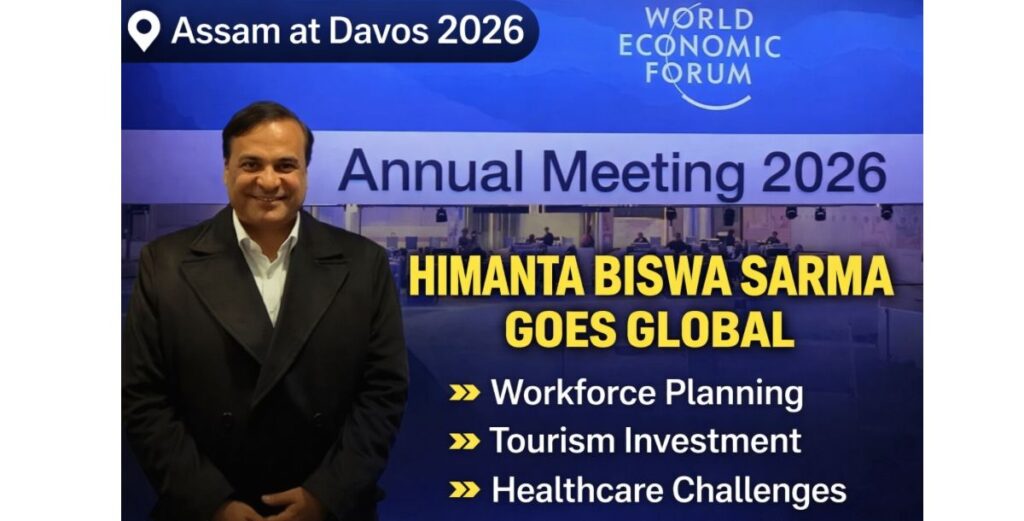
Often compared to Davos, the Swiss town synonymous with global economic dialogue, Assam is now aiming to replicate that stature within India. With its unique geographic advantage, abundant natural resources, and evolving infrastructure, the state is presenting itself as a gateway to Southeast Asia and a promising destination for investors.
Why Assam Is Being Called India’s ‘New Davos’
The comparison between Assam and Davos is not accidental. It is rooted in a broader vision of turning the state into a platform where policy, business, and global collaboration intersect.
1. Strategic Geographic Location
Assam sits at the crossroads of India’s Act East Policy, connecting mainland India to ASEAN countries. This makes it a natural trade corridor for international businesses looking to expand into Southeast Asia.
2. Rich Natural Resources
The state is endowed with:
- Oil and natural gas reserves
- Tea plantations (globally recognized)
- Biodiversity and eco-tourism potential
These resources make Assam attractive for sectors like energy, agriculture, and tourism.
3. Infrastructure Transformation
Recent years have seen massive investments in:
- Highways and logistics corridors
- Inland waterways
- Digital connectivity
This infrastructure push strengthens Assam’s case as a long-term investment hub.
Himanta Biswa Sarma’s Vision at WEF 2026
During his address and bilateral meetings at WEF 2026, Sarma highlighted a clear roadmap for Assam’s growth.InvestmentThe Assam government has introduced:
- Single-window clearance systems
- Investor-friendly taxation policies
- Sector-specific incentives
These reforms aim to reduce bureaucratic hurdles and attract foreign direct investment (FDI).
Focus Sectors for Growth
Sarma emphasized key sectors:
- Green energy
- Tourism and hospitality
- Agro-based industries
- Technology and startups
This diversified approach ensures sustainable and inclusive economic growth.
Global Investors Show Growing Interest
One of the most significant outcomes of Assam’s presence at WEF 2026 was the positive response from global investors.
- Multiple MoUs signed with international firms
- Interest from European and Asian investors
- Discussions around sustainable development projects
Investors are increasingly viewing Assam as an untapped opportunity with high growth potential.
Assam’s Tourism Push: A Key Driver
Tourism is central to Assam’s ‘New Davos’ vision.
- Kaziranga National Park (UNESCO World Heritage Site)
- Brahmaputra river cruises
- Cultural festivals and heritage sites
The government aims to develop Assam as a year-round global tourism destination, similar to Davos, which attracts visitors for both business and leisure.Sustainability at the Core
WEF 2026 was sustainability, and Assam aligned perfectly with this vision.
- Promotion of renewable energy
- संरक्षण of biodiversity
- Sustainable tourism practices
Sarma stressed that Assam’s growth would not come at the cost of its ecological balance.
Despite its potential, Assam faces several challenges:
1. Connectivity Issues
While improving, connectivity with major global markets still needs enhancement.
2. Perception Barrier
For years, Northeast India has been underrepresented in global investment discussions. Changing this perception will take consistent effort.
3. Skilled Workforce Development
To attract high-value industries, Assam must invest in education and skill development.
Government Initiatives Supporting Growth
The Assam government is actively working to overcome these challenges.
- Skill development programs for youth
- Startup ecosystem support
- Public-private partnerships
These initiatives aim to create a robust economic ecosystem.
India’s Economy
Assam’s emergence as a ‘New Davos’ has implications beyond the state.
Regional Development
It could transform the entire Northeast into an economic powerhouse.
Trade Expansion
Stronger ties with ASEAN nations could boost India’s global trade footprint.
Balanced Growth
Reducing regional disparities is crucial for India’s long-term economic stability.
Economists and industry leaders have welcomed Assam’s proactive approach.Many believe that:
- Assam could become a model for regional development
- The state’s strategy aligns with global investment trends
- Its focus on sustainability gives it a competitive edge
FAQs
Q1. Why is Himanta Biswa Sarma at WEF 2026 significant for Assam?
It marks Assam’s direct participation in global economic discussions that influence future investment and development.
Q2. What were the key focus areas at WEF 2026?
Workforce development, tourism growth, healthcare resilience, and global investment cooperation.
Q3. Did Assam sign any investment deals at WEF 2026?
No immediate deals were announced; the focus was on relationship-building and long-term engagement.
Q4. How does this help common citizens?
Global exposure can lead to future job creation, tourism growth, and improved infrastructure.
Q5. Was this part of India’s official delegation?
Yes, Himanta Biswa Sarma attended WEF 2026 as part of the Government of India delegation.
Conclusion
The presence of Himanta Biswa Sarma at WEF 2026 represents a calculated step toward positioning Assam within global economic networks.By participating in discussions on employment, tourism, healthcare, and investment, Assam has strengthened its international visibility at a critical moment.
As global attention shifts toward emerging regions, the impact of Himanta Biswa Sarma at WEF 2026 could shape Assam’s opportunities in the years ahead.