

writer by sanjoy gorh/05.03.2026 / 01.29 Pm/ Published
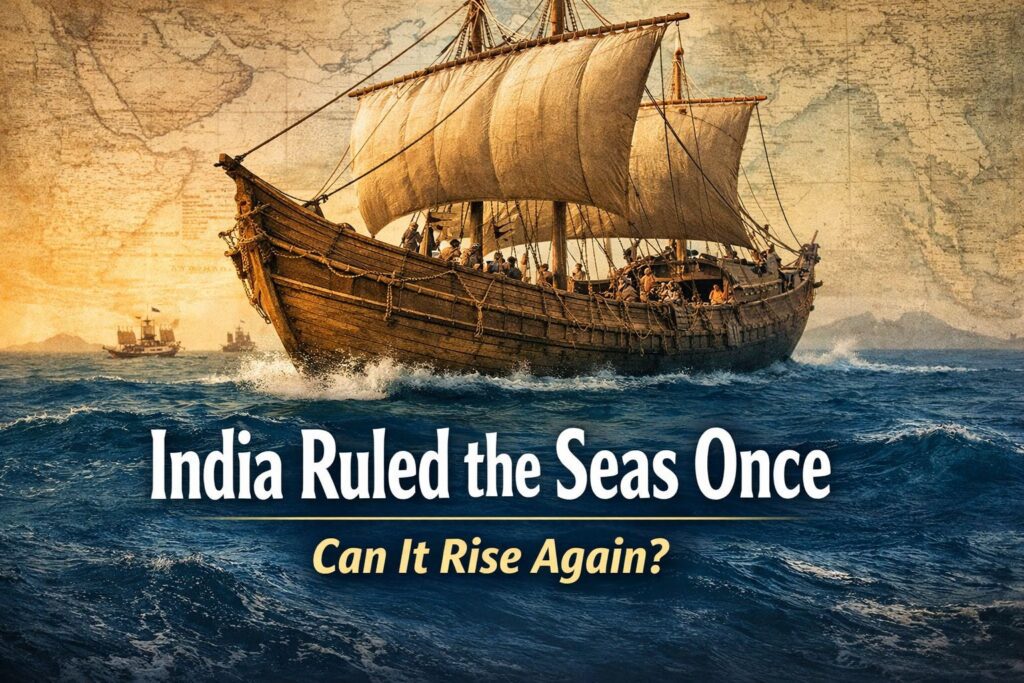
Imagine powerful Indian ships crossing the Bay of Bengal, carrying not just goods but ideas, culture, and influence across Southeast Asia. Centuries ago, the mighty Chola Empire launched naval expeditions that reshaped trade routes and established India as a dominant maritime force in the Indian Ocean region.
Today, as India hosts the International Fleet Review 2026 in Visakhapatnam with ships and delegations from over 70 nations, many are asking: What happened to that ancient sea power? And is India finally ready to reclaim its place as a major maritime force?
When India Ruled the Indian Ocean
India’s maritime heritage goes back thousands of years. Ancient ports like Lothal and Muziris connected India to Rome, Arabia, and Southeast Asia through monsoon winds.
The Chola Empire (9th–13th century) took this to another level:
- Under Raja Raja Chola I and Rajendra Chola I, they built a sophisticated fleet capable of overseas expeditions.
- In 1025 CE, Rajendra Chola’s navy conducted a major campaign against the Srivijaya empire, securing influence over key trade routes in present-day Indonesia, Malaysia, and beyond.
- Indian traders and ships linked the economies of Asia, the Middle East, and even parts of East Africa.
India wasn’t just trading it was spreading Tamil culture, architecture, and Hinduism while dominating regional sea lanes
Why Maritime Power Matters More Than Ever in 2026
Here’s a key fact: Global shipping carries over 80% of world trade by volume.For India specifically
- Nearly 90% of its foreign trade and most energy imports (oil and gas) depend on secure sea routes.
- Vital chokepoints like the Strait of Malacca and the Indian Ocean directly affect fuel prices, inflation, and economic growth.
- In an era of geopolitical tensions, control over maritime domains translates into real strategic influence.
Countries that master the seas will shape global trade, energy security, and the future Indo-Pacific order.
Archaeological evidence confirms trade with Mesopotamia and the Persian Gulf, proving that India operated as a global trading hub long before Europe entered the scene. This early foundation marked the rise of India maritime power as an economic force.
India is actively rebuilding its maritime strength with visible momentum:
Indian Navy Expansion
- Focus on becoming a 200+ ship navy by 2035, with all future warships built in India (Aatmanirbhar Bharat).
- Plans to induct around 15 new vessels in 2026 alone.
- Indigenous assets like aircraft carrier INS Vikrant (India’s first domestically built carrier) are now central to operations.
Major Diplomatic Show of Strength
In February 2026, India successfully hosted the International Fleet Review (IFR) 2026 and Exercise MILAN 2026 in Visakhapatnam one of the largest gatherings of naval forces in recent years, with participation from dozens of countries. These events showcased indigenous platforms and India’s growing role in maritime diplomacy.
Port & Infrastructure Push
The Sagarmala Project continues modernizing ports, improving connectivity, and boosting coastal shipping capacity, even as newer maritime initiatives gain priority.
Strategic Vision
From the original SAGAR doctrine to the broader MAHASAGAR vision (Mutual and Holistic Advancement for Security and Growth Across Regions) announced in 2025, India is deepening cooperation across the Indian Ocean and Global South while carefully balancing competition with China in the Indo-Pacific.
India is no longer just catching up — it is positioning itself as a responsible and capable maritime player.
Ancient Texts That Speak of Ocean Mastery
India’s oldest scriptures never treated the sea as a boundary. The Rigveda mentions ships navigating fierce waters, while the Ramayana and Mahabharata describe naval battles, overseas journeys, and island kingdoms.These references show that maritime knowledge was deeply embedded in Indian culture, reinforcing the civilizational depth behind India maritime power
Empires That Commanded the Indian Ocean
Under the Mauryas, shipbuilding became a regulated state industry, and sea routes connected India with the Mediterranean world. Ashoka used maritime diplomacy to spread ideas, not conquest.The Chola dynasty took this further. Their navy crossed the Bay of Bengal, subdued powerful kingdoms, and protected trade routes across Southeast Asia. At its peak, India maritime power rivaled any naval force of the medieval world.
How India Shaped Southeast Asia by Sea
India’s relationship with Southeast Asia was not built by invasion but by navigation. Traders, monks, and artisans sailed regularly to Java, Sumatra, and Cambodia.Languages, temple architecture, governance systems, and traditions evolved through these connections. Even today, festivals like Odisha’s Bali Jatra celebrate this era when India maritime power shaped entire regions
Shipbuilding Innovation Without Iron
Centuries before modern engineering, Indian shipbuilders mastered stitched ship technology. Teakwood planks were sewn with coir and sealed with natural resins, creating flexible yet durable vessels.Shipwrecks found near Oman confirm that Indian-built ships dominated long-distance trade. This innovation was a key pillar of India maritime power across the Indian Ocean
Why This Matters for India’s Future
We are entering an era where oceans will decide economic winners and geopolitical influence.Nations that secure their sea lanes, build strong navies, and develop world-class ports will control:
- Global supply chains
- Energy flows
- technology and trade partnerships
India, with its long coastline, strategic location, and rich maritime history, sits at a historic inflection point. By blending ancient lessons with modern capabilities indigenous shipbuilding, port development, and diplomatic outreach India is working to ensure its rise is not just on land, but also across the seas.
The Chola spirit of bold maritime ambition is being reawakened in the 21st century.
(FAQs)
1. Why was India a major maritime power in ancient times?
India had advanced ports, superior shipbuilding techniques, and global trade networks connecting Asia, Africa, and the Middle East.
2. What makes stitched shipbuilding unique?
It used natural fibers instead of iron, making ships flexible, durable, and ideal for long ocean voyages.
3. How did the Chola dynasty dominate the seas?
The Cholas built a powerful navy capable of overseas warfare and trade protection across Southeast Asia.
4. What goods did India trade by sea?
Spices, textiles, gemstones, ivory, and cultural knowledge formed the backbone of maritime trade.
5. How is India reviving its maritime heritage today?
Through projects like INSV Kaundinya, port expansion, naval modernization, and inland waterways development.
6. Why is maritime power critical for modern India?
It ensures trade security, energy access, and strategic dominance in the Indian Ocean region.
Conclusion
India’s maritime history is not a distant memory it is a strategic blueprint. From Harappan dockyards to Chola fleets, the oceans once carried India’s influence across continents. Today, as global power shifts back to sea routes, reconnecting with this heritage is essential.more ocen news visit this site
Modern initiatives, combined with historical insight, are laying the groundwork for renewed leadership. When innovation meets legacy, the revival of India maritime power becomes not just possible but unstoppable

Leave a Reply