
Updated August 26, 2026
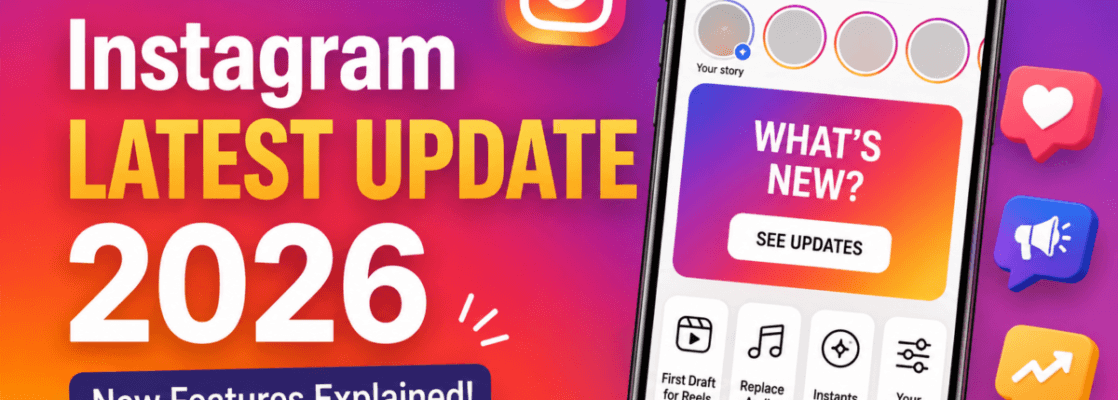
Instagram’s latest update is focused heavily on making Reels easier to create, while the platform continues changing how people discover and control content. The newest headline feature is First Draft, an editing tool that can automatically create an initial Reel from selected clips. Instagram has also introduced tools such as Replace Audio, Instants and new ways to influence recommendations. (TechCrunch)
If you have seen posts claiming that Instagram’s newest update lets everyone see who viewed their profile, don’t confuse that rumor with the confirmed product changes. The current updates documented by Instagram and credible reporting are about creation, sharing, recommendations and the app experience—not a new public profile-viewer list.
What is the newest Instagram update in August 2026?
The most recent major creator-facing change is First Draft, announced on August 25, 2026.
The feature is designed to reduce the repetitive work involved in putting together a Reel. After selecting multiple video clips, Instagram can automatically trim the footage, remove pauses and assemble an initial cut. Instagram says the first pass can be produced in under 10 seconds. (TechCrunch)
For a creator, the useful part isn’t that Instagram suddenly became a full video editor.
It is that the boring first edit can happen inside Instagram.
First Draft is initially rolling out on iPhone and can be accessed from Instagram’s camera or the Reels gallery after selecting multiple clips. (TechCrunch)
That makes this one of the most relevant 2026 updates for people who regularly create short videos.
[INTERNAL LINK: Instagram Reels tips]
What does First Draft actually do?
Think of First Draft as a starting point rather than a finished Reel.
You select your clips. Instagram creates an initial edit by trimming footage and removing pauses. You then take over and make the creative decisions yourself.
That distinction matters.
An automatic first cut can save repetitive editing work, but it does not replace the part of content creation that requires judgment: choosing the strongest opening, deciding what information stays, adding context and making the final video fit your audience.
TechCrunch reported that the feature is initially available on iPhone. (TechCrunch)
What creators should do: test First Draft on footage you already have rather than rebuilding your entire workflow around it. If the automatic cut gets you close to a usable Reel, it has real value.
Instagram also changed how you can edit old posts
Another practical 2026 update is Replace Audio.
Instagram now lets users change the music on published feed posts and carousels without deleting and re-uploading the post. The existing post can retain its likes, comments, shares and reach while the audio is replaced. (TechCrunch)
That fixes a surprisingly annoying problem.
Previously, changing the soundtrack could mean sacrificing the engagement already attached to a post. The new tool gives creators another option.
According to TechCrunch, users can access the option through the post’s menu and then the editing controls. (TechCrunch)
For creators with an older library of posts, this is more useful than another cosmetic interface change.
Instagram is giving users more control over recommendations
Instagram has also been working on Your Algorithm, a feature that lets users tell Instagram which topics they want to see more or less of.
Instagram began expanding this concept beyond a simple setting, with testing around easier access from the Feed and Reels experience. (TechCrunch)
This is significant because the recommendation system isn’t only about what creators publish.
It is also about what users tell Instagram they want.
That creates a different relationship between the viewer and the recommendation feed. Instead of passively accepting every recommendation, users can have more influence over the subjects appearing in their experience.
But there is an important distinction: some of the changes reported around Your Algorithm were still being tested. Instagram head Adam Mosseri said some elements were testing, some were coming soon and some might not work. (TechCrunch)
So don’t publish a headline saying every user now has every one of these controls.
That would turn a test into a confirmed feature.
Instants brought a different kind of sharing to Instagram
Earlier in 2026, Instagram introduced Instants, a format designed around quick, real-time photos.
Unlike normal Instagram posts, Instants are designed to be captured in the moment. Instagram says they disappear after being viewed and cannot be viewed after 24 hours. The feature also does not allow users to upload an existing photo from their phone’s gallery for the Instant itself. (About Facebook)
Users can share Instants with Close Friends or followers they follow back. Recipients can react, reply and send Instants back. (About Facebook)
Instagram also introduced a private archive for shared Instants, with the ability to turn archived Instants into a Story recap. (About Facebook)
The idea is clearly different from the highly edited Instagram post.
You take the photo, share it and move on.
Instagram’s look changed too
Not every Instagram update changes how you post.
On August 13, Instagram introduced a redesigned wordmark, meaning the text-based version of the Instagram name.
Instagram head Adam Mosseri described the new wordmark as sharper and more modern. TechCrunch reported that the previous design had been in use for about a decade. (TechCrunch)
This is a branding change, not a new algorithm feature.
That distinction is easy to lose when every change to the app gets described as an “Instagram update.”
For ordinary users, the wordmark does not change how Reels are created or how messages work. It is primarily an identity and design update.
What about Instagram’s algorithm in 2026?
The algorithm story is more complicated than “Instagram changed its algorithm.”
Instagram has continued to put significant attention on recommendations, Reels and original content.
Meta said in January that the prevalence of original content in Instagram recommendations in the US had increased by 10 percentage points in Q4 2025, with 75% of recommendations coming from original posts. (About Facebook)
That is a Meta-reported figure, so it should not be treated as a universal guarantee for every account or country.
For creators, the practical lesson is simpler: don’t build a strategy around reposting other people’s content and assume the platform will treat it the same as original work.
[INTERNAL LINK: Instagram algorithm 2026]
Third-party analysis from Later also highlights watch time, replays, engagement velocity and shares among the signals creators should pay attention to in Reels. (Later)
Those are useful working signals, but creators should avoid treating any third-party explanation of the ranking system as an official formula. Instagram does not publish a single public equation that tells creators exactly how much each signal is worth.
Can Instagram’s new update show who viewed your profile?
This is one of the biggest questions in your supplied search data.
The short answer is: don’t assume it does.
Search interest around “Instagram profile views” is clearly connected to the latest-update discussion, but the confirmed 2026 changes covered above do not establish a new feature that gives ordinary users a list of everyone who visited their profile.
Instagram does provide visibility into certain interactions, such as Story viewers, but that is different from a general profile-visitor list.
So if a Reel or TikTok-style post claims, “The new Instagram update now shows who stalked your profile,” check the actual feature announcement before believing it.
A screenshot or viral video is not proof of a platform-wide rollout.
Are people leaving Instagram in 2026?
The answer needs more care than a simple yes or no.
There are users who dislike changes to recommendation feeds, new features or the increasing amount of recommended content. Your supplied People Also Asked data shows that questions such as “Are people leaving Instagram in 2026?” and “Why are people not using Instagram anymore?” are appearing alongside searches for the latest update.
But that search behavior does not prove that Instagram is losing users.
Meta reported in September 2025 that Instagram had reached 3 billion monthly active users. (About Facebook)
That figure is from 2025, not a current August 2026 user count, so it should not be presented as today’s number.
The safer conclusion is that Instagram is changing quickly, and some users are unhappy with particular changes. That is very different from having evidence that everyone is abandoning the platform.
What should Instagram creators actually change?
Don’t throw away your entire content strategy because an update appeared.
Start with the features that affect your workflow.
If First Draft is available on your iPhone, test it on several existing clips. See whether its automatic cut genuinely reduces your editing time. If it produces weak openings, use it only as a rough first pass.
If you have older feed posts whose music needs changing, check whether Replace Audio is available on your account.
And keep watching recommendation changes, especially around original content and user-controlled recommendations.
The bigger shift is that Instagram is trying to make the platform useful from both sides: easier for creators to produce content and more controllable for viewers to decide what they see.
That is more meaningful than any single button moving to another part of the app.
Which Instagram 2026 updates matter most?
For most creators, I would rank the current changes by practical usefulness rather than hype.
First Draft is the most interesting new creator tool because it attacks the repetitive part of Reel editing. (TechCrunch)
Replace Audio is useful if you manage an existing library of feed posts and carousels. (TechCrunch)
Your Algorithm matters more to viewers because it gives people greater influence over recommendations, although parts of the experience have been in testing. (TechCrunch)
Instants changes how people share quick personal moments, rather than changing the core Instagram posting workflow. (About Facebook)
The redesigned wordmark is mostly cosmetic. (TechCrunch)
That’s the distinction worth keeping.
A new logo might be the thing everyone notices. A small editing tool might be the thing that actually saves a creator time.
What should you check after updating Instagram?
If you’re a creator, open the app and check your Reel creation screen first.
Look for First Draft if you’re on iPhone. Then check an older feed post to see whether Replace Audio is available.
For viewers, check your recommendation controls and whether Your Algorithm features are available on your account.
And don’t rely on a viral “secret update” video to understand what Instagram has actually launched.
[INTERNAL LINK: Instagram new features 2026]
The bottom line
The latest Instagram update is not one giant algorithm switch.
It is a series of changes aimed at creation, recommendations, sharing and the overall app experience. The newest headline feature is First Draft, while Replace Audio solves a practical problem for existing posts. Instants changes private, spontaneous sharing, and Your Algorithm gives users more influence over recommendations. (TechCrunch)
If you create Reels, test First Draft first. If you manage older posts, check Replace Audio. And if you see claims that the latest update suddenly reveals profile visitors, verify them before trusting the claim.
That is the useful way to follow Instagram in 2026: separate the confirmed rollout from the rumor, then use the features that actually solve a problem.