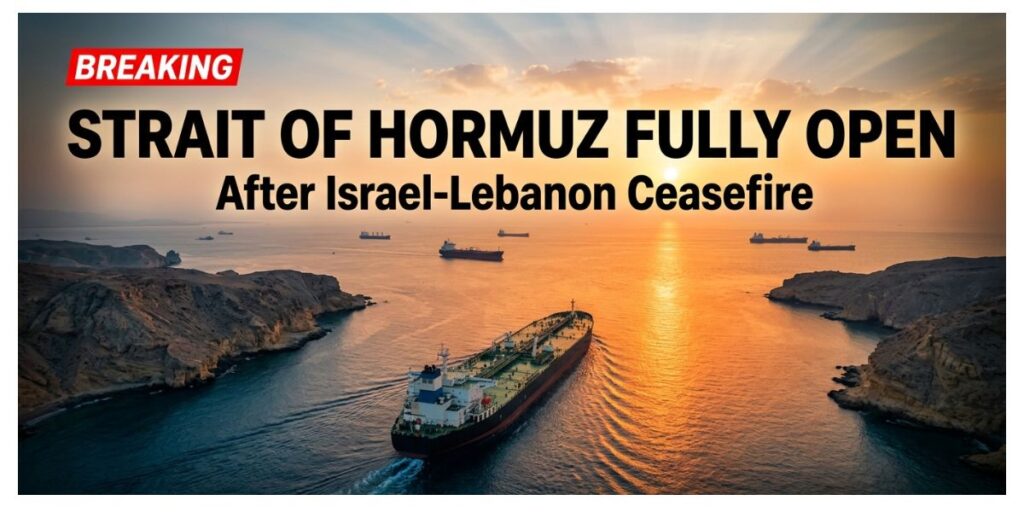
Iran has declared the Strait of Hormuz completely open for commercial vessels during the Israel-Lebanon ceasefire. What this means for global oil prices,trade,and India’s economy.
Iran Declares Strait of Hormuz Fully Open A Ray of Hope Amid Middle East Tensions
Imagine waking up to news that one of the world’s most vital oil arteries is flowing freely again. That’s exactly what happened on April 17, 2026, when Iran announced that the Strait of Hormuz is now “completely open”to commercial shipping.This development comes right after a U.S.-brokered 10-day ceasefire between Israel and Lebanon took effect.For families in India worried about rising fuel costs,and for economies worldwide bracing for energy shocks, this feels like a much-needed breather.
Let’s break down what’s happening, why it matters, and what it could mean for all of us in the days ahead.
- Iran officially declares the Strait of Hormuz open for all commercial vessels during the Lebanon ceasefire.
- The move follows a fragile 10-day truce brokered with U.S. involvement.
- Oil markets react quickly — prices drop as supply fears ease.
- President Trump acknowledges the announcement, calling the strait “fully open and ready for full passage.”
- Potential relief for energy-importing countries like India, where fuel prices directly touch daily life.
On Friday, Iranian Foreign Minister Abbas Araghchi shared the news on X (formerly Twitter) In line with the ceasefire in Lebanon, the passage for all commercial vessels through the Strait of Hormuz is declared completely open for the remaining period of the ceasefire, following coordinated routes set by Iranian authorities.
Moments later, President Donald Trump responded positively, confirming that Iran had announced the strait is “fully open and ready for full passage.”
This announcement marks a significant shift.In recent weeks, tensions had led to heavy disruptions in the strait, with shipping traffic dropping dramatically due to military actions, blockades, and safety concerns. The Israel-Lebanon ceasefire appears to have created just enough space for this de-escalatory step.
While the truce is only for 10 days and the broader regional situation remains complex, reopening this critical waterway sends a signal that dialogue might still be possible.
Why the Strait of Hormuz Is So Important
Picture a narrow stretch of water between Iran and Oman barely 21 miles wide at its narrowest point. Yet this small passage carries enormous weight. Every day under normal conditions, around 20-21 million barrels of oil and petroleum products flow through it. That’s roughly 20% of the entire world’s oil supply and about 25% of all oil traded by sea.
It’s the main exit route for oil from the Persian Gulf to global markets. Countries across Asia,including India, China, Japan, and South Korea, depend heavily on it.
For India specifically, the stakes are personal. We import more than 85% of our crude oil needs. A large chunk of that oil has historically passed through the Strait of Hormuz. When flows get disrupted, it pushes up global prices, which quickly show up at petrol pumps, in transportation costs, and even in the price of everyday goods.
In recent weeks, as tensions rose, India had to rely more on alternative sources like Russian crude and dip into strategic reserves. The reopening brings hope that supplies can stabilize and prices may ease in the coming days.
Immediate Impact on Oil Markets and Global Trade
Markets wasted no time reacting. Oil futures dropped sharply following the announcement,reflecting reduced fears of a prolonged supply crunch. Stocks in energy-related sectors and broader indices also saw positive movement.
For everyday people, this could mean:
- Potential relief at fuel stations in India and elsewhere.
- Lower shipping and logistics costs, which often feed into inflation.
- More breathing room for industries that rely on affordable energy.
Of course, the situation is still fluid. The ceasefire is temporary, and actual tanker traffic will need time to normalize. But the psychological shift from fear of closure to an official opening is already helping calm nerves.
The Bigger Geopolitical Picture
This isn’t just about oil tankers. It’s part of a delicate diplomatic dance.
The 10-day Israel-Lebanon ceasefire has opened a small window for de-escalation across the region. U.S.officials have hinted that talks with Iran on sanctions, nuclear issues, and broader security could resume soon possibly even this weekend.President Trump has described the overall mood as improving, while analysts watch closely to see if this leads to longer-term stability or remains a short pause.Iran’s decision to open the strait during the ceasefire shows a willingness to support calm in exchange for progress in negotiations. At the same time,everyone knows the risks: any breakdown could quickly change the picture.
For now, the focus is on keeping the momentum going and ensuring safe passage for vessels.
- Daily oil flow (normal): Approximately 20.9 million barrels of crude and products.
- Global importance: ~20% of world oil supply; ~25% of seaborne traded oil.
- India’s exposure: Significant portion of imported crude transits the region; recent disruptions added pressure on fuel prices and inflation.
- Recent context: Traffic had fallen sharply due to military risks and blockades before today’s declaration.
- Economic ripple: Sustained higher oil prices can add billions to India’s import bill and affect household budgets.
For most Indians, geopolitics feels distant until it hits the wallet. Higher oil prices mean costlier petrol and diesel, which raise transport fares, food prices, and manufacturing costs. In a country where millions are still recovering from economic pressures, even small relief matters.Today’s news offers cautious optimism.If shipping resumes smoothly and the ceasefire holds, we could see some downward pressure on fuel prices in the weeks ahead. That would be welcome news for families,farmers, truck drivers, and businesses alike.
Experts suggest monitoring the next few days closely actual tanker movements and diplomatic follow-ups will determine how much relief materializes.
Analysts are considering a few likely paths
- 1. Positive Momentum: The ceasefire holds, talks advance, and the strait remains open beyond the initial period. This could lead to gradually stabilizing energy prices.
- 2. Cautious Continuation: Shipping resumes at lower volumes under coordination, keeping markets steady but watchful.
- 3. Setbacks: Any incident that breaks the fragile truce could tighten controls again, pushing prices higher.
- 4. Most voices lean toward cautious hope right now. The very fact that Iran made this public declaration tied to the ceasefire is seen as a constructive step.
FAQs
- 1. What exactly did Iran announce?
Iran declared the Strait of Hormuz completely open to all commercial vessels for the remaining duration of the Israel-Lebanon ceasefire, along pre-announced coordinated routes.
2. Why now?
The announcement follows the start of a 10-day ceasefire in Lebanon and appears aimed at supporting regional de-escalation and possible wider talks.
3. Will oil prices fall right away?
Markets have already reacted with declines. How much and how quickly prices ease for consumers will depend on how fast actual shipping traffic picks up and whether calm continues.
4. How does this affect India?
India could see some relief in fuel prices and inflation pressure due to its heavy reliance on imported oil. It’s a positive signal, though full effects will take time.
5. Is the situation completely resolved?
No the ceasefire is short-term, and deeper issues remain. But today’s move is a meaningful positive development that reduces immediate risks.
conclusion
In a world full of complex conflicts, moments like this remind us how interconnected we all are. A narrow strait halfway across the globe can influence the cost of filling up your scooter or cooking a meal at home in Jorhat or anywhere in India.
Today’s announcement brings a sense of relief after weeks of uncertainty. It shows that even amid deep tensions, space for pragmatism and dialogue can still emerge.
The coming days will be crucial. Will this opening lead to longer-lasting stability? Or will it remain a brief pause in a longer story? For now, many are simply hoping the tankers keep moving, prices ease, and the region finds more room for peace.As always with geopolitics, staying informed and prepared is key. But for today, there’s reason to feel a little lighter about what lies ahead