

Writer by sanjoy gorh 04.03.2026 time 6.30 PM Published
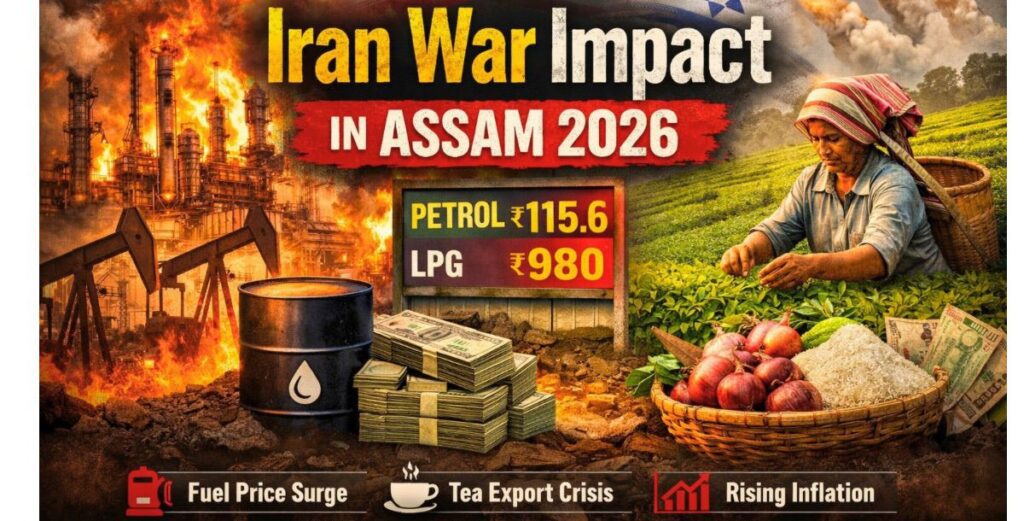
The ongoing war in West Asia centred on Iran has sent shockwaves far beyond the conflict zone, and Assam—one of India’s key agricultural and tea‑producing states—is now feeling the heat. In 2026, the Iran‑led tensions, Strait of Hormuz disruptions, and global oil‑market volatility are directly affecting Assam’s economy through fuel prices, logistics costs, and the fragile tea‑export ecosystem
March 2026 The ongoing conflict involving Iran, Israel and the United States now nearly a month old is no longer a distant geopolitical headline. Its ripple effects are reaching India’s Assam, affecting oil refineries, tea exports, fuel prices and household budgets across the state.
Analysts now warn that if the Iran war continues without swift diplomatic resolution, Assam’s economy could feel notable pressure through multiple channels.
How the Iran war is hitting fuel prices in Assam
Iran’s involvement in the broader Middle East conflict has pushed global crude‑oil prices upward, even though India’s oil marketing companies have so far kept retail petrol and diesel prices largely frozen since April 2022. Any spike in international crude rates still filters into the Indian economy through higher refining, transportation, and conversion costs, which in turn squeeze downstream sectors like agriculture and small‑scale manufacturing in Assam
Assam’s long history as India’s traditional oil hub means global crude price swings matter locally.The state hosts several of India’s key refineries including Numaligarh, Bongaigaon Guwahati and Digboi that process both domestic and imported crude. While not directly linked to Middle Eastern pipelines, these refineries are sensitive to For Assam’s refineries, this doesn’t always mean immediate shutdowns or shortage, but it does mean
- Feedstock cost increases
- Higher freight & insurance expenses
- Tighter refining margins compared with coastal plants
Because Assam’s refineries depend on longer internal transport routes rather than coastal shipments, those additional logistics costs compound price pressures.
Fuel Prices Climb A Cost Felt at the Pump
For Assam, this means:
- • Higher diesel and kerosene costs for tea gardens, farms, and transporters, which rely heavily on fuel for harvesting, processing, and movement of goods.[sentinelassam +1]
- Increased inflationary pressure on basic commodities, as trucking, river‑barge transport, and local delivery networks absorb higher fuel tariffs.[timesofindia.indiatimes]
Although Union Home Minister Amit Shah has publicly assured that there is no plan for a nationwide lockdown or acute fuel shortage, fears of potential supply disruptions in early 2026 have kept markets on edge. For Assam’s rural and semi‑urban economy, even a small, sustained rise in fuel expenditure can pinch margins and consumer spending.Why the Iran‑Middle East crisis is a “blow” to Assam tea
Assam’s tea industry, especially orthodox tea, is heavily dependent on West Asian markets. Nearly 40–50% of Assam’s orthodox tea exports are consumed by Iran, Iraq, the UAE, and other Gulf‑linked countries.
Though India has strategic reserves and a government directive to maintain supplies, Brent crude prices have already moved higher in reaction to the conflict up roughly 10% in recent weeks.That price rise filters down to everyday consumers: petrol, diesel and LPG in Assam are climbing alongside global benchmarks. For many Assamese families, higher fuel prices quickly translate into:
- Higher transport costs
- Increased food and grocery prices
- Strain on household budgets
Experts note that short-term reserves provide a buffer, but sustained high crude prices would prolong pain at the petrol pump.
Tea Exports: Orthodox Tea Under Shadow
For Assam’s tea sector, which supports thousands of workers and producer families, the Iran war has brought fresh industry anxiety.
Nearly half of Assam’s premium orthodox tea exports traditionally find buyers in Iran and other West Asian markets. But industry sources say that ongoing military escalation and shipping uncertainties are already affecting demand.Exporters warn the conflict could force
- Reduced orders from key West Asian buyers
- Rising freight & insurance charge
- Lower prices if alternate markets cannot absorb tea supply
Many tea estates are now tracking global shipping lanes, logistics costs, and pricing indicators daily a stark reflection of how a geopolitical conflict thousands of kilometers away can directly impact incom and employment in rural Assam.
While Assam is not a major source of foreign remittances compared with some other Indian states, the broader Indian workforce in the Gulf includes Assamese nationals too.With regional instability disrupting job markets and slowing money flows back home, some families dependent on remittances could see delays or decline in household income all adding to economic stress.
When the Iran‑led war escalated in 2026:
- Dubai slowed re‑exports to Iran and other Gulf states, cutting off a major transit channel for Assam tea.
- Payment delays and cancellations crept in, as buyers cited sanctions‑related risks, currency volatility, and insurance uncertaintyIndustry bodies such as the Tea Association of India (TAI) have warned that prolonged disruption could lead to:
- Stockpiling of unsold tea in auction centres like Guwahati, causing a domestic supply glut.
- Falling auction prices, especially for premium orthodox grades, as estates and small‑holders struggle to offload excess stock
One exporter remarked that while the Assam government’s subsidy of ₹15 per kg on orthodox tea was meant to boost production and exports, the war has instead turned the market into a high‑risk zone with uncertain demand
Strait of Hormuz disruption and Assam tea exports
A major flashpoint has been the closure and partial blockade of the Strait of Hormuz, through which almost 41% of Assam tea consignments destined for Iran, Kuwait, Bahrain, Qatar, Saudi Arabia, and the UAE are transported. Any disruption in this chokepoint translates into:
• Delayed shipments and higher freight insurance premiums.• Greater reliance on alternative routes, which are longer and costlier, pushing up logistics bills for Assam‑based exporters.
Some analysts estimate that tens of millions of kilograms of tea are stuck in Indian ports or warehouses, waiting for clarity on shipping feasibility and payment guarantees. For Assam’s cash‑strapped tea gardens—many of which already face thin profit margins—this blockage is a direct threat to cash flow and employmentHidden costs: Fuel, fertiliser, and operational squeeze
The war’s impact does not stop at export routes; it also hits the cost of production inside
Supply Chain & Inflation: Everyday Goods More Expensive
Beyond oil and tea, wider supply chain disruption could make everyday goods costlier
- Freight rerouting raises transportation costs
- Delays in cargo can increase the price of imported commodities
- Inflation could rise if crude remains elevated for months
This is not hypothetical India’s central bank and economists have already flagged vulnerabilities tied to oil price shocks triggered by the conflict.
- Strategic oil reserves ease immediate supply issues
- Refinery operations remain stable
- Fuel, LPG and everyday item prices may continue upward
- Export-dependent sectors like orthodox tea may require market diversification
- State policymakers may need support programs for logistics and producers
Long termThe biggest question remains diplomatic if peace negotiations can halt further escalation, markets may calm. Continued conflict, however, means sustained inflation and economic drag on states like Assam.
Assam.Key pressure points:
- Fuel‑driven transport costs: Higher diesel prices mean more expense in moving green leaf from gardens to factories and processed tea to auction centres and warehouses
- Input‑cost inflation: Fertilisers, packaging material, and machinery operation depend on energy‑intensive processes; any rise in fuel and power costs pushes up overall production costs.[• Labour and wage pressures: With rising living costs due to inflation, estates may face demands for higher wages, further squeezing profitability.]
If global oil prices remain elevated and the Strait of Hormuz remains unstable, these layered costs could deep‑freeze profitability for many small‑ and medium‑sized tea estates in Assam.
Assam.Key pressure points:
• Fuel‑driven transport costs: Higher diesel prices mean more expense in moving green leaf from gardens to factories and processed tea to auction centres and warehouses
• Input‑cost inflation: Fertilisers, packaging material, and machinery operation depend on energy‑intensive processes; any rise in fuel and power costs pushes up overall production costs.[• Labour and wage pressures: With rising living costs due to inflation, estates may face demands for higher wages, further squeezing profitability.]
If global oil prices remain elevated and the Strait of Hormuz remains unstable, these layered costs could deep‑freeze profitability for many small‑ and medium‑sized tea estates in Assam.
Social and political implications in Assam
The Iran‑war‑linked economic stress has also begun to resonate in Assam’s political and social landscape.
• Public anxiety about fuel and groceries: In early‑March 2026, Union Home Minister Amit Shah visited Guwahati and publicly reassured citizens that there would be no lockdown or severe fuel shortage, trying to preempt panic‑buying and hoarding.
• Election‑time vulnerability: With assembly‑level issues already acute, any sharp rise in fuel or food prices can quickly turn into a governance‑credibility issue for local and state leaders.[For tea‑garden workers and their families, the stakes are even higher. If tea‑export revenues shrink, estates may cut shifts, reduce recruitment, or delay wage hikes, directly affecting livelihoods in Assam’s tea‑belt districts such as Dibrugarh, Tinsukia, and Golaghat.What Assam can do: Short‑term and long‑term moves
Without waiting for the war to end, Assam and the central government can take several steps to mitigate damage and build resilience:
Short‑term measures
• Diversify export markets: Accelerate pushes into Southeast Asia, Africa, and Eastern Europe, reducing over‑dependence on West Asian buyers• Expand duty‑free or concessional trade windows: Negotiate better payment and insurance terms with non‑Iranian Gulf partners to keep tea flowing even when Hormuz‑linked routes are unstable.• Strengthen domestic branding: Promote Assam tea more aggressively in India’s own premium and specialty‑tea markets, using e‑commerce and organised retail.[
Medium‑ to long‑term strategies
- Invest in value‑added products: Shift portion of production from basic bulk tea to packaged, branded, and flavoured tea with higher margins and less dependence on cut‑throat export auctions.
- Develop alternative logistics corridors: Enhance rail and inland‑water‑transport connectivity so Assam is less dependent on sea‑route bottlenecks like the Strait of Hormuz.[facebook +1]• Policy support for green energy: Help estates adopt solar or biomass‑based power and heating to reduce long‑term exposure to fuel‑price shocks
Conclusion
Assam’s link to global energy markets and traditional commodity exports like tea means geopolitical conflicts like the Iran war no longer feel distant. Even if no battlefield is within the state, economic and social impacts from fuel costs to export prices are real and ongoing.
Assamese families, businesses and policymakers alike are now watching global developments closely, understanding that decisions made in Tehran, Washington and Riyadh could shape prices and livelihoods back home.

Leave a Reply