

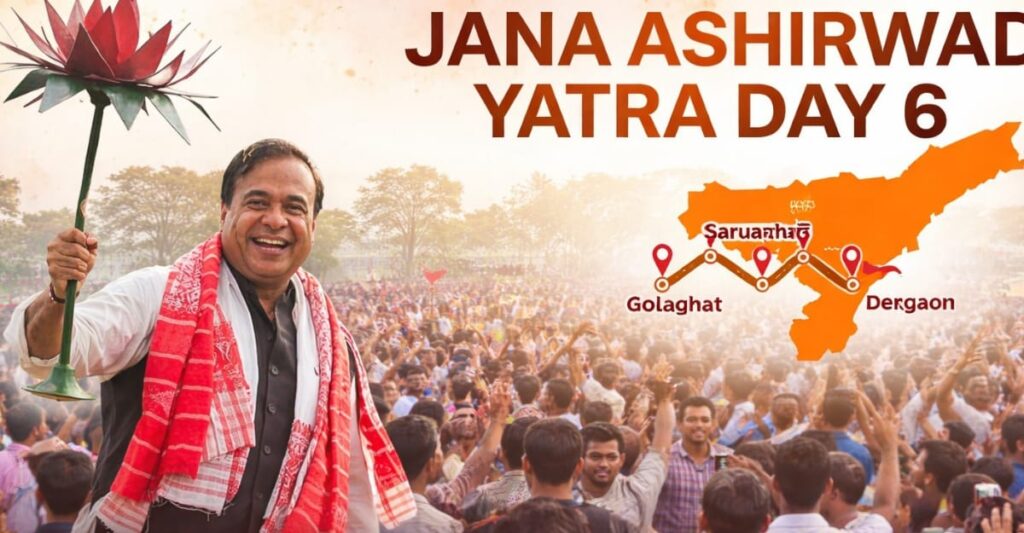
The Jana Ashirwad Yatra has entered a crucial phase in Assam’s political landscape, with Chief Minister Himanta Biswa Sarma set to travel through key towns of the Golaghat region on its sixth day. The outreach journey, which began as a statewide effort to directly connect with citizens, is steadily gaining momentum as large crowds gather across districts.
On March 7, the Jana Ashirwad Yatra will pass through important locations including Sarupathar, Golaghat, Khumtai and Dergaon. For many residents, the visit represents a rare opportunity to interact with the state’s top leadership and raise concerns that affect daily life.More than a political tour, the Jana Ashirwad Yatra is shaping into a large-scale public listening exercise one that could influence governance priorities in the months ahead.
Political outreach campaigns are not new in Indian politics. But the Jana Ashirwad Yatra stands out because of its timing and scale.
Across Assam, issues like infrastructure development, employment opportunities, flood management, and rural connectivity remain central to public discussion. By traveling through multiple districts, the government aims to hear directly from citizens rather than relying solely on administrative reports.a recent message shared online, Himanta Biswa Sarma said he was “overwhelmed by the unprecedented response” the Jana Ashirwad Yatra has received from people across the state.
Such statements reflect the political significance of the journey: it is not only about addressing issues but also about strengthening trust between leadership and citizens.
Day 6 Route
Day 6 of the Jana Ashirwad Yatra will focus on the Golaghat belt—an area known for its economic and political importance in Upper Assam.The journey will begin in Sarupathar, a town surrounded by agricultural communities where farmers often raise concerns about market access, irrigation, and transportation.
From there, the Jana Ashirwad Yatra will move toward Golaghat, a major administrative and commercial hub. Local traders, students, and civic groups are expected to gather to share their perspectives.
The tour will then continue through Khumtai, an area that has played a key role in regional politics, before concluding the day’s schedule in Dergaon, where local residents are preparing to welcome the convoy.Along the route, people typically line the streets, wave flags, and attempt to engage with the Chief Minister as the caravan passes.
What makes the Jana Ashirwad Yatra different from conventional rallies is its focus on direct engagement.
Instead of limiting interactions to large stage events, the journey includes road interactions, short public addresses, and informal meetings with local leaders and residents.For many villagers, these brief moments offer a chance to communicate issues that might otherwise take months to reach government officials.
Supporters argue that the Jana Ashirwad Yatra strengthens democratic participation by bringing leaders closer to the public.At the same time, political observers point out that such tours also help leaders gauge voter sentiment and emerging concerns across regions.
The decision to bring the Jana Ashirwad Yatra through Golaghat is not accidental.
The district plays an important role in the political dynamics of Upper Assam. It combines rural communities, small towns, agricultural economies, and growing urban centers.Because of this mix, issues raised here often reflect broader challenges facing the state.Residents in the Golaghat region commonly highlight concerns such as:
- Flood control and river management
- Job opportunities for young people
- Road and transport infrastructure
- Access to quality healthcare
- Support for farmers and small businesses
By visiting the region through the Jana Ashirwad Yatra, the government gains first-hand insights into these challenges.
Public Response: Crowds, Curiosity and Expectations
the districts visited so far, the Jana Ashirwad Yatra has attracted significant crowds.Supporters gather along the route to welcome the Chief Minister, while many curious residents come simply to witness the political event.
Mobile phones raised in the air capture photos and videos as the convoy passes through towns and villages.For younger residents especially, the Jana Ashirwad Yatra has become a moment to engage with politics beyond social media headlines.
However, public expectations are equally high. Many people hope the concerns raised during these visits will translate into visible development projects.The real impact of the Jana Ashirwad Yatra will depend on what happens after the tour.
Citizens and analysts will closely watch whether issues raised during the journey lead to policy discussions, government initiatives, or new development announcements.
the concerns voiced by communities begin to shape administrative decisions, the Jana Ashirwad Yatra could become more than just a political campaign—it could evolve into a model for ongoing public engagement.
FAQ
1.What is the Jana Ashirwad Yatra?
The Jana Ashirwad Yatra is a statewide outreach journey led by Assam Chief Minister Himanta Biswa Sarma to meet citizens, hear local concerns, and seek public support.
2.Which places will be covered on Day 6?
The yatra will travel through Sarupathar, Golaghat, Khumtai, and Dergaon on March 7.
3.Why are people paying attention to the Jana Ashirwad Yatra?
Because it offers a rare opportunity for direct interaction between the state leadership and local communities.
Conclusion
the Jana Ashirwad Yatra continues its journey across Assam, Day 6 in the Golaghat region represents another important chapter. The visit to Sarupathar, Golaghat, Khumtai, and Dergaon will not only draw crowds but also bring local issues into the spotlight.
Whether the journey ultimately shapes policy decisions or political narratives, one thing is clear: the Jana Ashirwad Yatra has already become one of the most closely watched public outreach campaigns in Assam today.

Leave a Reply