

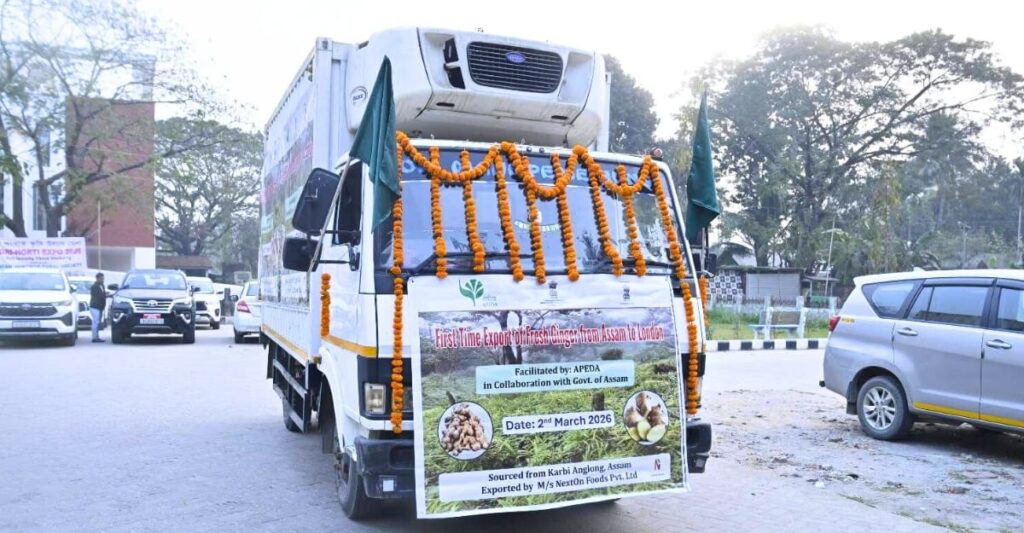
On March 2, 2026, a refrigerated truck stood decorated with marigold garlands, ready to begin a long journey. Inside it was freshly harvested, GI-tagged ginger from Karbi Anglong.It was not a massive consignment by global trade standards. But when Karbi Anglong ginger exported to London became a reality, it marked something deeper than volume it marked validation.For the farmers who have grown ginger in the hills for generations, this was history in motion.
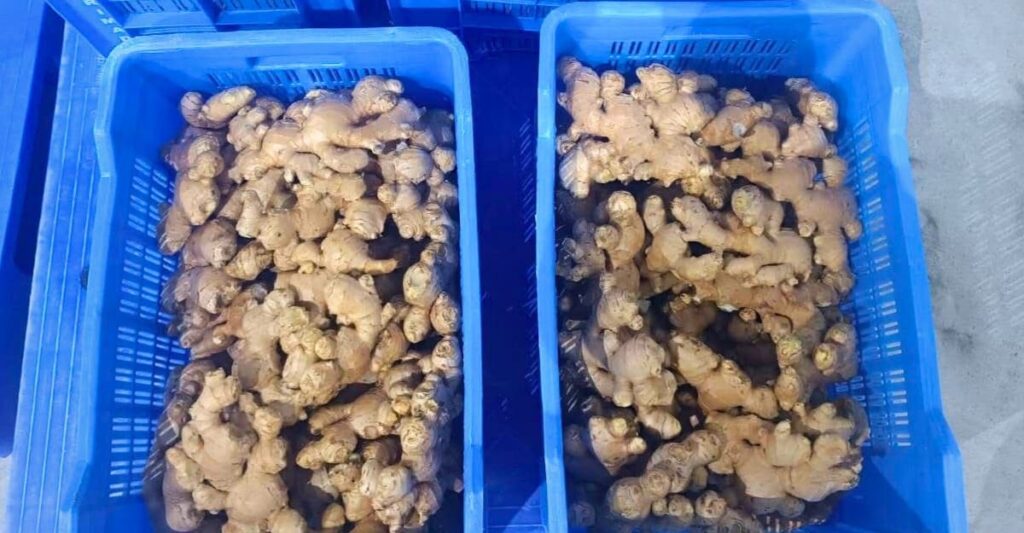
Karbi Anglong’s terrain is not easy. The fields are scattered across hilly landscapes, dependent largely on rainfall and traditional farming knowledge passed down through families.The ginger grown here is known for its sharp aroma, strong flavor, and firm texture. Recently awarded a Geographical Indication (GI) tag, it now carries official recognition of its distinct origin and quality.That recognition laid the foundation for Karbi Anglong ginger exported to London because in today’s global markets, origin matters as much as output.
The global food economy is changing.
Consumers in cities like London increasingly care about traceability, authenticity, and region-specific produce. They want to know where their food comes from and how it was grown.In that context, Karbi Anglong ginger exported to London arrives at the right time. It fits into a market that values identity, sustainability, and transparency.
This is not just about meeting demand. It is about meeting a new kind of demand.
From Local Mandis to International Markets
For years, most ginger farmers in Karbi Anglong depended on local traders. Prices fluctuated. Margins were thin. Transportation costs often ate into profits.Export access changes the equation.With institutional support and improved logistics, the pathway that enabled Karbi Anglong ginger exported to London shows that farmers in remote districts can participate in global supply chains.
That shift could gradually reduce dependence on volatile domestic wholesale markets.Behind policy announcements are real households.
Farmers who once worried about post-harvest losses now see their produce entering international cold-chain systems. The exposure to export standards encourages better sorting, grading, and packaging practices. the momentum continues, Karbi Anglong ginger exported to London could translate into:
- Better farmgate prices
- Stable buyer relationships
- Reduced distress sales
- Increased confidence among young farmers
The most powerful change may not be financial at first it may be psychological.When farmers see their crop reach London, the sense of possibility expands.
Assam has long been identified globally with tea. Agriculture beyond tea has often remained underrepresented in export conversations.This milestone signals diversification. successful, the model behind Karbi Anglong ginger exported to London could extend to turmeric, black rice, pineapples, and other GI-tagged or high-value crops from the region.
Diversified exports reduce risk. They strengthen rural economies and improve resilience against domestic price shocks.Exporting perishable goods to Europe is not simple.It requires
- Cold storage and refrigerated transport
- Phytosanitary certificatio
- Quality compliance
- Coordinated logistics
The success of this shipment indicates that the ecosystem is improving. Systems are aligning.
Without that backbone, Karbi Anglong ginger exported to London would have remained symbolic. Instead, it demonstrates operational readinessOne export makes headlines.Repeated exports build industries.
The next phase will determine whether this is a one-time celebration or the start of a consistent trade corridor. Experts emphasize the importance of farmer producer organizations, long-term contracts, and continuous quality monitoring.If structured properly, Karbi Anglong ginger exported to London could become a case study in how regional agriculture integrates with global markets.
For decades, farmers in the Northeast often felt geographically distant from opportunity. Markets seemed far away physically and economically.This shipment subtly changes that narrative.It tells farmers that their produce is not limited by geography. It tells young people that agriculture can be modern and globally connected.That shift in mindset may outlast the shipment itself.
The coming months will be crucial.Will London buyers place repeat orders?
Will price premiums hold steady?
Will other GI-tagged products follow the same path?If the answers are positive, Karbi Anglong ginger exported to London may be remembered not as a first attempt but as the beginning of a sustained transformation.
Conclusion
This story is not about a truck. It is not even just about ginger.It is about access.It is about recognition.And it is about a farming community in the hills of Assam stepping onto a global platform with quiet determination.
supported by consistent policy and market linkage, Karbi Anglong ginger exported to London could redefine how Northeast India participates in international trade not as a peripheral supplier, but as a confident contributor.

Leave a Reply