
By Investigative Desk | Pune, Maharashtra
the annals of criminal investigations, it is often the smallest, most overlooked detail that cracks a case wide open. A smudged fingerprint. An alibi that doesn’t hold. A phone call made at the wrong time. In the shocking murder of Ketan Agarwal, the son of a prominent Maharashtra businessman, it was a piece of clothing — a hoodie worn in sweltering 33-degree Celsius heat at Lohagad Fort near Pune — that unraveled an elaborate conspiracy of love, betrayal, and cold-blooded murder.
What began as a seemingly routine trekking tragedy has transformed into one of Maharashtra’s most sensational criminal cases of 2025, exposing a web of secret relationships, premeditated planning, and multiple alleged attempts on a young man’s life before his killers finally succeeded.
The Day That Changed Everything
On June 18, 2025, Ketan Agarwal, a young businessman from a well-regarded Pune family, fell to his death in a gorge at Lohagad Fort, a popular 12th-century hillfort located approximately 52 kilometres west of Pune in the Sahyadri mountain range. The fort, perched at an altitude of around 1,033 metres above sea level, draws thousands of trekkers and history enthusiasts each year. On that fateful morning, however, it became the alleged setting for a calculated murder.
Initial reports from the scene suggested the incident was a tragic accident. Trekking mishaps at elevated forts are not unheard of in Maharashtra, particularly during the summer months when trails can be uneven and crowded. Police arrived, documented the scene, and the case appeared headed toward a closed file marked “accidental death.”
But something didn’t sit right with investigators. In an era where surveillance technology has become an invisible witness to daily life, the CCTV cameras positioned around Lohagad Fort had captured something unusual — something that, on any other day, might have been dismissed as an eccentricity.
The Hoodie That Gave It All Away
When detectives reviewed the CCTV footage from June 18, they observed Ketan Agarwal walking alongside his fiancée, Siya Goyal. The pair appeared to be trekking together, navigating the stone pathways of the ancient fort. But trailing them at a deliberate distance was a third figure — a young man dressed in shorts, wearing a hoodie pulled up to conceal most of his face, and earphones plugged into his ears.
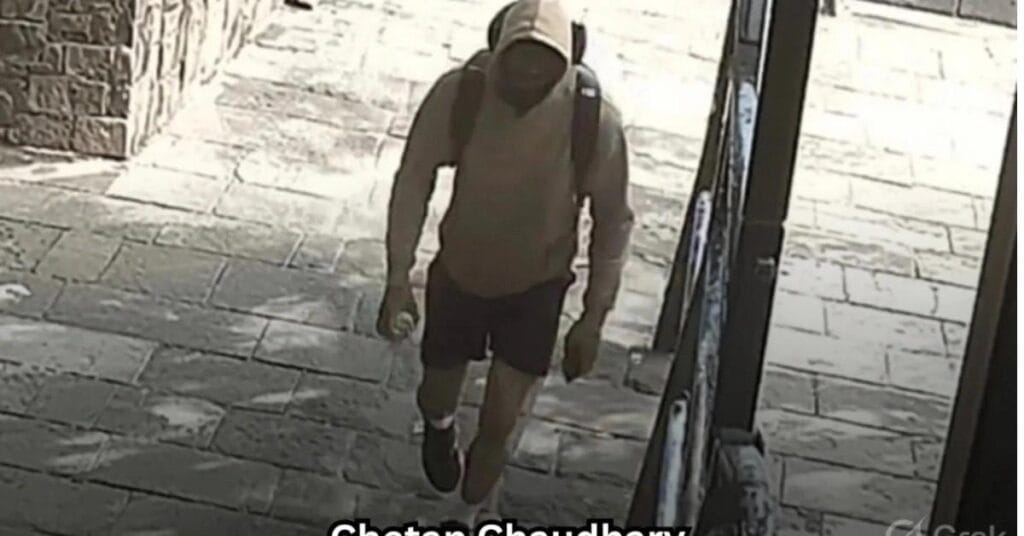
To a casual observer, the man might have seemed like just another trekker. But to the investigators, his attire raised an immediate red flag. The date was June 18. The temperature was 33 degrees Celsius. Pune’s summer heat is notorious, and the rocky, sun-exposed terrain of Lohagad Fort would have made wearing a hoodie not merely uncomfortable but genuinely inexplicable — unless the wearer had a very specific reason for concealing his identity.
“The clothing was completely inconsistent with the weather conditions,” a police official familiar with the investigation noted. “No one in their right mind wears a hoodie covering their face while trekking in that kind of heat. It told us immediately that this person did not want to be identified.”
The footage yielded further details that deepened suspicion. In one clip, Siya Goyal is seen glancing back toward the hooded figure — a brief, telling look that investigators interpreted as a signal or acknowledgment. Shortly after, the hooded man sat down on the path, as if pausing to allow the couple to move ahead. The choreography, police say, appeared rehearsed.
Unmasking the Third Man
Through painstaking technical analysis, investigators worked to identify the man behind the hoodie. They cross-referenced social media profiles, examined call data records, and ran facial recognition comparisons between still frames extracted from the CCTV footage and photographs available online.
The identity that emerged was 22-year-old Chetan Choudhary, a dry-fruit businessman who had allegedly been in a secret romantic relationship with Siya Goyal — Ketan Agarwal’s own fiancée.
The revelation sent shockwaves through the investigation. Digital forensics teams pulled phone records that told a damning story: over a span of just seven months, Siya Goyal and Chetan Choudhary had exchanged more than 2,000 phone calls, amounting to nearly 238 hours of conversation. The two had allegedly first met through overlapping business circles — Siya ran a bakery in Pune, while Chetan operated his dry-fruit trade — and had reportedly begun their relationship in November 2024.
As the picture sharpened, investigators turned their attention to Siya herself. Those who interacted with her in the days following Ketan’s death later told police that her emotional response struck them as unusual. Investigators reportedly found a conspicuous absence of the grief one might expect from a woman who had just watched her fiancé die in front of her.
A Fairytale Wedding That Was Never Meant to Happen
To the outside world, Ketan Agarwal and Siya Goyal appeared to be a couple on the cusp of a lavish new chapter. They had announced their engagement in February 2025, and their families were deep in the planning of what was expected to be a spectacular wedding in November — an event reportedly to feature luxury venues, private jet arrangements, and palace-style hospitality befitting the family’s social standing.
Behind the scenes, however, cracks had allegedly begun to form. According to Ketan’s uncle, who spoke to investigators during the inquiry, Siya had at one point asked whether the wedding could be delayed by a year. The request, passed off at the time as perhaps nerves or logistical concerns, acquired a far more sinister meaning once the investigation gathered momentum.
Police now allege that Siya had no intention of going through with the marriage. Her relationship with Chetan Choudhary had allegedly deepened to the point where the two viewed Ketan not as a fiancé, but as an obstacle — one they allegedly decided to permanently remove.
Earlier Attempts: A Passport Hidden in Bali
One of the most chilling aspects of the investigation is the allegation that June 18 was not the first time Ketan Agarwal’s life had been in danger at the hands of those he trusted most.
Weeks before the fatal trek, Ketan and Siya had planned a pre-wedding photoshoot in Bali — a romantic getaway that was also meant to serve as a celebratory milestone before their November nuptials. The trip never happened. At Mumbai’s Chhatrapati Shivaji Maharaj International Airport, as the couple prepared to board their flight, Ketan discovered his passport was missing.
His family later alleged to police that Siya had deliberately hidden the passport to prevent the trip from taking place. At the time, the incident was puzzling and frustrating, but not obviously sinister. In hindsight, investigators believe it may have been connected to a broader plan — a Bali trip, in a foreign country with less predictable emergency response, could have provided an even more concealed opportunity.
Then came June 14 — four days before Ketan’s death. According to police, Siya allegedly attempted to push Ketan off a cliff at Lohagad Fort during what appeared to be a routine visit to the same location. Ketan, police claim, narrowly escaped death by grabbing hold of a bush on the cliff face. Siya then allegedly diverted attention by shouting that she had spotted a snake nearby — a sudden commotion that drew focus away from what had just occurred and allowed her to comfort Ketan, allaying any suspicion he might have had.
Authorities believe that after this failed attempt, the couple escalated their planning. Investigators say Siya and Chetan had even devised a contingency — a so-called “Plan C” — in the event that their primary scheme on June 18 did not succeed.
It did.
The Geography of Crime: Why Lohagad?
The choice of Lohagad Fort as the alleged murder site was almost certainly not arbitrary. The fort’s rugged terrain, steep gorges, and the inherent risks associated with trekking at altitude provided built-in plausibility for an “accidental” death. Each year, trekking incidents — slips, falls, dehydration emergencies — occur at forts across Maharashtra. A fall into a gorge at Lohagad would, under normal circumstances, invite little suspicion.
The location also offers a degree of crowd cover. Trekkers arrive in groups and individually throughout the day, making it relatively easy for an additional person to trail a couple without drawing immediate attention — particularly if that person keeps a careful distance and stays near the edges of the path.
What the alleged conspirators may not have fully accounted for was the expanding network of CCTV surveillance at popular tourist and heritage sites in Maharashtra, nor the meticulous nature of investigators who would scrutinize every frame of that footage — including the inexplicable sight of a young man in a hoodie, face half-hidden, sweating his way through a treacherous fort in the peak of summer.
Arrests and Legal Proceedings
Both Siya Goyal and Chetan Choudhary were arrested by Pune police and charged under sections pertaining to murder and criminal conspiracy under Indian law. Following their initial production before a magistrate, both accused were remanded to seven days of police custody, granting investigators the time needed to continue examining digital evidence, reconstruct timelines, and record further statements.
The case has drawn enormous attention across Maharashtra and nationally, with media coverage highlighting both the alleged premeditation involved and the use of modern investigative tools — including CCTV analysis, call data records, and social media cross-referencing — to piece together the conspiracy.
Surveillance, Heat, and Human Error
The Ketan Agarwal case is, in many ways, a study in the undoing of a criminal plan through a single overlooked detail. The alleged conspirators are said to have planned across months, executed a dry run, survived a failed attempt, and coordinated their movements with apparent care. Yet a hoodie — worn to hide a face, worn in defiance of basic weather logic — became the thread that unravelled everything.
For law enforcement, the case underscores the growing value of CCTV infrastructure at heritage and tourist sites, not merely as a deterrent but as a forensic resource. For the public, it serves as a reminder that in the age of digital surveillance, anonymity in a crowd is increasingly difficult to maintain — and that the smallest inconsistency, something as mundane as the wrong clothing on a hot day, can be the detail that justice hangs upon.
Ketan Agarwal was 33 years old. He was the son of a respected Maharashtra businessman, a man weeks away from what his family believed would be the happiest chapter of his life. Instead, his death — and the investigation that followed — has become a grim testament to the lengths to which betrayal can reach, and to the forensic vigilance that ultimately brought his alleged killers into custody.
The case continues. But in the scorched hills above Pune, where an ancient fort has stood witness to centuries of history, a hoodie on a hot June day has already told its most important story.

Sanjoy Gorh – Founder & Editor, FinBuzz India
Sanjoy Gorh is the founder and editor of FinBuzz India (finbuzzindia.com), an independent digital news platform delivering accurate, clear, and timely news to readers across Assam, Northeast India, and beyond.
Driven by a deep passion for digital journalism, Sanjoy launched FinBuzz India with a clear mission: to give grassroots stories the attention they deserve and bring local voices to a national stage. Hailing from Assam, he brings hands-on, on-ground experience in news reporting, content creation, and digital media management.
His editorial focus spans Assam local news, Northeast India developments, government schemes and exam updates, finance, technology and AI, business and startups, sports, and national affairs — always with an emphasis on making important topics simple, relevant, and accessible to everyday readers.
At the heart of his work lies an unwavering commitment to factual, unbiased reporting. Sanjoy believes journalism’s greatest responsibility is building reader trust, and every story published on FinBuzz India reflects that belief.
With a vision to grow FinBuzz India into the most trusted digital news voice of Northeast India, Sanjoy continues to raise the bar, one story at a time.
Connect with Sanjoy: [Twitter/Xhttps://x.com/amolgorh84648?s=11 ] | [https://www.linkedin.com/in/finbuzz-india-6b0a00307?utm_source=share_via&utm_content=profile&utm_medium=member_ios]