
By Sneha Rawat | Digital Culture Reporter | June 10, 2026 | 7 min read
Indian social media this week, you’ve probably seen a rabbit emoji followed by a carrot. That’s the new symbol of the Khargosh Janta Party (KJP) — a satirical political movement launched by YouTuber and Bigg Boss OTT winner Elvish Yadav. And no, it’s not a real party. But the conversation it’s sparking very much is.
In a country where political satire has exploded since the viral emergence of the Cockroach Janta Party (CJP), Elvish Yadav’s rabbit-themed counter-movement has done something rare: it has made millions of young Indians laugh, reflect, and re-engage with a political conversation they had been tuning out. The KJP isn’t just a joke — it’s a mirror held up to a generation demanding to be seen.
The Origin Story: How a Chief Justice’s Words Sparked a Revolution
To understand the Khargosh Janta Party, you first need to understand what made the Cockroach Janta Party explode. In May 2026, India’s Chief Justice made remarks during a public session that compared certain unemployed youth and student activists to “cockroaches” — creatures who scatter in the light and breed in the dark. The remark was intended as a sharp criticism. It became something far larger.
Within 48 hours, Gen Z and millennial Indians had done what they do best: they reclaimed the insult. The Cockroach Janta Party was born on X (formerly Twitter), Instagram, and YouTube Shorts — a satirical, decentralised political movement using the cockroach as a badge of resilience. “We’re everywhere. You can’t get rid of us,” became its unofficial war cry. Millions followed.
Elvish Yadav, known for his sharp comedic sensibility and a YouTube subscriber base exceeding 16 million, saw an opportunity not to copy the wave — but to ride it in a completely different direction.
The Khargosh Janta Party: A Manifesto That Bit Back
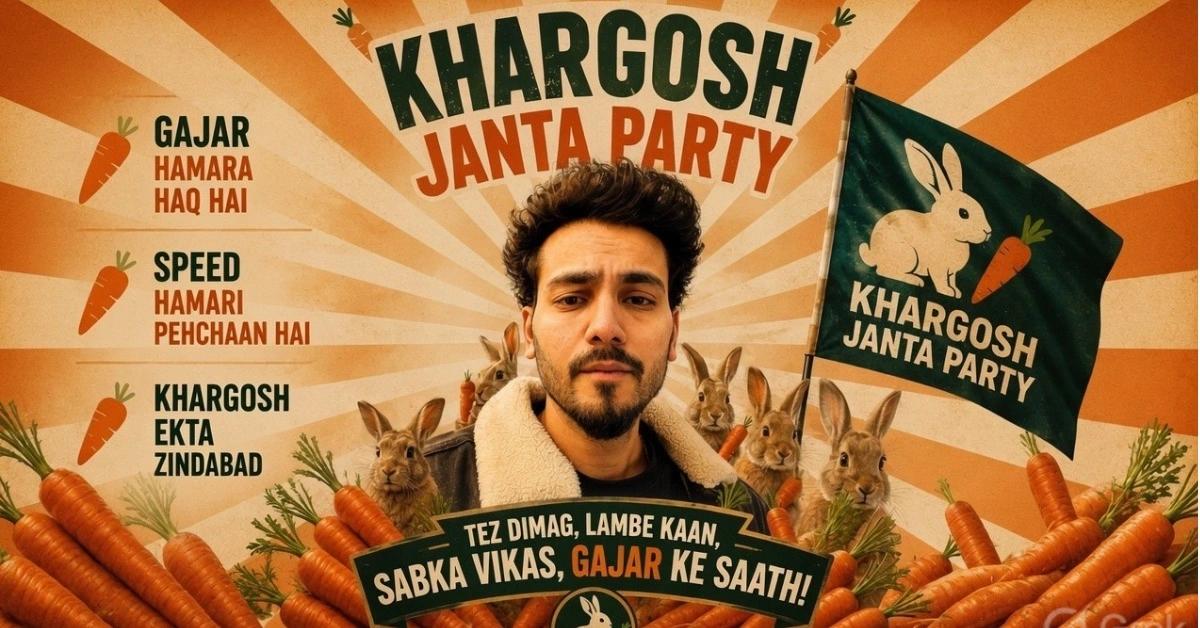
Elvish unveiled the Khargosh Janta Party with a rabbit mascot on its flag and a slogan that is equal parts absurd and pointed: “Sharp minds, long ears, and development powered by carrots.” But behind the humour is a carefully constructed three-point manifesto that resonates deeply with young Indians.
Point 1 — Carrots as a Fundamental Right. No Indian youth should go hungry for opportunity. The carrot here is not just a vegetable. It is the promise of employment, education, and economic mobility that India’s young population has been told is just around the corner — perpetually, frustratingly out of reach.
Point 2 — Speed Is Our Identity. “We don’t crawl — we sprint.” This is a direct, pointed jab at the sluggishness of bureaucratic systems and decades of delayed promises. The rabbit runs. The systems around it do not. That contrast is the joke and the truth at the same time.
Point 3 — Rabbit Unity Above All. Solidarity among youth, regardless of region, caste, or economic background. In a country where divisions are routinely weaponised by those in power, the call for a unified rabbit identity carries unexpected weight.
Yadav invited followers to gather at Delhi’s historic Jantar Mantar — the traditional site of public demonstrations — with the teaser: “Free carrots for everyone.” The event quickly trended as #KhargoshJantaParty and #FreeGajar across every major platform simultaneously
Why Elvish Yadav? Understanding the Messenger Behind the Movement
Elvish Yadav is not a random content creator. He is arguably the most watched Hindi YouTuber in India, with videos regularly hitting 20 to 40 million views. His fanbase — which he calls the Elvish Army — skews young, urban, and deeply online. He won Bigg Boss OTT Season 2 with the largest public vote in the show’s history, a testament to his extraordinary grip on the 18 to 28 age demographic.
What makes Yadav an effective vehicle for political satire isn’t just his reach — it’s his authenticity. He comes from Gurgaon’s working-class corridors, and his content has always carried a tone of “one of us against a system not built for us.” When he speaks about carrots and rabbits, his audience doesn’t just laugh. They feel seen.
That distinction matters enormously in the attention economy of 2026. Trust, not just reach, is the currency that converts views into movements. Yadav has both.
CJP vs KJP: Two Movements, One Generation
With two viral “parties” now dominating online discourse, it is worth asking what exactly separates them. The honest answer is: tone, origin, and aspiration — but not audience.
The Cockroach Janta Party emerged from the ground up, born out of raw collective anger at being publicly demeaned by one of the country’s highest judicial voices. It was defiant and reactive — a generation saying “you called us vermin and we are choosing to wear that label as armour.” Its energy was dark, sharp, and righteous.
The Khargosh Janta Party, by contrast, came from the top down — a single influential creator shaping a movement rather than a leaderless crowd self-organising. Its tone is aspirational rather than angry, playful rather than defiant. Where the cockroach says “we survive despite you,” the rabbit says “we are ready — are you going to let us run?”
Together, the two movements are not rivals but complements. They represent the full emotional range of India’s disillusioned, energised youth: fury on one side, hunger on the other. The CJP gave language to the wound. The KJP is reaching for the bandage.
This Just a Joke, or Something More?
The temptation — especially among those outside the 18 to 28 demographic — is to dismiss the Khargosh Janta Party as frivolity. A content creator chasing views. Internet noise mistaken for signal. That reading misses the point entirely.
Political satire has a long and genuinely powerful lineage in India. From the folk theatre of colonial resistance to cartoonist R.K. Laxman’s beloved Common Man, the tradition of using humour to speak truth to power is deeply embedded in this nation’s cultural DNA. What Elvish Yadav has done with the KJP fits squarely in that tradition — he is simply doing it on YouTube Shorts instead of a street stage.
More importantly, both movements are symptom and signal simultaneously. They indicate a generation that is politically aware, emotionally raw about its circumstances, and deeply creative in how it expresses those feelings. A generation that has watched opportunities promised but never delivered. Systems designed for someone else. Conversations held about them but never genuinely with them.
The carrot manifesto is a joke. The hunger behind it is not.
What Real Young Indians Are Saying
On the ground — or rather, on their feeds — the reaction to the KJP among the 18 to 28 age group has been overwhelming. Comment sections under Elvish’s announcement video filled with messages ranging from gleeful absurdism to surprisingly earnest engagement.
One user wrote: “This is exactly how I feel — I am fast, I am ready, and nobody is giving me a chance.” Another: “The rabbit has been underestimated in every story. Time to change the ending.” These are not the comments of people who see this purely as entertainment. They are the comments of people who found a symbol that fits.
Several young professionals shared that the KJP articulated something they had struggled to put into words: the frustration of being part of a generation told it has every advantage while being systematically blocked from using those advantages. The rabbit, as Elvish framed it, is the perfect avatar for that experience — fast, clever, underestimated, and hungry.
Can a Meme Movement Create Real Change?
Here is the honest, complicated truth: satirical online movements rarely translate directly into policy. The Khargosh Janta Party will not contest elections. No carrots will be legislated into fundamental rights. The Jantar Mantar gathering, however large it becomes, will not rewrite the constitution.
But that is not the only measure of impact that matters.
The CJP forced a national conversation about how India’s institutions speak to and about its young people. The KJP is extending that conversation — shifting it from “what are we angry about” to “what do we actually want.” That shift from grievance to aspiration is genuinely meaningful, and it is a shift that political scientists and cultural analysts consistently identify as a precursor to organised action.
Social scientists studying digital movements point to what they call pre-political behaviour — the cultural groundwork laid before formal political organising becomes possible. Memes, satirical parties, and viral campaigns are pre-political. They build shared vocabulary, shared identity, and shared purpose. The youth who joke about carrot rights today are the voters, activists, and community leaders of tomorrow. The politicians and institutions wise enough to listen — not to the punchline, but to the feeling underneath — will be the ones who remain relevant.
The Bottom Line
The Khargosh Janta Party is many things simultaneously: a content creator’s viral moment, a Gen Z political meme, a genuine cultural artefact, and a surprisingly lucid commentary on youth disenfranchisement in contemporary India. Elvish Yadav may have built it for laughs — and it has delivered those laughs, abundantly. But like all the best satire, it leaves something behind after the laughter fades: a question, a feeling, and perhaps the beginning of a real demand.
Free carrots for everyone. It is absurd. It is perfect. And somewhere underneath the joke, it is exactly what a generation is asking for.