
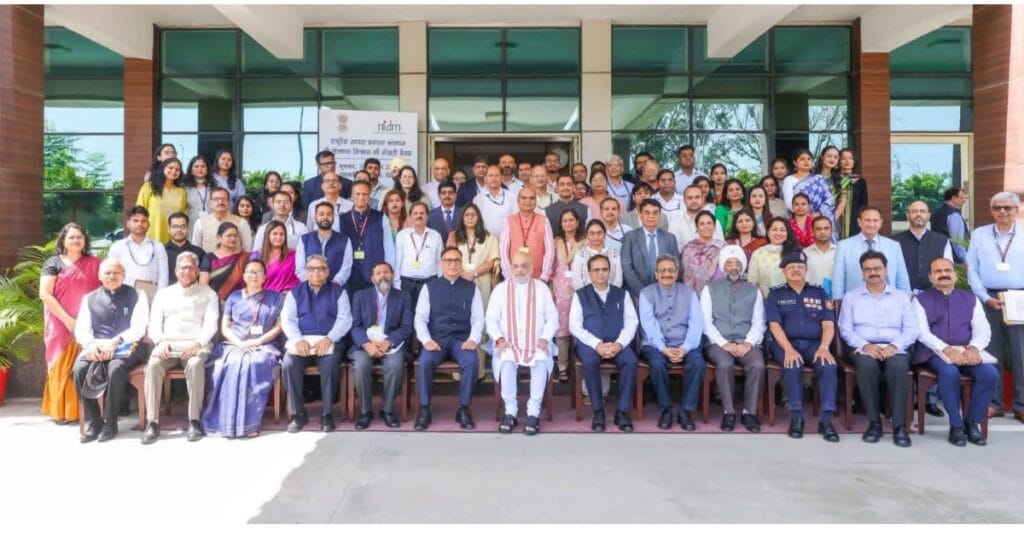
New Delhi, September 10, 2026: Assam’s senior administrative official L. Sweety Changsan, ACS, Assam, attended the third Governing Body meeting of the National Institute of Disaster Management (NIDM) chaired by Union Home Minister Amit Shah in New Delhi.
The meeting focused on a major shift in India’s disaster-management approach—from responding after disasters to reducing risks before they happen. The government discussed disaster-resilient villages and cities, early-warning systems, climate-related risks, research, training and a broader “Whole of Government” approach.
While several reports focused mainly on Amit Shah’s direction to create dedicated disaster-management cells, the official government release contains several additional decisions that could have wider implications for states such as Assam, which regularly faces flood and other climate-related risks.
What Was Discussed at the NIDM Meeting?
Amit Shah said India’s disaster-management system is moving beyond the traditional focus on relief and rehabilitation.
According to the Ministry of Home Affairs, the new approach is based on three major pillars:
- Risk reduction
- Early-warning systems
- Zero Casualty
The government also wants disaster preparedness to become a responsibility shared across departments instead of being handled only by specialised disaster-management agencies.
This means departments dealing with infrastructure, agriculture, education, urban development and other areas will increasingly have to consider disaster risks while planning and implementing their work.
Dedicated Disaster Cells to Be Created in Departments
One of the most important decisions from the meeting was the direction to establish a dedicated and focused cell in every concerned department.
These cells will help implement the agenda of creating villages and cities that are more resilient to disasters, including risks associated with climate change and global warming.
The department heads have also been asked to review the progress of these cells at least once every three months.
For readers, this is significant because the decision is not limited to creating another disaster-response programme. It places responsibility for preparedness inside the regular working system of government departments.
A Major Change: Study Why Damage Happens After Every Disaster
Another important point that received less attention in early reports is the proposed post-disaster analysis.
Amit Shah directed that NDMA and NIDM should work with the National Disaster Response Force (NDRF) and State Disaster Response Forces (SDRFs) to study the causes of damage after disasters.
A joint team is expected to examine what caused the damage and prepare a detailed report. The objective is to use those findings to improve future prevention and rescue measures.
This could help disaster authorities move from simply asking “How do we respond?” to also asking “Why did the damage happen, and how can it be reduced next time?”
Why the Meeting Matters for Assam
The participation of L. Sweety Changsan, ACS, Assam, gives the meeting an important Northeast connection. She was listed among the distinguished members of the NIDM Institute Body who attended the meeting.
Assam is particularly relevant to discussions around disaster resilience because communities across the state face recurring flood and other environmental risks.
However, it is important to make one distinction: the meeting did not announce a new Assam-specific flood package or special financial allocation for Assam. The available official release does not make such an announcement.
Instead, the broader national decisions on risk reduction, early warnings, resilient infrastructure and post-disaster analysis could be relevant to Assam’s future disaster-management planning.
₹2.5 Lakh Crore Spent on Disaster Management
The meeting also highlighted the scale of India’s disaster-management spending.
According to the government, around ₹2.5 lakh crore has been spent in the disaster-management sector over the past 11 years.
The government also said:
- SDRF allocation has increased nearly four times.
- NDRF allocation has increased nearly three times.
- The 16th Finance Commission has provided ₹2 lakh crore for the current period.
- The Disaster Management Act has been amended after 20 years.
- Urban Disaster Management Authorities have been introduced.
- Digital disaster databases at national and state levels are being developed.
- The National Crisis Management Committee has received statutory status.
These figures show that the meeting was not only about long-term policy. It also reviewed the broader institutional and financial changes taking place in India’s disaster-management system.
NIDM to Expand Research, Training and Innovation
Amit Shah also called for NIDM to strengthen its role as a national centre for research, innovation, policy support, training and departmental cooperation.
NIDM and NDMA have been asked to study international disaster-management research and consider how useful practices can be adapted to Indian conditions.
The government also wants universities to become more closely connected with NIDM’s research and capacity-building work.
NIDM’s institutional development was also discussed. The government said four acres of land have recently been allocated to the institute and that it is working towards becoming a world-class model institution.
Disaster Preparedness Could Reach Schools and Colleges
One of the more unusual points from the meeting was the emphasis on a disaster-management mobile application.
Amit Shah called for wider promotion and adoption of the application through primary, secondary and higher education.
The idea is to make disaster awareness and preparedness more familiar to people before emergencies occur, rather than treating disaster management only as a specialised government activity.
Focus on India’s Five Lakh Villages
The government also stressed that international cooperation is useful, but India’s priority must remain its own communities.
Amit Shah specifically referred to the country’s five lakh villages while discussing the goal of building disaster-resilient communities.
The wider objective is to transform knowledge into capacity, capacity into preparedness and preparedness into measurable outcomes, with Zero Casualty remaining the long-term goal.
What This Means Going Forward
The third NIDM Governing Body meeting signals a broader approach to disaster management in India.
For Assam, the participation of L. Sweety Changsan places the state within this national discussion on disaster preparedness, resilience and climate-related risks. But the real impact will depend on how these national directions are translated into state-level planning and implementation.
The most significant change may be the move toward prevention, preparation and learning from previous disasters, rather than focusing only on relief after an emergency.
With dedicated departmental cells, quarterly reviews, joint post-disaster studies, stronger research and wider use of early-warning and preparedness tools, the government is seeking to build a system that can reduce damage before the next disaster strikes.