

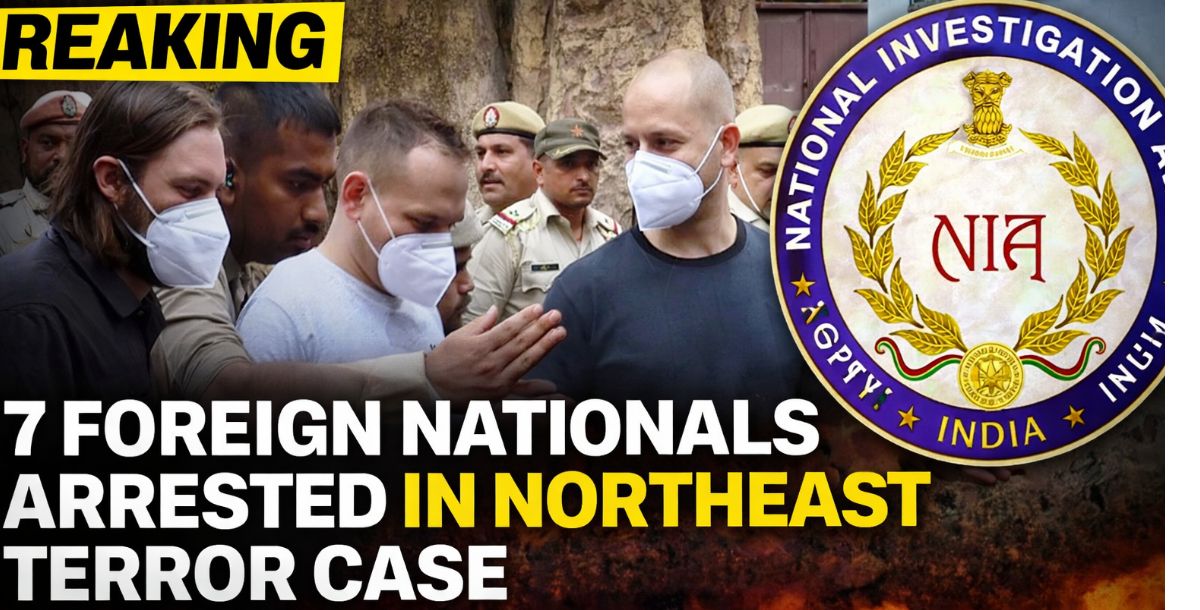
India’s internal security landscape is facing a sharp new challenge. The National Investigation Agency (NIA) has arrested seven foreign nationals in a case that could redefine how insurgency operates in the Northeast bringing drone warfare and global links into focus at a critical time.
The NIA arrests foreign nationals development matters now because it signals a shift from traditional insurgency tactics to tech-driven operations. With tensions simmering along the India–Myanmar border, authorities fear this could be the beginning of a more sophisticated, internationally connected threat.
Inside the NIA Arrests Foreign Nationals Case
According to investigators, the NIA arrests foreign nationals case involves one American and six Ukrainian citizens accused of supporting insurgent activities in Northeast India.The American has been identified as Matthew Aaron VanDyke. The identities of the Ukrainian nationals have not been fully disclosed, but officials confirm all seven are under interrogation.
Authorities say the group entered India on tourist visas but allegedly violated visa norms by traveling to restricted areas in Mizoram without proper permits.What makes the NIA arrests foreign nationals case particularly serious is what investigators claim happened next.
Cross-Border Movement and Drone Training Allegations
Sources indicate the accused crossed into Myanmar, where they allegedly conducted training sessions for armed ethnic groups.These sessions reportedly included
- Drone assembly and deployment
- Surveillance techniques
- Signal jamming and electronic disruption
Officials believe the NIA arrests foreign nationals case reveals an attempt to introduce modern warfare tactics into a region long dominated by conventional insurgency.There are also allegations that the group facilitated the supply of drone equipment sourced from Europe and routed through Indian territory raising red flags about global logistics networks.
Court Action Under UAPA
A special court in New Delhi has remanded all seven accused to 11-day custody.The charges have been filed under the Unlawful Activities (Prevention) Act (UAPA), one of India’s strictest anti-terror legislations.
Legal experts say the use of UAPA in the NIA arrests foreign nationals case indicates the seriousness of the allegations, especially those linked to terrorism, training, and cross-border coordination.
The NIA arrests foreign nationals case comes at a time when security agencies are already dealing with evolving threats in the Northeast.For decades, insurgency in the region has been driven by local grievances and armed movements. But this case suggests a possible shift:
- Foreign nationals allegedly involved
- Advanced technology like drones being introduced
- Cross-border training and coordination
Security analysts warn that such developments could transform the nature of conflict in border regions, making it harder to detect and control.
Drones: A New Frontier in Insurgency
One of the most alarming aspects of the NIA arrests foreign nationals case is the alleged use of drones.Drones are no longer limited to global battlefields they are increasingly being used for:
- Reconnaissance
- Payload delivery
- Surveillance in difficult terrain
insurgent groups in Northeast India gain such capabilities, it could significantly enhance their operational reach.Authorities have already tightened drone regulations, but this case may push for stricter enforcement and monitoring.
National Security Concerns Deepen
The NIA arrests foreign nationals investigation is now expanding beyond the initial arrests.Officials are examining
- Funding sources
- Communication channels
- Possible links to banned insurgent outfits
There is also concern about whether Indian territory was used as a transit hub for equipment and training logistics.The involvement of foreign nationals adds a geopolitical dimension, raising questions about external influence in regional conflicts.
The NIA arrests foreign nationals case is still unfolding.During the custody period, investigators are expected to
- Interrogate the accused in detail
- Map their travel and contacts
- Coordinate with international agencies
Officials have not ruled out further arrests as the probe deepens.
FAQ
1.Who made the arrests?
The arrests were carried out by the National Investigation Agency.
2.How many people were arrested?
Seven—one American and six Ukrainian nationals.
3.What are the main charges?
They have been booked under the Unlawful Activities (Prevention) Act for alleged terror links and unlawful activities.
4.Where did the activities take place?
The case involves movement through Mizoram and cross-border operations in Myanmar.
5.Why is this case significant?
It highlights possible foreign involvement and the use of drone technology in Northeast insurgency.
Conclusion
The NIA arrests foreign nationals case is more than just a counter-terror operation it’s a warning signal.suggests that insurgency in India may be entering a new phase, shaped by technology, international actors, and cross-border coordination. For policymakers and security agencies, the challenge now is not just to respond but to anticipate what comes next.
As the investigation unfolds, this case could redefine how India approaches internal security in its most sensitive regions.

Leave a Reply