

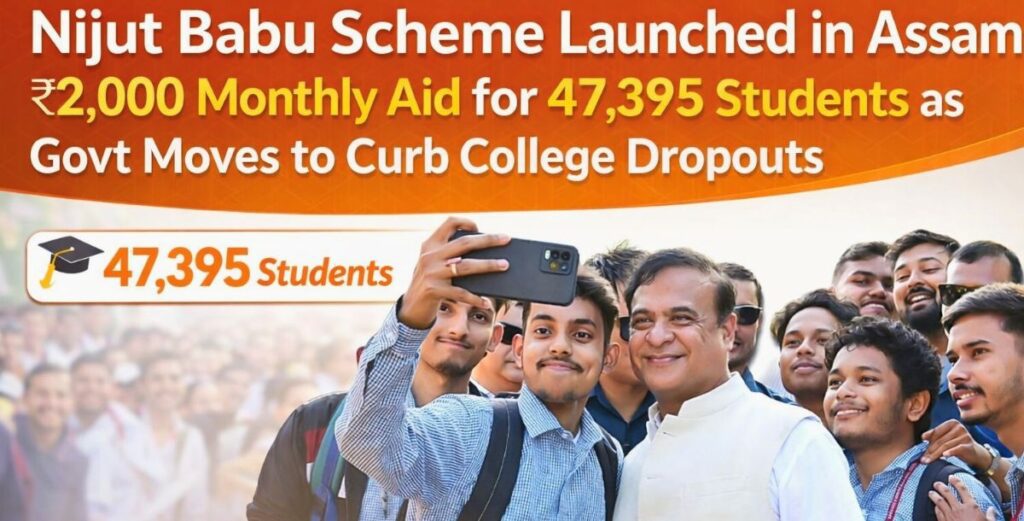
Guwahati: In a politically significant move ahead of elections, the Assam government has rolled out the Nijut Babu Scheme, extending monthly financial assistance to male students in higher education. Chief Minister Himanta Biswa Sarma formally launched the initiative on Thursday, fulfilling a public promise to make college education more affordable for boys after previously supporting girls under a parallel scheme.
The announcement matters now because rising education costs continue to push students—particularly from low-income families out of colleges and universities. With admissions underway and academic expenses mounting, the Nijut Babu Scheme is positioned as a direct intervention to prevent dropouts.
From Nijut Moina to Nijut Babu: Expanding Financial Support
The new scheme follows the success of the Nijut Moina, which provided financial assistance to female students pursuing higher education across the state. According to official data, more than 2.5 lakh girl students have already benefited under that initiative.
With the launch of the Mukhyamantrir Niyut Babu, the government has now extended similar financial support to boys from economically weaker families.
Officials say the expansion reflects an attempt to balance gender-focused welfare measures while maintaining the core objective ensuring students complete their higher education without financial interruption.
Who Will Benefit Under Nijut Babu Scheme?
According to an official release issued by the Government of Assam, the Mukhyamantrir Niyut Babu scheme will benefit:
- 47,395 first-year undergraduate and postgraduate students
- Students belonging to families with an annual income below ₹4 lakh
Eligible students will receive monthly financial assistance, with the primary aim of reducing financial stress during the crucial first year of higher education—a stage where dropout rates tend to be highest.
Education department officials note that the first year often determines whether a student continues or withdraws due to economic constraints. By targeting this phase, the Nijut Babu Scheme attempts to plug a critical gap in the education pipeline.Assam has made steady progress in improving enrolment rates, but retention remains a concern—especially among students from rural and semi-urban districts.
Financial strain, travel expenses, hostel costs, digital access, and examination fees frequently combine to create pressure that forces students to discontinue their studies.
The Nijut Babu Scheme directly addresses this concern. Rather than offering one-time scholarships, it provides structured monthly assistance. Policy experts argue that predictability in income support can significantly improve retention outcomes.simple terms, when families know that financial help will arrive every month, long-term academic planning becomes possible.
The launch comes at a time when Assam is preparing for electoral activity. While opposition voices may view the scheme through a political lens, governance analysts point out that targeted education subsidies often have measurable long-term economic benefits.
Chief Minister Himanta Biswa Sarma has consistently placed education reforms at the center of the state’s development narrative. From infrastructure upgrades to scholarship expansions, the administration has emphasized access and affordability.The Nijut Babu Scheme now completes what the government calls a “balanced support framework” for both male and female students.
Real Impact: What ₹2,000 a Month Can Mean
For many families earning less than ₹4 lakh annually, college expenses represent a significant burden.A steady monthly assistance can help cover
- Hostel or rental contributions
- Study materials and books
- Transportation costs
- Examination and form fees
- Digital learning tools
For postgraduate students, the financial breathing space may allow them to focus on academic performance instead of part-time work.Education economists suggest that even modest, regular financial support often produces outsized results in continuation rates.
Students seeking benefits under the Nijut Babu Scheme should
- Verify income eligibility criteria
- Monitor official college notices
- Follow instructions issued by the Higher Education Department
- Ensure documentation is accurate and up to date
Transparency and timely disbursement will determine the credibility of the initiative. Past welfare rollouts in Assam have increasingly relied on digital verification systems to streamline payments.
Taken together, the Nijut Moina and Nijut Babu initiatives signal a broader strategy: reduce financial barriers to higher education and strengthen enrolment in state institutions.By covering both girls and boys under structured assistance programs, the government aims to improve gross enrolment ratios and build a stronger skilled workforce base in Assam.
If executed effectively, the Nijut Babu Scheme could contribute to
- Higher completion rates
- Reduced dropout percentages
- Increased postgraduate participation
- Greater economic mobility among low-income households
The coming academic sessions will offer the first measurable indicators of its success.
FAQ
Q1: What is the Nijut Babu Scheme?
It is a monthly financial assistance program launched by the Assam government to support male students in higher education from families earning below ₹4 lakh annually.
Q2: How many students will benefit?
47,395 first-year undergraduate and postgraduate students are expected to benefit initially.
Q3: How is it different from Nijut Moina?
Nijut Moina supports female students, while Nijut Babu extends similar support to male students.
Q4: What is the primary goal?
To prevent dropouts in higher education due to financial hardship.
Conclusion
The Nijut Babu Scheme marks a significant expansion of Assam’s student welfare framework. By focusing on affordability and continuity, the government is attempting to address one of higher education’s most persistent challenges financial exclusion.
Whether the scheme transforms long-term educational outcomes will depend on transparent implementation and sustained fiscal support. For now, it sends a clear signal: higher education in Assam is being positioned as a right that should not be interrupted by economic hardship.

Leave a Reply