

writer by sanjoy gorh
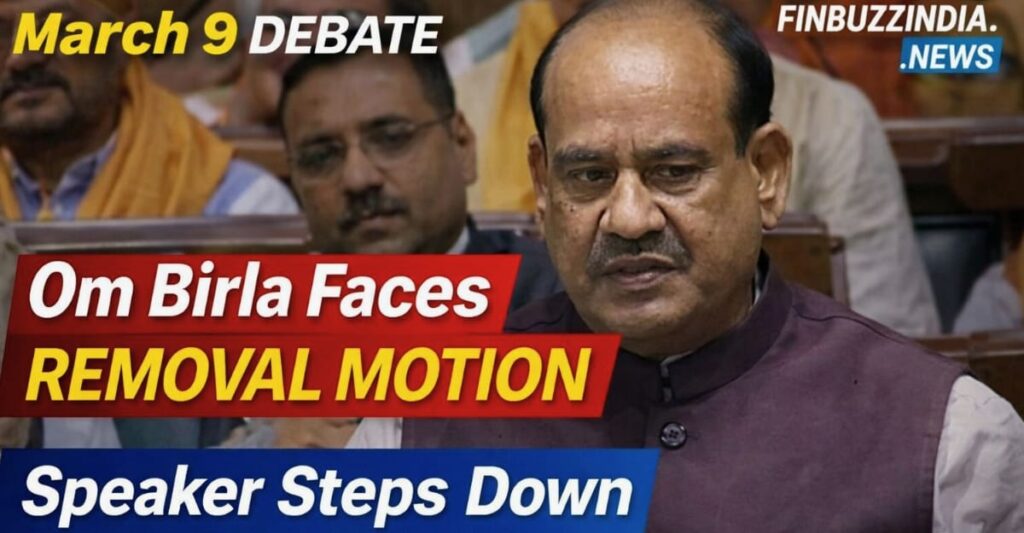
India’s Lok Sabha recently rejected an opposition-led motion to remove Speaker Om Birla, marking a rare but failed challenge to parliamentary leadership. The event unfolded during the 2026 Budget Session amid accusations of bias, highlighting deep political divides
The development has sparked political debate in New Delhi and beyond. The Om Birla removal motion is not just another parliamentary procedure it represents a rare test of accountability for one of the most powerful constitutional positions inside the Lok Sabha.For many observers of Indian politics, the moment will be symbolic: the Speaker temporarily stepping away from the chair of authority while Parliament debates his conduct.
The Om Birla removal motion has quickly become one of the most closely watched developments of the ongoing Budget Session.
Opposition parties have accused Om Birla of acting in a partisan manner during parliamentary proceedings. Their criticism focuses on decisions involving suspensions of MPs and the handling of debates inside the House.The ruling side has firmly rejected these allegations, arguing that the Speaker has followed established parliamentary rules and procedures.
This political clash has turned the Om Birla removal motion into more than a procedural step. It is now a reflection of the broader tensions shaping India’s parliamentary politics.
Timeline of Events
Opposition parties, including Congress and TMC, submitted the notice in early February 2026 after Speaker Birla denied Leader of Opposition Rahul Gandhi permission to speak on sensitive issues like excerpts from an unpublished memoir by former Army chief General MM Naravane. Debate commenced on March 9, lasting nearly 12 hours over two days, with over 42 MPs participating; Congress MP Dr. Mohammad Jawed formally moved the resolution, alleging Birla’s impartiality lapsed by favoring the ruling NDA and targeting women opposition MPs. Birla stepped aside from the chair during proceedings, resuming only after a voice vote defeated the motion on March 11
Why Om Birla Cannot Preside Over the Debate
Under parliamentary rules governing the Lok Sabha, a Speaker cannot preside when a motion for their removal is being discussed.The rule exists to protect fairness and neutrality during the debate.
Since the Om Birla removal motion directly concerns his position, another presiding officer usually the Deputy Speaker or a member chosen by the House will conduct the proceedings.As a result, Om Birla will sit on the Treasury benches with other MPs instead of occupying the Speaker’s chair.
In practical terms, it means the person who usually manages debates, maintains order, and controls proceedings will temporarily become just another participant in the chamber.
The Om Birla removal motion follows a formal constitutional procedure that has existed since India adopted its parliamentary system.The process typically involves several steps.
First, Members of Parliament submit a written notice proposing the removal of the Speaker.
Second, the motion must be admitted and scheduled for discussion in the House.
Third, MPs debate the resolution and present arguments supporting or opposing it.
Finally, the Lok Sabha votes on the motion.If a majority of members present and voting support the resolution, the Speaker can be removed from office.
However, such motions are extremely uncommon in Indian parliamentary history. Most never reach the final stage because of political arithmetic inside the House.
Still, the Om Birla removal motion has already attracted public attention because of the unusual circumstances it creates inside Parliament.
Constitutional Requirements
Under Article 94(c) of the Indian Constitution, removing the Speaker requires a resolution backed by a majority of all Lok Sabha members—over 50% of 543 seats (about 272 votes)—after a 14-day notice supported by at least 50 MPs. Here, 118 opposition MPs backed it initially, but no division vote occurred; the voice vote sufficed due to NDA’s numerical strength (around 293 seats), ensuring quick rejection. This is only the fourth such attempt since 1952 (others in 1954, 1966, 1987), none successful
Key Accusations and Defenses
Critics like TMC’s Mahua Moitra claimed Birla oversaw “the liquidation of parliamentary democracy,” citing mass suspensions of 100+ opposition MPs in 2023 and unequal speaking time. BJP leaders, including Home Minister Amit Shah, dismissed it as opposition “lies” and ego-driven disruption, emphasizing Birla’s adherence to rules where “no one is above the law.” Birla defended his neutrality post-vote, noting every MP’s right to speak per procedure
Can Om Birla Vote on the Motion?
Yes, the Speaker retains the right to vote during the Om Birla removal motion.However, there is a procedural difference.
Normally, MPs vote using the electronic voting system inside the Lok Sabha chamber. Because Om Birla will not be presiding during the debate, he will submit his vote through a written slip instead.
The adjustment may seem technical, but it reflects how carefully parliamentary rules are designed to maintain neutrality during sensitive proceedings.The Om Birla removal motion was introduced during the second phase of the Budget Session of Parliament.
Opposition parties claim the Speaker’s decisions have favored the ruling side during key parliamentary moments, especially when it comes to disciplinary actions and debate management.
The government has strongly dismissed these accusations, saying Om Birla has acted strictly according to the rules of the House.Political analysts believe the debate will likely be intense but predictable. The outcome will largely depend on the numerical strength of parties in the Lok Sabha.
practical terms, removal motions rarely succeed when the ruling alliance holds a majority.
Yet even if the motion fails, the discussion itself could shape the political atmosphere inside Parliament for weeks.Beyond the political drama, the Om Birla removal motion highlights an important feature of India’s democratic system: institutional accountability.
The Speaker of the Lok Sabha holds enormous authority. The position controls debates, disciplinary decisions, and the functioning of the House.
But the Constitution also ensures that the Speaker remains answerable to Members of Parliament.That balance between authority and accountability is what makes moments like this significant.When Parliament debates a removal motion, it reminds citizens that even the highest offices in democratic institutions are subject to scrutiny.
Broader Implications
The failed motion underscores the Speaker’s entrenched position, insulated by the ruling coalition’s majority, and reflects ongoing Budget Session tensions over issues like farmer policies and trade deals. It failed to alter parliamentary dynamics but amplified calls for Speaker impartiality reforms, though historical precedent suggests little change ahead.
FAQ
1.Why will Om Birla sit with MPs during the debate?
Parliamentary rules prevent the Speaker from presiding over the House when a motion seeking their removal is being discussed.
2.Can Om Birla defend himself during the debate?
Yes. He has the right to participate in the discussion and respond to allegations made by MPs.
3.Will Om Birla be able to vote?
Yes, but he will cast his vote through a written slip rather than the electronic voting system.
4.Are removal motions common in India?
No. Such motions are extremely rare in the history of the Lok Sabha.
Conclusion
The upcoming debate on the Om Birla removal motion could create one of the rarest scenes in India’s Parliament a Speaker sitting among MPs while the House debates his future.Whether the motion succeeds or fails, the moment will underline a powerful principle of parliamentary democracy: authority must always remain accountable to the House it serves.
For observers of Indian politics, March 9 may become a memorable chapter in the story of how Parliament tests its own institutions.
source of referenc
- India News Network – Debate Coverage
- Times of India – Congress View

Leave a Reply