
Writer by finbuzzindia/07.05.2026 Time 3.00 PM Published
Today the Operation Sindoor Anniversary, first anniversary of defining chapter in India’s modern defense history.Launched on May 7, 2025, this precision-led mission was a decisive response to the Pahalgam terror attacks, aimed at dismantling high-value threats across the border.
One year later,the nation stands united in remembrance.Led by Prime Minister Modi and the top military brass, leaders have adopted the Operation’s emblem striking tricolor badge as their digital identity.This anniversary isn’t just about tactical success; it’s a tribute to the valor of armed forces and promise of justice kept.
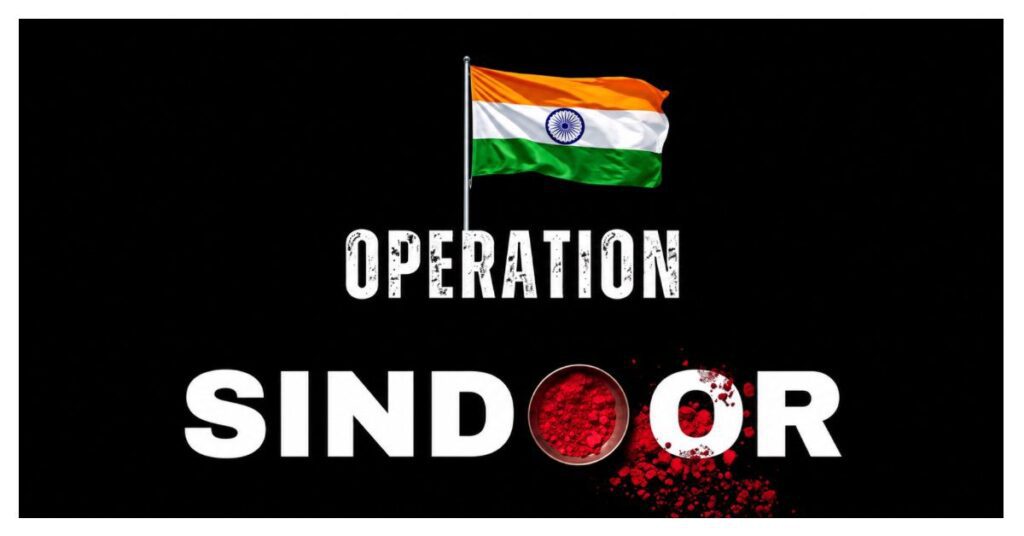
The event is centered on the Indian Armed Forces (Army, Air Force, and Navy) who executed the mission. Today, the “who” extends to the national leadership—including Prime Minister Narendra Modi, Union Ministers, and Chief Ministers—who are leading the digital tribute by updating their profile pictures to the Operation Sindoor emblem.The nation is observing Operation Sindoor Anniversary.This was a multi-service military operation launched to dismantle terror launchpads and infrastructure. The current observation includes nationwide tributes, social media campaigns, and high-level commemorative ceremonies to honor the bravery of the personnel involved.
While the operation originally targeted locations across the Line of Control (LoC) and deep into terror hubs like Muzaffarabad and Bahawalpur, the anniversary celebrations are happening across India.centered in New Delhi (at the National War Memorial), regional recognition in states like Assam.The operation was officially launched on May 7, 2025, following the Pahalgam attacks in April of that year. The anniversary is being marked today, May 7, 2026, as a day of national pride and remembrance.
The operation was initiated as a punitive and preventive strike to ensure “zero tolerance” toward cross-border terrorism. The anniversary is being held to reinforce national security resolve, pay homage to the fallen, and celebrate the successful tactical coordination that boosted India’s strategic standing.
The anniversary is being marked and ceremonially. Strategically, the operation was carried out through coordinated precision strikes involving air assets and elite ground forces. Today, it is being commemorated through the “Digital DP” campaign, public speeches by the Defence Ministry, and news retrospectives highlighting the 88-hour mission that achieved its objectives without civilian collateral.
Purpose of operation sindoor
Operation Sindoor was to deliver a decisive, punitive response to the Pahalgam terror attacks while dismantling the infrastructure of cross-border terrorism. Initiated as a “pre-emptive” strike, the mission aimed to neutralize high-value terror launchpads and training camps—specifically targeting groups like LeT and JeM to deter future aggression.
By employing precision guided munitions and advanced surveillance, the Indian Armed Forces sought to establish a “new normal” of strategic dominance. The operation successfully eliminated over 100 terrorists across nine key locations, reaffirming India’s zero-tolerance policy while maintaining strict operational restraint to avoid civilian and state-military collateral damage.
Intelligence of selection
Intelligence of selection was the backbone of Operation Sindoor, transforming Raw data into a scalpel-like military strike. It relied on a “microscopic scan” of the terror landscape, where multi-agency inputs identified nine high-value targets across the border. This wasn’t just about finding camps; it was a sophisticated process of vetting locations to ensure they were strictly active terror infrastructures, not civilian areas.
By layering satellite imagery with human intelligence, the mission achieved surgical precision. This meticulous selection allowed the armed forces to neutralize over 100 terrorists with zero collateral damage, proving that modern warfare is won by information as much as firepower.
Opperation ethies and restraint
Operation Sindoor was immense, its execution was defined by a strict ethical code. The mission was built on the principle of “proportionality and distinction,” ensuring that every strike was a direct answer to aggression rather than an act of expansion.
The primary restraint was the absolute protection of non-combatants. Despite the proximity of terror camps to local villages, The Indian Armed Forces utilized high-precision technology to avoid a single civilian casualty. By focusing exclusively on verified terror infrastructure and avoiding Pakistani sovereign military assets, India maintained the moral high ground, proving that national security can be upheld without compromising international humanitarian standards.
Demonstracting leadrship
The leadership displayed during Operation Sindoor was a masterclass in strategic courage and accountability. It wasn’t just about giving orders; it was about the top brass taking ownership of a high-stakes mission from the war room to the digital front. Leaders across the military and political spectrum demonstrated a unified vision, ensuring that the objective remained clear: justice without overreach.
This resolve is visible today as the nation’s highest officials lead by example, adopting the operation’s emblem to honor the forces. By prioritizing the safety of their personnel and the ethics of the mission, they transformed a complex military action into a symbol of national integrity and strength.
Operation Sindoor achieved
Operation Sindoor Anniversary (May 7–10, 2025) is recognized as a watershed moment in India’s strategic history. On its first anniversary today, the following achievements have been highlighted as its lasting legacy:
1. Tactical & Operational Success
- Neutralization of Terror Hubs: The operation successfully dismantled nine major terror camps and launchpads across the Line of Control (LoC) and deep into Pakistan-controlled territory (including Muzaffarabad and Bahawalpur).
- Over 100 terrorists were confirmed killed in action, dealing a crippling blow to the leadership of groups like Lashkar-e-Taiba (LeT) and Jaish-e-Mohammed (JeM).
- Tri-Service It was the first modern instance of the Army, Navy, and Air Force acting under a unified integrated plan, demonstrating that India no longer operates in military “silos.”
2. Strategic & Diplomatic
- Establishment of “Zero Tolerance”: The operation moved India beyond “diplomatic statements” to a doctrine of decisive retribution, establishing a new “red line” for cross-border provocations.
- Naval Dominance: The Indian Navy restricted the Pakistan Navy to its ports by deploying a full Carrier Battle Group, effectively blockading maritime aggression without firing a single shot at sea.
- Indus Waters Treaty Lever: non-kinetic move, India held the Indus Waters Treaty in abeyance, signaling that water cooperation is contingent on an end to cross-border terrorism.
3. Indigenous Capability Validation
- Battle-Proven Technology: The operation served as a successful real-world test for home-grown systems like the BrahMos supersonic cruise missile and the Akash Air Defence system, which proved highly effective against enemy drones and aircraft.
- Economic Following the success of these systems, India’s defense exports reached a record high of ₹38,424 crore in the 2025-26 fiscal year—a 62% increase.
4. Doctrine
- Escalation Control: India proved it could execute a high-intensity strike and halt the operation on its own terms, preventing a full-scale war while still achieving its punitive objectives.
- Tech-Centric Warfare: The mission accelerated India’s shift toward AI-driven targeting and unmanned systems, which are now being integrated across all three services.
What did the operation end ?
Operation Sindoor effectively ended three major things during its active window in May 2025:
1. The 88-Hour Military Conflict
The operation, which began on May 7, 2025, concluded four days later. Following heavy damage to terror infrastructure and a series of border skirmishes, the Directors General of Military Operations (DGMOs) of both India and Pakistan communicated via their hotline. They agreed to a total ceasefire, which went into effect at 17:00 IST on May 10, 2025, bringing an end to the active kinetic exchange on land, air, and sea.
2. Active Terror Infrastructure in 9 Key Zones
The operation ended the functional existence of nine major terror launchpads and training facilities. By using precision strikes and loitering munitions, the Indian Armed Forces neutralized hubs linked to Lashkar-e-Taiba (LeT), Jaish-e-Mohammed (JeM), and Hizbul Mujahideen.
- Sawai Nala, Syedna Bilal, and Kotli Abbas
- Muridke and Bahawalpur (deep within Pakistani territory)
- Bhimber and Gulpur
3. The Status Quo of the Indus Waters Treaty
The operation led to the termination/abeyance of the 1960 Indus Waters Treaty. India announced that water cooperation would remain suspended until Pakistan “credibly and irrevocably” ended its support for cross-border terrorism. This move ended decades of traditional water diplomacy.
Conclusion
One year later, Operation Sindoor Anniversary stands as a landmark of national resilience and strategic maturity. It successfully replaced a policy of restraint with one of decisive accountability, dismantling terror networks while upholding the highest ethical standards of warfare. By integrating cutting-edge indigenous technology with a unified tri-service command, India didn’t just avenge a tragedy—it redefined its security doctrine for a new era.
Today, as the nation observes this anniversary, the mission remains a powerful testament to the fact that justice, when backed by unwavering leadership and precision, is the most effective deterrent against global terror.