
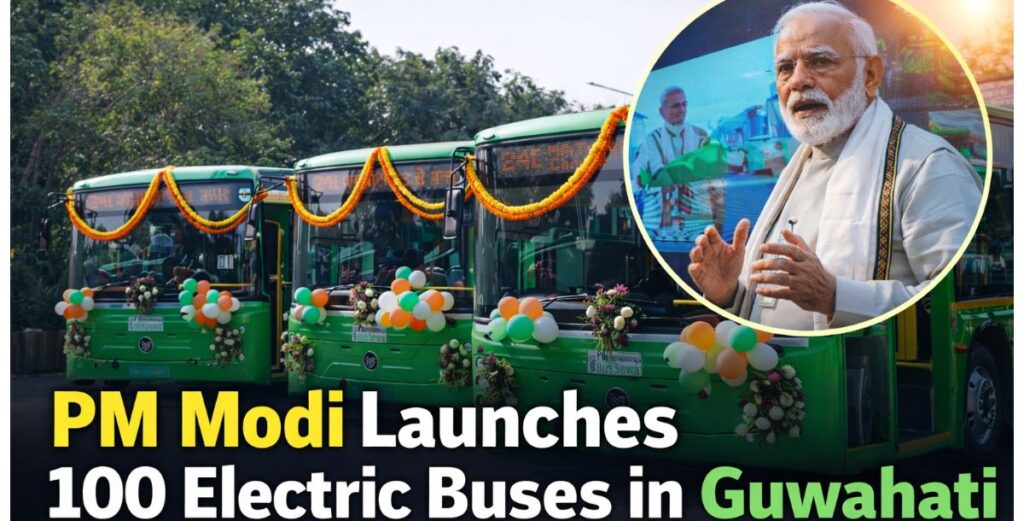
When Prime Minister Narendra Modi flagged off 100 electric buses in Guwahati, it wasn’t just a ceremonial launch. It signaled a turning point for urban mobility in Northeast India and a strong push toward cleaner, more affordable public transport at a time when cities are battling pollution and rising fuel costs.
The rollout of 100 electric buses in Guwahati comes under the Centre’s ambitious PM-eBus Sewa scheme. For thousands of daily commuters, this is not just a policy announcement it’s a visible shift in how the city plans to move its people in the years ahead.With urban air quality concerns rising and transport demand surging, the timing of this move matters more than ever.
A Major Push Under PM-eBus Sewa
The PM-eBus Sewa Scheme, launched in August 2023, aims to deploy 10,000 electric buses across 169 cities in India. With a financial outlay of ₹57,613 crore, it is one of the country’s largest public transport electrification programs.The 100 electric buses in Guwahati are part of this larger nationwide transition.
The scheme follows a Public-Private Partnership (PPP) model. Private operators manage the buses, while the government provides viability gap funding and infrastructure support. This approach reduces the burden on state governments and accelerates deployment.
Officials say the buses are equipped with modern safety systems, improved seating comfort, and energy-efficient technology designed for urban routes.
Why Guwahati Is at the Centre of Attention
Guwahati, often called the gateway to Northeast India, has experienced rapid expansion over the past decade. Population growth, commercial development, and increased vehicle usage have led to traffic congestion and worsening air quality.The launch of 100 electric buses in Guwahati directly addresses these challenges.
For a city that functions as the administrative and economic hub of Assam, reliable public transport is essential. The introduction of electric buses strengthens Guwahati’s infrastructure while aligning the region with India’s broader clean energy mission.Experts say improving bus networks in regional hubs like Guwahati can have a multiplier effect boosting trade, tourism, and daily productivity.
What Changes for Daily Commuters?
The impact of the 100 electric buses in Guwahati will be felt immediately on key city routes.Here’s what residents can expect:
Cleaner air: Electric buses produce zero tailpipe emissions, reducing particulate matter and harmful pollutants.Lower noise levels: Unlike diesel engines, electric buses operate quietly, improving the urban sound environment.Improved travel comfort: Newer fleets typically offer smoother rides and better maintenance standards.
Long-term cost efficiency: Over time, electric fleets reduce fuel and maintenance costs compared to diesel alternatives.Charging infrastructure is being developed alongside deployment to ensure operational continuity.
Part of India’s Larger Climate Commitment
India has pledged to achieve net-zero carbon emissions by 2070. Transport electrification is central to that strategy.While electric cars often dominate headlines, public transport electrification delivers a much higher impact. One electric bus can replace dozens of private vehicles on the road.
The introduction of 100 electric buses in Guwahati demonstrates how climate commitments are translating into ground-level action.India also imports a significant share of its crude oil. Expanding electric public transport reduces long-term fuel dependence and strengthens energy security.
Beyond Metro Cities: A Strategic Shift
Historically, major infrastructure upgrades were concentrated in metro cities. But the 100 electric buses in Guwahati show that the clean mobility transition is expanding beyond Delhi, Mumbai, and Bengaluru.
Under the scheme, 10,000 electric buses will reach 169 cities many of them Tier-2 and regional hubs.This broader distribution signals a more inclusive growth strategy, ensuring that smaller cities are not left behind in the sustainability push.
For Northeast India, improved mobility also enhances regional connectivity and economic resilience.While the launch of 100 electric buses in Guwahati marks a milestone, successful implementation will depend on several factors:
- Reliable and fast charging networks
- Skilled maintenance teams
- Efficient route planning
- Timely financial support
Experts caution that fleet electrification must be supported by strong operational management. Without that, even well-funded schemes can struggle.
However, early adoption in cities like Guwahati could serve as a model for others.Authorities indicate that deployment may continue in phases depending on demand and performance metrics.
If the PM-eBus Sewa scheme achieves its target of 10,000 buses, India could emerge as one of the largest electric bus markets globally.For now, the spotlight remains on Guwahahati, where commuters will soon see and experience the difference firsthand.
FAQs
1. How many electric buses were launched in Guwahati?
A total of 100 electric buses were launched under the PM-eBus Sewa scheme.
2. What is the PM-eBus Sewa Scheme?
It is a central government initiative launched in August 2023 to deploy 10,000 electric buses across 169 cities.
3. How does the PPP model work?
Private operators run the buses, while the government provides financial assistance and infrastructure support.
4. Why are electric buses important?
They reduce pollution, lower noise, improve energy efficiency, and support India’s climate goals.
5. Will Guwahati get more electric buses?
Expansion is possible in future phases depending on operational performance and demand.
Conclusion
The launch of 100 electric buses in Guwahati is more than a transport upgrade it is a statement about India’s urban future.As cities grapple with pollution and congestion, sustainable mobility is no longer optional. It is essential.
For Guwahati’s residents, this shift promises cleaner air and better connectivity. For India, it marks another concrete step toward building greener, more resilient cities.






Leave a Reply