
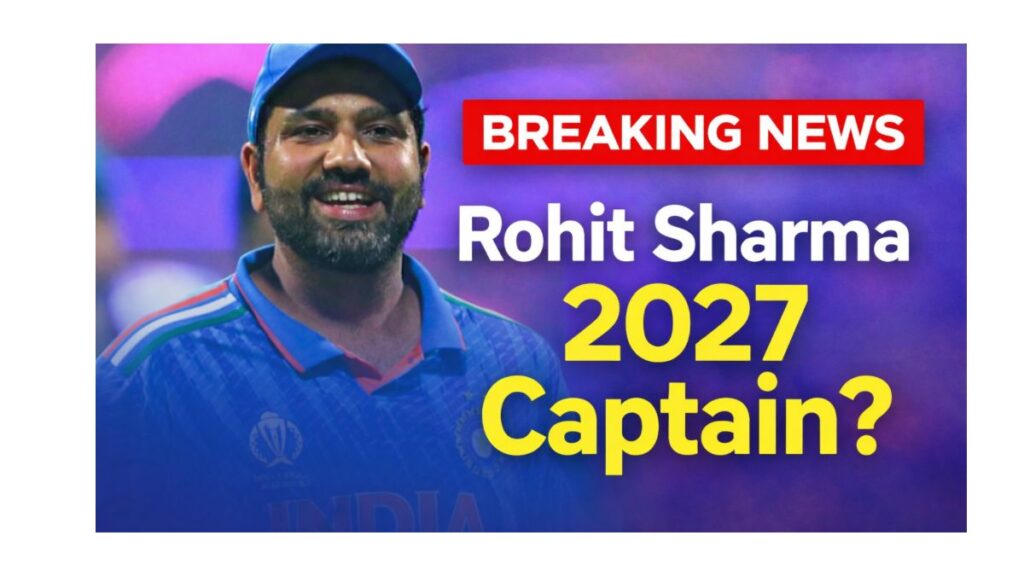
India’s World Cup planning has entered a decisive but cautious phase and the discussion around possible role Rohit Sharma 2027 World Cup Captaincy reflects how the BCCI is thinking about leadership, risk control, and continuity rather than emotion or popularity.Contrary to social media noise, there is no official decision and no public confirmation. What exists instead is a structured internal evaluation—one that weighs experience, fitness trends, transition timelines, and tournament conditions years in advance.
This is not a captaincy announcement.
It is a governance-level planning conversation.
What Makes This Discussion Different From Past Speculation in Rohit Sharma 2027 World Cup captaincy
Unlike routine captaincy rumors, this conversation is happening early in the World Cup cycle, which itself is a shift in approach.According to reports and cricketing sources:
- The BCCI may sound out Rohit Sharma regarding future leadership availability
- Selectors are mapping multiple leadership scenarios, not naming a captain
- Any decision will depend on form, fitness, and workload sustainability, not legacy
The board’s use of long-term planning signals a move away from last-minute calls that have previously unsettled India’s ODI campaigns.
Leadership as a Risk-Management Tool
From a selector’s perspective, captaincy is less about age and more about risk mitigation in high-pressure tournaments.Rohit Sharma offers:
- Deep experience in ICC events
- Proven decision-making under knockout pressure
- Tactical familiarity with varied playing conditions
For tournaments in South Africa, Zimbabwe, and Namibia, where pitches, bounce, and match tempo differ from Asia, situational experience becomes a measurable asset, not an emotional one.This is why his name continues to feature in planning discussions.
Why Age Alone Is Not the Deciding Metric
Rohit Sharma will be close to 40 during the 2027 World Cup cycle, but selectors increasingly rely on fitness data and role clarity, not birth certificates.Recent selection policies show:
- Performance benchmarks matter more than age brackets
- Leadership roles can be separated from long-term playing guarantees
- Captains are reviewed cycle-by-cycle, not tournament-by-tournament
In other words, being considered does not mean being locked in.
How This Impacts India’s Transition Strategy
A key concern for Indian cricket has been abrupt leadership changes before major tournaments.
Keeping Rohit Sharma in the leadership conversation without committing allows the BCCI to:
- Groom future leaders without immediate pressure
- Maintain stability within the senior core
- Avoid rushed transitions close to ICC events
This approach also gives younger players time to develop leadership traits organically rather than being fast-tracked into high-stakes roles.
The Role of the Senior Core in This Planning
Leadership continuity also affects players like Virat Kohli and other senior ODI regulars.A stable captaincy framework helps:
- Preserve dressing-room clarity
- Maintain defined on-field roles
- Reduce tactical confusion in crunch matches
From a team-management perspective, clarity off the field often translates into calm on it.
What Is Confirmed and What Is Not
Confirmed facts
- No official BCCI announcement has been made
- No captain has been named for the 2027 World Cup
- Leadership reviews are ongoing as part of long-term planning
Not confirmed
- Rohit Sharma being finalized as captain
- Any exclusion or confirmation of younger leadership options
This distinction is critical to avoid misinformation.
Why This Conversation Matters in 2026, Not 2027
World Cup-winning teams usually finalize leadership well before the tournament year.Early discussions help with:
- Stable squad building
- Leadership grooming pipelines
- Avoiding reactive decisions after setbacks
India’s recent ICC history suggests that clarity beats urgency.
Expert Context: Why Rohit Sharma Still Commands Trust
- Over 10,000 ODI runs
- Only player with three ODI double centuries
- Extensive captaincy experience across formats
- Track record of managing star-heavy squads
These credentials explain why selectors continue to evaluate him seriously without committing prematurely.
FAQs
1.is confrim Rohit Sharma 2027 World Cup captaincy ?
No. There is no confirmation. Discussions are exploratory only.
2.Why is the BCCI considering experienced leadership?
Because World Cups reward composure, planning, and adaptability—especially in unfamiliar conditions.
3.Is age a concern?
Yes, but it is one of several factors, alongside fitness, form, and workload.
4.Are younger leaders being prepared?
Yes. The BCCI is tracking future options alongside senior leadership.
Conclusion
The conversation around Rohit Sharma 2027 World Cup captaincy is not about nostalgia or guarantees. It reflects a more mature, data-driven approach to leadership planning by the BCCI.Nothing is decided.But the intent is clear: India wants leadership clarity early without closing doors too soon.
That balance may define how competitive the team looks when the World Cup finally arrives.and more sport trending news visit our site



Leave a Reply