

Writer by sanjoy gorh 03.03.2026 Time 8.00 AM Published
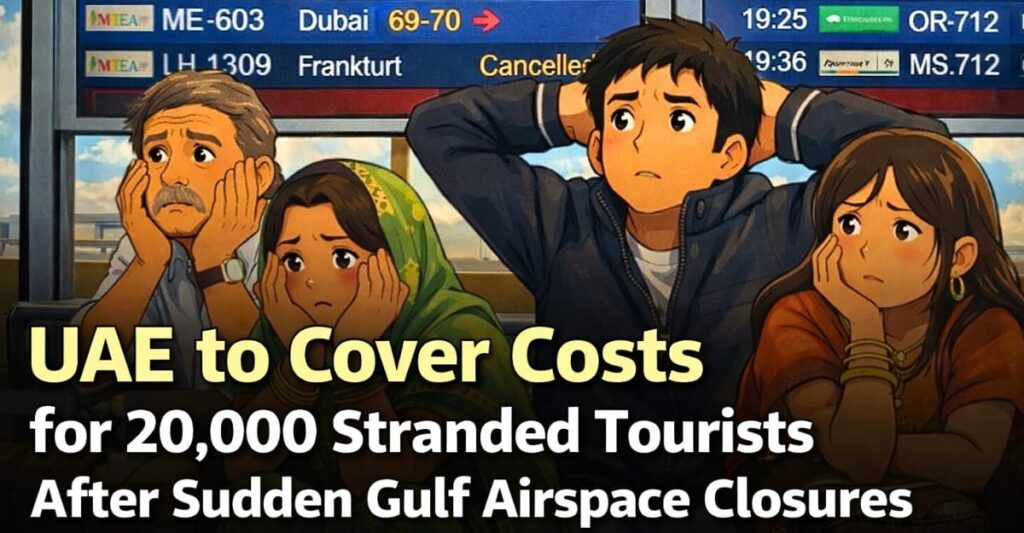
In a remarkable display of government-backed hospitality, the United Arab Emirates has announced it will fully cover hotel accommodation, meals, refreshments and rebooking assistance for more than 20,000 tourists and transit passengers stranded across its airports. The move, triggered by sudden Gulf airspace closures linked to escalating Iran-US-Israel military tensions in early March 2026, has turned potential chaos into a story of swift, compassionate action.
For the thousands of travellers including a large number of Indian tourists and expats whose flights were grounded at Dubai International (DXB), Abu Dhabi’s Zayed International (AUH) and Sharjah (SHJ), this support is more than financial relief. It is a powerful signal that the UAE stands by its visitors even in the face of geopolitical uncertainty.
What Exactly Is the UAE Offering?
According to the General Civil Aviation Authority (GCAA), the state is bearing “all hosting and accommodation costs” for affected passengers whose flights were cancelled or rescheduled due to official airspace restrictions. The Department of Culture and Tourism Abu Dhabi (DCT Abu Dhabi) has directed hotels to extend stays and send invoices directly to the government. Dubai’s Department of Economy and Tourism (DET) has issued similar instructions to hotels, ensuring no stranded guest faces surprise bills.
The package includes:
- Full hotel accommodation until flights resume
- Complimentary meals and refreshments
- Assistance with rebooking on the earliest available services
- Coordinated support from national carriers Emirates, Etihad, flydubai and Air Arabia offering refunds or complimentary changes
This coordinated response has already helped over 20,000 passengers, preventing the kind of out-of-pocket distress seen in past global disruptions.
Why This Crisis Hit So Hard — And Why the UAE Responded So Decisively
The trigger was rapid escalation in the Iran-US-Israel conflict, forcing several Gulf nations to close airspace for safety. Long-haul routes connecting Asia, Europe and Africa were instantly disrupted. Hubs like Dubai and Abu Dhabi, which handle millions of transit passengers annually, became temporary homes for thousands.
Unlike many countries that leave stranded travellers to fend for themselves, the UAE activated pre-planned emergency aviation protocols within hours. This is not the first time the emirates have shown such resilience — the sector has weathered pandemics, regional tensions and extreme weather. But this latest move stands out for its scale and speed. By absorbing costs upfront, authorities have eliminated panic pricing, protected hotel partners and preserved traveller trust — critical for a nation where tourism and aviation contribute heavily to GDP.
Special Relief for Indian Travellers and Expats
For Indian nationals one of the largest visitor and transit groups in the UAE the support has been particularly reassuring. The Indian Embassy in Abu Dhabi and Consulate in Dubai activated 24×7 helplines and are coordinating non-scheduled repatriation flights. Stranded Indians have publicly praised the UAE’s hospitality, with many receiving free hotel vouchers and meals without delay. One Indian traveller shared, “They gave us free food and hotel vouchers we felt truly looked after.”
This proactive stance is especially significant given the strong India-UAE ties. With direct flights, business links and a huge Indian diaspora in the Gulf, any disruption affects families, professionals and leisure travellers alike. The UAE’s decision ensures that no Indian family is forced to choose between safety and financial strain.
A Strategic Win for UAE Tourism and Global Reputation
Beyond immediate relief, the move is a masterstroke in brand positioning. In an era where travellers share experiences instantly on social media, visible government support prevents negative stories and reinforces the UAE’s image as one of the world’s safest and most visitor-friendly destinations.
Aviation experts note that such decisive action can become a case study in crisis management. While other regions sometimes witness refund delays or price gouging, the UAE has chosen compassion and efficiency qualities that will likely attract even more tourists once normal operations resume.
Practical Advice for Anyone Still Stranded
If you are among those affected:
- 1. Check flight status only through your airline’s official app or website.
- 2. Do not cancel tickets independently — wait for airline guidance.
- 3. Keep your booking confirmation and passport details handy.
- 4. Contact your airline or the airport’s passenger support desk for hotel and meal vouchers.
- 5. Indian nationals should register on the embassy portal or call the dedicated helpline for repatriation updates.
Travel insurance that covers trip interruptions remains valuable, but the UAE’s direct support has reduced out-of-pocket risks significantly.
What This Means for the Future of Travel
The UAE’s response highlights a growing global expectation: governments and aviation hubs must treat passengers as guests, not just customers, during crises. As geopolitical risks rise and extreme weather events increase, this model of shared responsibility could inspire similar policies elsewhere.
For now, over 20,000 stranded tourists in the UAE are experiencing hospitality at its finest — not as a marketing slogan, but as a government commitment. As flights gradually resume, the story will shift from disruption to resilience, further cementing the UAE’s position as a global aviation leader that truly puts people first.
The announcement that the UAE to cover costs for more than 20,000 stranded tourists comes at a tense moment for regional travel.
After escalating military tensions triggered widespread airspace closures across parts of the Middle East, departure boards across the Gulf turned red with cancellations. Long-haul connections were suspended. Transit passengers were left waiting for updates that changed by the hour.For thousands, journeys simply stopped mid-route.
Emergency Support for Stranded Travelers
Authorities confirmed that the UAE to cover costs plan includes hotel accommodation, meals, refreshments, and rebooking support for passengers affected by cancellations caused by official airspace restrictions.
This applies to both arrivals and departures disrupted due to security measures.practical terms, it means travelers are not being asked to pay out of pocket for nights in unfamiliar cities while waiting for flights to resume. For families, elderly passengers, and solo travelers, that reassurance matters.
FAQ
1.Who qualifies for accommodation and meals?
Passengers whose flights were cancelled due to official airspace closures linked to security measures.
2.Are transit passengers included?
Yes, transit travelers affected by cancellations are receiving support.
3.Can passengers request refunds instead?
Major UAE carriers are offering full refunds or free rebooking options.
4.When will normal operations resume?
That depends on ongoing security evaluations and regional developments.
Conclusion
Air travel depends on predictability. When that disappears, anxiety rises quickly.By confirming that the UAE to cover costs for stranded tourists, authorities have moved decisively to reduce uncertainty.For now, thousands remain in waiting. But they are not alone and not left to shoulder the burden themselves.

Leave a Reply