
Published: June 2026 | Category: Weather & Climate | Reading Time: 9 minutes
Table of Contents
- Breaking: Western Disturbance Triggers Nationwide Alerts
- What Is a Western Disturbance?
- Why Do Western Disturbances Come to India?
- Delhi-NCR: Storm and Rain Alert Issued
- Rain Batters Northeast and South India
- Which States Are Most Affected by Western Disturbances?
- Are Western Disturbances Hot or Cold?
- Agricultural Significance: Why Rabi Crops Depend on It
- Western Disturbance vs. Monsoon: Key Differences
- IMD Forecast: What to Expect in the Coming Days
- Safety Guidelines During Storms
- Frequently Asked Questions
Western Disturbance Triggers Nationwide Storm and Rain Alerts
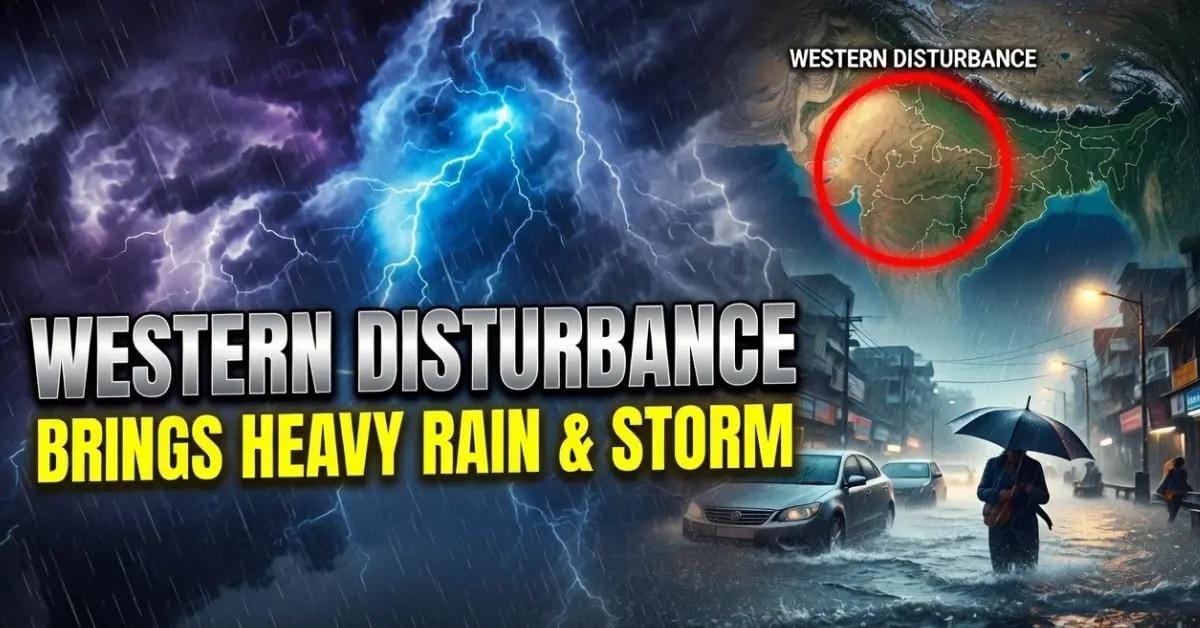
A potent Western Disturbance is currently sweeping across the Indian subcontinent, triggering widespread rain, thunderstorms, and lightning alerts from the Himalayas to the southern peninsula. The India Meteorological Department (IMD) has issued Orange and Yellow weather alerts for multiple states, warning residents of gusty winds reaching 50–70 km/h, heavy rainfall, and isolated hailstorms.
This weather system — one of the most meteorologically significant phenomena affecting the Indian subcontinent — has already drenched parts of Punjab, Haryana, Himachal Pradesh, and Uttarakhand, while its moisture-laden tail is pushing rainfall into the Northeast and South India simultaneously. Disruptions to flights, road travel, and outdoor activities have been reported across the affected zones.
Understanding what a Western Disturbance is, how it forms, and why it matters is critical for every Indian citizen — not just meteorologists. This deep-dive article answers every major question you may have.
What Is a Western Disturbance?
A Western Disturbance (WD) is an extra-tropical cyclonic storm that originates in the Mediterranean Sea, Caspian Sea, or Black Sea region and travels eastward toward the Indian subcontinent. Unlike the Indian Summer Monsoon — which flows from south to north — Western Disturbances move from west to east, embedded in the mid-latitude westerly jet stream.
In technical meteorological terms, a Western Disturbance is a low-pressure trough or cyclonic circulation in the middle and upper troposphere (5–12 km altitude). It carries significant moisture absorbed from the Mediterranean and surrounding water bodies, which it then deposits as rain and snow as it moves across Iran, Afghanistan, Pakistan, and finally into India.
Key Characteristics of a Western Disturbance
- Origin: Mediterranean Sea, Caspian Sea, Black Sea, Atlantic Ocean
- Movement: West to East, driven by westerly jet streams
- Altitude: Operates primarily at 5,000–12,000 meters above sea level
- Season: Most active between October and April (peak: December–March)
- Precipitation Type: Rain in plains, heavy snowfall in Himalayas
- Duration: Typically 2–7 days per event
- Frequency: India receives 4–7 Western Disturbances per month during peak winter
The term “Western” refers to the direction from which the disturbance arrives — the west — not to a western region of India. The word “disturbance” in meteorology indicates a disruption to the normal atmospheric pressure pattern.
Why Do Western Disturbances Come to India?
The arrival of Western Disturbances in India is governed by a powerful atmospheric mechanism: the subtropical westerly jet stream. This fast-flowing air current at 9–13 km altitude acts like a river in the sky, transporting weather systems from the Middle East and Central Asia directly toward the Indian subcontinent.
The Science Behind Western Disturbances Reaching India:
Step 1 — Formation: Low-pressure systems develop over the Mediterranean Sea due to the temperature contrast between warm sea water and cold polar air masses from Europe.
Step 2 — Moisture Loading: As the disturbance moves eastward, it absorbs moisture from the Mediterranean, Caspian, and Arabian Sea regions.
Step 3 — Jet Stream Transport: The subtropical westerly jet stream, which lies just south of the Himalayas during winter (at approximately 25°N–30°N latitude), picks up and steers these systems eastward toward India.
Step 4 — Orographic Lift: When the moisture-laden disturbance encounters the Himalayas and Hindu Kush mountain ranges, the air is forced upward (orographic lifting), cooling rapidly and triggering intense precipitation — rain at lower elevations and snow above 2,000 meters.
Step 5 — Spillover Effect: The moisture tail of the disturbance can extend deep into the Indo-Gangetic Plain, the Northeast, and even trigger pre-monsoon showers in South India when conditions are favorable.
This is why a storm born in the Mediterranean can bring rain to Mumbai, snow to Manali, and floods to Assam — all from the same weather event.
Delhi-NCR: Storm and Rain Alert Issued
The Delhi-NCR region is currently under a Yellow Alert, with the IMD predicting thunderstorms accompanied by lightning and gusty winds of 40–60 km/h in the coming 24–48 hours. Residents should expect:
- Sky conditions: Partly cloudy to overcast
- Temperature drop: Day temperatures 3–5°C below seasonal average
- Rainfall: Light to moderate, with isolated heavy spells
- Thunderstorm risk: High during afternoon and evening hours (2 PM–8 PM window)
- Dust storm probability: Moderate, especially in western Delhi and neighboring Haryana
The National Disaster Response Force (NDRF) has been placed on standby across the NCR region. The Delhi Traffic Police has issued advisories urging commuters to avoid low-lying underpasses during heavy rainfall and to keep emergency contacts ready.
Practical advice for Delhi-NCR residents:
- Avoid parking under trees or near electricity poles
- Keep vehicles away from flood-prone areas
- Charge mobile phones in advance of the storm
- Follow IMD’s Mausam app for real-time updates
Rain Batters Northeast and South India
While the primary influence zone of a Western Disturbance is northwest India, the interaction between a WD and other moisture systems can trigger significant rainfall across the entire country.
Northeast India: Heavy Rain and Flood Warning
States including Assam, Meghalaya, Arunachal Pradesh, Manipur, Mizoram, Nagaland, Tripura, and Sikkim are experiencing heavy to very heavy rainfall. The Brahmaputra and Barak river systems are rising, and the Central Water Commission has issued flood alerts for low-lying districts.
- Assam: Red alert for Lakhimpur, Dibrugarh, and Dhemaji districts
- Meghalaya: Cherrapunji (Sohra) already recording 150+ mm in 24 hours
- Arunachal Pradesh: Landslide risk elevated along National Highways 13 and 415
The Northeast’s vulnerability stems from its geography — the funnel-shaped valleys of the region act as moisture traps, intensifying rainfall when large-scale weather systems push humid air from the Bay of Bengal northward.
South India: Pre-Monsoon Activity Intensifies
Kerala, Tamil Nadu, coastal Karnataka, and Andhra Pradesh are receiving pre-monsoon thundershowers. The Western Ghats are particularly active, with isolated extremely heavy rainfall (>204.4 mm/day) reported in parts of Kerala’s Idukki and Wayanad districts.
This southern activity is not directly caused by the Western Disturbance itself but is triggered by the convergence of moisture streams it displaces — a phenomenon meteorologists call “remote forcing.”
Which States Are Most Affected by Western Disturbances?
Western Disturbances primarily impact Northwest and North India, with cascading effects across the country. Here is a state-by-state breakdown:
Primary Impact Zone (Direct Effect)
| State/UT | Type of Precipitation | Season |
|---|---|---|
| Jammu & Kashmir | Heavy snowfall, rain | Oct–Apr |
| Himachal Pradesh | Snow above 2,000m, rain in valleys | Nov–Mar |
| Uttarakhand | Snow at higher altitudes, rain in foothills | Nov–Mar |
| Punjab | Rain, occasional hail | Dec–Mar |
| Haryana | Rain, thunderstorms | Dec–Mar |
| Delhi-NCR | Rain, thunderstorms, cold waves | Dec–Mar |
| Rajasthan (Northern) | Rain, dense fog, cold wave | Dec–Feb |
Secondary Impact Zone (Indirect Effect)
| State | Effect |
|---|---|
| Uttar Pradesh | Fog, cold wave, moderate rain |
| Bihar | Dense fog, cold wave intensification |
| West Bengal | Cold wave, isolated rain |
| Northeast India | Enhanced pre-monsoon activity |
Western Disturbances Hot or Cold?
This is one of the most commonly asked questions about Western Disturbances, and the answer is nuanced: Western Disturbances are fundamentally cold-weather phenomena, but they create complex temperature dynamics.
Why Western Disturbances Are Associated with Cold:
Western Disturbances arrive during winter and early spring (October to April), when North India already experiences cold conditions. The storms they bring are driven by cold polar air interacting with relatively warmer subtropical air — the classic recipe for extra-tropical cyclone formation.
When a Western Disturbance passes over India:
- Before arrival: Cold, dry northwesterly winds intensify, dropping temperatures sharply
- During the storm: Cloud cover actually moderates temperatures slightly (nights become warmer, days become cooler)
- After passage: A dramatic temperature drop occurs as cold continental air from Central Asia rushes in — this is when Delhi experiences its coldest nights
The “Cold Wave” Connection:
The most dangerous cold waves in North India are not caused by the Western Disturbance itself but by the cold air intrusion that follows its passage. The WD essentially clears the path for Arctic and Siberian air masses to pour into the subcontinent.
However, Western Disturbances can also interact with the pre-monsoon heat (March–May) to create violent thunderstorm activity, making them appear “warm” in early spring. In this season, they trigger Nor’westers (Kalbaishakhi) in West Bengal and pre-monsoon storms across India.
In summary: Western Disturbances are primarily cold-season systems, but their impact ranges from intensifying cold waves in winter to triggering heat-season thunderstorms in spring.
Agricultural Significance: Why Rabi Crops Depend on Western Disturbances
Perhaps the most critical — yet least discussed — aspect of Western Disturbances is their agricultural importance. India’s Rabi crop season (October to March) depends significantly on WD-induced rainfall.
Crops Benefited by Western Disturbances:
- Wheat (the most important) — sown in October–November, harvested in March–April. WD rains during December–February are called “mahawat” and are critical for grain filling.
- Mustard — benefits from WD moisture in Rajasthan, Haryana, and UP
- Barley, Gram (Chickpea), Lentils, Peas — all Rabi staples that benefit from WD rain
- Potato — WD rains reduce irrigation costs across North India
The Punjab-Haryana wheat belt — which produces ~60% of India’s wheat — depends on 2–4 well-distributed Western Disturbance events between December and February. A deficit of WD activity leads to lower soil moisture, reduced grain size, and ultimately, lower MSP-supported yields.
The IMD’s seasonal forecast for Western Disturbance activity is, therefore, closely watched by the Ministry of Agriculture and the Food Corporation of India every winter.
Western Disturbance vs. Indian Summer Monsoon: Key Differences
Many people confuse Western Disturbances with the Indian Summer Monsoon. Here is a clear comparison:
| Feature | Western Disturbance | Indian Summer Monsoon |
|---|---|---|
| Origin | Mediterranean/Atlantic | Indian Ocean/Bay of Bengal |
| Direction | West to East | South to North |
| Season | Oct–Apr (winter/spring) | Jun–Sep (summer) |
| Mechanism | Extra-tropical cyclone | Thermal low + ITCZ migration |
| Primary Region | North & Northwest India | All India |
| Precipitation | Rain in plains, snow in Himalayas | Heavy rain across India |
| Agricultural Role | Rabi crops | Kharif crops |
| Frequency | 4–7 per month (peak winter) | Continuous June–September |
IMD Forecast: What to Expect in the Coming Days
The India Meteorological Department has issued the following forecast based on the current active Western Disturbance:
Next 24 Hours:
- Heavy to very heavy rain over Himachal Pradesh, Uttarakhand, and Jammu
- Thunderstorms with lightning over Delhi-NCR, Punjab, Haryana, and North Rajasthan
- Heavy rain warning for Assam and Meghalaya
Next 48–72 Hours:
- Gradual weakening of WD as it moves toward Nepal and the eastern Himalayas
- Residual cloudy conditions over the Indo-Gangetic Plain
- A fresh WD is expected to approach Northwest India within 5–7 days
The IMD’s Nowcast service updates every 3 hours and provides district-level alerts. Citizens can access alerts via:
- IMD’s official website: mausam.imd.gov.in
- Sachet Portal: sachet.ndma.gov.in
- Mausam App (Android/iOS)
Safety Guidelines During Western Disturbance Storms
When a Western Disturbance-induced storm is forecast for your area, follow these IMD-recommended safety protocols:
During Thunderstorms:
- Stay indoors and away from windows
- Unplug electrical appliances to prevent surge damage
- Do not take shelter under isolated trees
- Avoid open fields, hilltops, and water bodies
- If outdoors and caught in a storm, crouch low — do not lie flat
During Heavy Rain:
- Avoid low-lying areas, underpasses, and riverbanks
- Do not attempt to drive through flooded roads (6 inches of water can sweep a car)
- Keep a 72-hour emergency kit ready (water, food, torch, first aid, documents)
In Himalayan Regions:
- Be alert for flash flood and landslide advisories
- Avoid trekking or highway travel during active alerts
- Follow state disaster management authority (SDMA) orders
During Cold Waves (Post-WD):
- Protect elderly, children, and livestock from extreme cold
- Wear layered clothing and avoid outdoor exposure at night
- Report cases of hypothermia to nearest PHC immediately
FAQ
Q1: How many Western Disturbances does India get per year? India receives approximately 50–100 Western Disturbances per year, of which 20–30 are strong enough to cause significant weather events. Peak frequency is December through February.
Q2: Can a Western Disturbance cause flooding? Yes. When a strong WD interacts with the Bay of Bengal moisture, it can trigger extremely heavy rainfall that causes flash floods, particularly in the Himalayas, Northeast India, and occasionally the Indo-Gangetic Plain.
Q3: Is a Western Disturbance the same as a cyclone? No. Western Disturbances are extra-tropical systems, while cyclones are tropical systems. WDs form in mid-latitudes and move west to east; cyclones form over tropical oceans and are usually confined to coastal areas.
Q4: Does climate change affect Western Disturbances? Research published in journals including Climate Dynamics and Nature Climate Change suggests that climate change is altering WD intensity and frequency — with stronger disturbances becoming more common and their geographic influence expanding further south and east than historically observed.
Q5: What is “mahawat” and why is it important? “Mahawat” is the Hindi/Urdu term for WD-induced winter rain in the Indo-Gangetic Plain. It is critical for wheat cultivation and is eagerly anticipated by farmers in Punjab, Haryana, and western UP.
Conclusion
A Western Disturbance is far more than a weather event that brings a few days of rain. It is a lifeline for Rabi agriculture, a trigger for Himalayan snowpack that feeds India’s rivers through summer, a hazard management challenge for millions in vulnerable areas, and increasingly, a climate change indicator being studied by scientists worldwide.
As the current active disturbance continues to move eastward — bringing storms to Delhi, deluging the Northeast, and awakening the pre-monsoon in the South — staying informed, following official alerts, and preparing adequately are the smartest actions any Indian citizen can take.
Bookmark IMD’s official portals, follow your state disaster management authority, and share this article with family and friends in affected regions.
Sources: India Meteorological Department (IMD), Central Water Commission (CWC), Ministry of Earth Sciences, National Disaster Management Authority (NDMA), peer-reviewed literature in Climate Dynamics & Nature Climate Change.
For real-time weather alerts, visit mausam.imd.gov.in