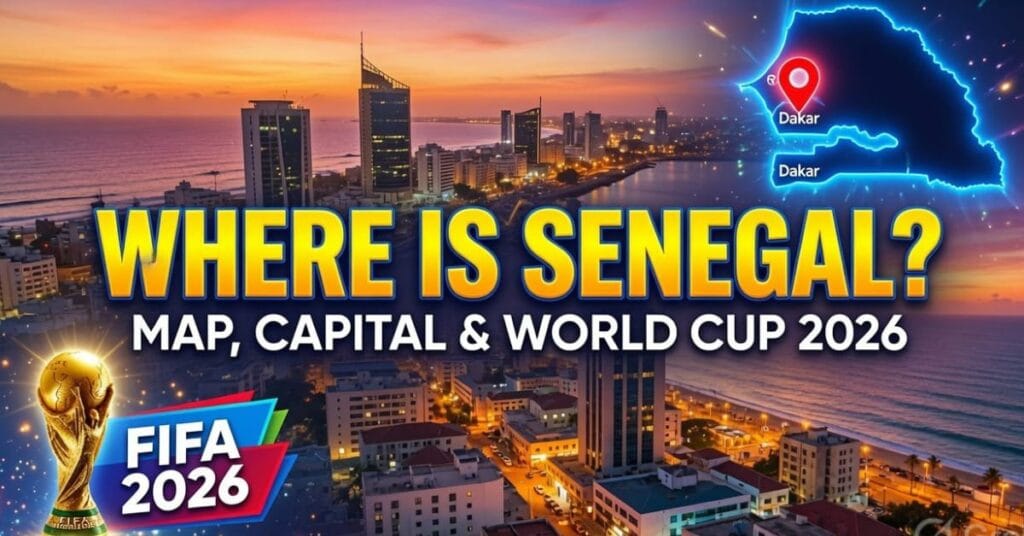
If you’ve been watching the FIFA World Cup 2026 and found yourself typing “where is Senegal” into Google, you’re not alone. Senegal’s matches including today’s clash on the global stage have sent millions of fans searching for a quick geography refresher. Here’s everything you need to know in one place: location, map, capital, population, and the story behind that famous nickname.
Where Is Senegal Located?
Senegal sits on the westernmost edge of the African continent, facing directly onto the Atlantic Ocean. So if you’re wondering what continent is Senegal in, the answer is Africa specifically West Africa, making it one of the closest African nations to the Americas in terms of pure geography.
In coordinate terms, Senegal stretches roughly between 12° and 17° north latitude and 11° to 18° west longitude. That places it just north of the equator, in a band of West Africa known as the Sahel a transition zone between the Sahara Desert to the north and the tropical regions further south.
Because of its position, Senegal has historically been nicknamed the “Gateway to Africa.” Its capital city juts out into the Atlantic on a peninsula, making it the closest mainland African point to both Europe and North America by sea and air. That’s part of the reason Senegal has long served as a hub for transatlantic trade, travel, and more recently international flights connecting Africa to the rest of the world.
Senegal on the Map: Bordering Countries
Pull up a Senegal map and you’ll notice an unusual shape the country almost completely wraps around a much smaller neighbor. Here’s the full rundown of its borders:
- Mauritania – to the north, separated largely by the Senegal River
- Mali – to the east
- Guinea – to the southeast
- Guinea-Bissau – to the southwest
- The Gambia – an entirely separate country that Senegal surrounds on three sides (north, east, and south), leaving Gambia with only a narrow strip of land along the Gambia River and a small Atlantic coastline
This geographic quirk dates back to colonial-era border drawing, when French (Senegal) and British (Gambia) territories were carved out independently of each other, ignoring local ethnic and geographic logic. The result: one of the most distinctive borders on the entire African continent.
Senegal also shares a maritime border with the island nation of Cape Verde, off its Atlantic coast, and its total land area runs close to 197,000 square kilometers (about 76,000 square miles) roughly the size of the U.S. state of South Dakota, or a bit smaller than the United Kingdom.
Is Senegal a Country? Quick Facts Table
Yes Senegal is a country, and a fully sovereign one. It gained independence from France in 1960 and has been governed as a semi-presidential republic ever since, with a reputation as one of West Africa’s most politically stable democracies (it has never experienced a military coup since independence, which is rare in the region).
Here are the essential facts at a glance:
| Fact | Detail |
|---|---|
| Official name | Republic of Senegal |
| Capital | Dakar |
| Continent | Africa (West Africa) |
| Population | Approximately 18 million people |
| Land area | ~197,000 km² (~76,000 sq mi) |
| Official language | French |
| Widely spoken language | Wolof (spoken by roughly 80% of the population) |
| Government | Semi-presidential republic |
| Independence | April 4, 1960 (from France) |
| National symbols | The lion and the baobab tree |
While French remains the official language for government and education, most everyday conversation across the country happens in Wolof, which functions as Senegal’s true lingua franca alongside dozens of other local languages, including Pulaar, Serer, and Mandinka.
Senegal’s Capital: Dakar
If you searched for Senegal capital, the answer is Dakar and it’s one of the more strategically located capital cities in the world. Dakar sits on the Cap-Vert Peninsula, which marks the absolute westernmost point of mainland Africa. That positioning has made it a major port city and aviation hub for centuries.
Dakar is home to a significant share of Senegal’s population and serves as the country’s political, economic, and cultural center. It’s also known internationally for hosting the Dakar Rally’s historic starting point (in earlier editions of the race) and for its vibrant arts scene, including the Dak’Art biennial exhibition, one of Africa’s most important contemporary art events.
Why Is Senegal Called the “Lions of Teranga”?
Football fans searching for Senegal Lions of Teranga are usually trying to understand the team’s nickname and it’s a beautiful piece of cultural context that most match-day coverage skips entirely.
“Teranga” is a Wolof word that roughly translates to “hospitality.” It’s considered a core part of Senegalese cultural identity the idea that warmth and generosity toward guests and strangers is a national value, not just a nice gesture. The “Lions” part comes from the lion’s status as Senegal’s national animal and a symbol of strength, prominently featured on the country’s coat of arms.
Put together, “Lions of Teranga” captures something distinctly Senegalese: fierce competitiveness paired with a deep cultural emphasis on hospitality and welcome. It’s a nickname earned through decades of football history including Senegal’s historic 2002 World Cup run, when they reached the quarterfinals in just their first-ever World Cup appearance, famously beating defending champions France in the opening match.
Senegal at the FIFA World Cup 2026
This year’s tournament marks Senegal’s fourth World Cup appearance overall (following 2002, 2018, and 2022), and their third consecutive qualification — a streak that reflects the squad’s rise as one of Africa’s most consistent footballing nations over the past decade.
Senegal’s 2026 squad, led by head coach Pape Thiaw, includes several Premier League and European league standouts: goalkeeper Édouard Mendy, defender Kalidou Koulibaly, winger Ismaïla Sarr, and veteran forward Sadio Mané, one of the most decorated African players of his generation. The team plays under the nickname “Lions of Teranga” and competes in the green, yellow, and red of the Senegalese flag.
In the group stage, Senegal has already faced France a high-profile rematch of their 2002 World Cup shocker before moving on to face Norway, led by superstar striker Erling Haaland. That Senegal vs Norway matchup is exactly what’s driving the current spike in searches about Senegal’s geography, history, and culture, as fans around the world tune in and want context on a team many are seeing compete on the world stage for the first time.
Whatever happens on the scoreboard, Senegal’s 2026 campaign has already accomplished something significant: introducing millions of new fans to a country defined by resilience, hospitality, and footballing pride.
Senegal’s Economy and Culture at a Glance
Beyond football, Senegal has built a reputation as one of West Africa’s more diversified economies. Key industries include fishing (the country has one of the richest fishing grounds in West Africa thanks to its long Atlantic coastline), agriculture, phosphate mining, tourism, and a fast-growing digital sector under the government’s “Digital Senegal” development strategy. Recent offshore oil and gas discoveries have also positioned Senegal as an emerging energy producer in the region.
Culturally, Senegal punches well above its size. It’s the birthplace of Négritude, an influential literary and political movement from the mid-20th century that celebrated African identity and heritage, championed by Senegal’s first president, Léopold Sédar Senghor, himself a celebrated poet. Senegal is also internationally known for its music scene mbalax, the country’s signature rhythm-driven genre, helped launch global stars like Youssou N’Dour onto the world stage.
For travelers, Senegal’s biggest draws include Gorée Island, a UNESCO World Heritage Site off the coast of Dakar with a sobering history tied to the Atlantic slave trade, and Lake Retba (Lac Rose), a striking pink-hued lake near the capital that regularly appears on “unusual places to visit in Africa” lists.
A Brief History of Senegal at the World Cup
Senegal’s senior men’s national team didn’t qualify for its first World Cup until 2002 — but when it finally arrived, it made history immediately. In their tournament debut, Senegal stunned defending champions France 1-0 in the opening match of the entire competition, then went on to reach the quarterfinals, becoming only the second African nation ever to do so (after Cameroon in 1990). That run remains the gold standard for Senegalese football and is still referenced constantly whenever the national team takes the pitch today.
After a 16-year gap, Senegal returned to the World Cup in 2018 and qualified again in 2022, where they reached the round of 16. Off the back of that consistency — and a continental title win at the 2021 Africa Cup of Nations, Senegal’s first ever — the Lions of Teranga arrived at the 2026 tournament as one of the African continent’s most respected and battle-tested squads, rather than a surprise underdog.
FAQ
Q1.Is Senegal a country?
Yes. Senegal is an independent, sovereign country located in West Africa. It became independent from France in 1960 and operates as a semi-presidential republic.
Q2.What continent is Senegal in?
Senegal is located on the continent of Africa, specifically in the West African region, along the Atlantic coastline.
Q3.What is the capital of Senegal?
The capital of Senegal is Dakar, located on the Cap-Vert Peninsula — the westernmost point of mainland Africa.
Q4.What countries border Senegal?
Senegal borders Mauritania to the north, Mali to the east, and Guinea and Guinea-Bissau to the south. It also almost entirely surrounds the smaller country of the Gambia.
Q5.Why are Senegal’s national football team called the “Lions of Teranga”?
“Teranga” is a Wolof word meaning hospitality, a core Senegalese cultural value, while the lion is the country’s national animal and a symbol of strength — together representing the team’s identity on and off the pitch.
Q6.What language is spoken in Senegal?
French is Senegal’s official language, but Wolof is the most widely spoken language across the population, alongside other regional languages such as Pulaar and Serer.
Sanjoy Gorh – Founder & Editor, FinBuzz India
Sanjoy Gorh is the founder and editor of FinBuzz India (finbuzzindia.com), an independent digital news platform delivering accurate, clear, and timely news to readers across Assam, Northeast India, and beyond.
Driven by a deep passion for digital journalism, Sanjoy launched FinBuzz India with a clear mission: to give grassroots stories the attention they deserve and bring local voices to a national stage. Hailing from Assam, he brings hands-on, on-ground experience in news reporting, content creation, and digital media management.
His editorial focus spans Assam local news, Northeast India developments, government schemes and exam updates, finance, technology and AI, business and startups, sports, and national affairs — always with an emphasis on making important topics simple, relevant, and accessible to everyday readers.
At the heart of his work lies an unwavering commitment to factual, unbiased reporting. Sanjoy believes journalism’s greatest responsibility is building reader trust, and every story published on FinBuzz India reflects that belief.
With a vision to grow FinBuzz India into the most trusted digital news voice of Northeast India, Sanjoy continues to raise the bar, one story at a time.
Connect with Sanjoy: [Twitter/Xhttps://x.com/amolgorh84648?s=11 ] | [https://www.linkedin.com/in/finbuzz-india-6b0a00307?utm_source=share_via&utm_content=profile&utm_medium=member_ios]