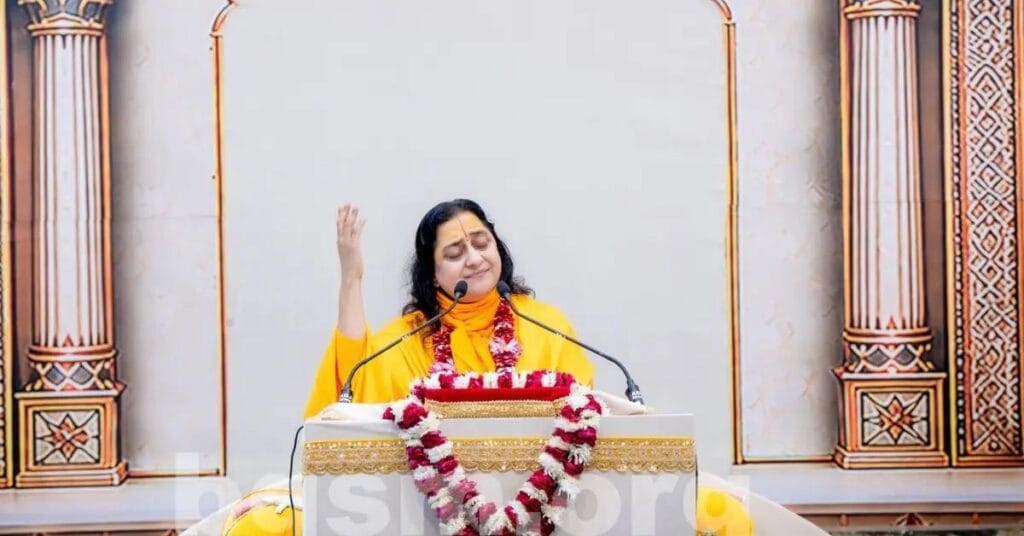
Who Is Raseshwari Devi Ji?
Raseshwari Devi Ji is one of India’s most respected contemporary spiritual teachers — a woman who gave up a promising academic career at the age of 22 to dedicate her entire life to spreading the ancient wisdom of the Upanishads, meditation, and Krishna Bhakti.
She is the founder and president of the Braj Gopika Seva Mission (BGSM), a spiritual and charitable organisation established in 1998 in Odisha. As of 2026, her mission has conducted over 300 spiritual programmes across 140 cities and 11 Indian states, and has established 21 meditation and spiritual practice centres, primarily in Odisha.
She is a devoted disciple of Jagadguru Shri Kripalu Ji Maharaj, from whom she absorbed the philosophy of Raganuga Bhakti — unconditional devotional love for Shri Krishna — and Vedantic non-duality. Her teachings centre on inner peace, self-discipline, emotional resilience, and practical spirituality relevant to modern life.
In 2026, her name surged across Indian social media and wellness communities after she announced two landmark projects on World Meditation Day 2026 (21st December): a massive 1,500-seat yoga and meditation hall in Odisha’s Tangi, Khurda district, and a mega meditation camp in Haridwar. These announcements, combined with her receiving the Odisha Seva Samman Award 2026, brought her into the national spotlight.
Early Life and Spiritual Calling
Raseshwari Devi Ji was born on January 12, 1968, in Bhilai, Chhattisgarh, into a deeply devout family where spiritual values were part of daily life. From a very young age, she showed an extraordinary inclination toward inner reflection, meditation, and devotion.
She pursued higher education in Mathematics and English Literature — a combination that reflects both her analytical discipline and her love of language and expression. By all indications, she was headed for an academic or perhaps an engineering career. But destiny had other plans.
At a young age, she attended a spiritual discourse by Jagadguru Shri Kripalu Ji Maharaj, one of India’s most revered spiritual masters of the 20th century. That encounter transformed her completely. She immersed herself in his teachings of Radha-Krishna devotion and Upanishadic philosophy.
On October 15, 1988 — at just 22 years of age — she took the vow of sannyas: renouncing material possessions, worldly ambitions, and personal relationships to become a full-time spiritual teacher. This lifelong commitment to brahmacharya (celibacy) and detachment from worldly bonds has defined every dimension of her public and personal life ever since.
Braj Gopika Seva Mission — Her Life’s Work
In 1998, Raseshwari Devi Ji formally established the Braj Gopika Seva Mission (BGSM) in Odisha. The Mission’s core mandate centres on five pillars:
- Sanatana Dharma — preserving and spreading India’s ancient spiritual heritage
- Meditation — making ancient practices accessible to every section of society
- Humanitarian Service — welfare activities benefiting communities across Odisha
- Upanishadic Wisdom — making India’s oldest scriptures meaningful in daily life
- Radha-Krishna Devotion — cultivating bhakti as a path to inner transformation
Key Milestones of BGSM
| Year | Milestone |
|---|---|
| 1988 | Raseshwari Devi Ji takes sannyas vow at age 22 |
| 1998 | Founds Braj Gopika Seva Mission in Odisha |
| 2007 | Launches Bal Sanskar Shivir — moral education for children |
| 2014 | Launches Yuva Utthan Shivir — youth empowerment programme |
| 2022 | Receives Global Peace Award |
| 2023 | Expands mission through digital platforms in coastal Odisha |
| 2025 | Meets President Droupadi Murmu at Rashtrapati Bhavan |
| 2026 | Receives Odisha Seva Samman Award; announces 1,500-seat meditation hall |
Her flagship youth programmes — Bal Sanskar Shivir and Yuva Utthan Shivir — have touched thousands of children and young people annually, promoting moral values, cultural awareness, and emotional resilience. She has also been honoured as a Spiritual Ambassador by the Youth Peace Ambassador Organisation under India’s Ministry of Youth Affairs.
In 2023, she extended her reach through digital platforms, allowing coastal and semi-urban communities across Odisha to access Upanishadic teachings and guided meditation sessions from wherever they are.
Odisha’s New 1,500-Seat Yoga and Meditation Hall
The most talked-about announcement from Raseshwari Devi Ji in 2026 is the construction of a massive yoga and meditation hall in Tangi, Khurda district, Odisha — located close to Bhubaneswar.
The centre is currently under development and is expected to accommodate more than 1,500 people simultaneously, making it one of the largest dedicated meditation spaces in eastern India.
What Will the Centre Offer?
This is not simply a hall — it is being designed as a complete spiritual wellness hub, planned to include:
- A 1,500-seat meditation and yoga hall for large group sessions
- Meditation retreats for individuals and groups seeking deep inner work
- Yoga education programmes rooted in traditional yogic science
- Community wellness activities promoting mental health and mindfulness
- Youth-focused spiritual camps continuing the BGSM tradition
- Workshops on integrating meditation into modern daily life
Raseshwari Devi Ji’s vision behind this centre reflects a deeply human concern: in a world increasingly burdened by stress, anxiety, and disconnection, she wants to offer people — especially young Indians and families — a physical sanctuary where ancient wisdom can be practised, lived, and shared.
The inauguration of this hall is being planned to coincide with World Meditation Day 2026 on 21st December, adding symbolic significance to what promises to be a landmark moment for India’s spiritual wellness landscape.
Week-Long Meditation Camp in Haridwar 2026
The second major announcement from Raseshwari Devi Ji and the Braj Gopika Seva Mission is a mega meditation camp in Haridwar, Uttarakhand, running from June 11 to June 17, 2026 — a full week of immersive spiritual engagement in one of India’s holiest cities.
Camp Highlights
- Duration: 7 days (11 June – 17 June 2026)
- Location: Haridwar, Uttarakhand
- Expected participants: Approximately 2,500 seekers
- Reach: Participants from 14 Indian states and international attendees
The camp is designed to be much more than a passive retreat. Participants will engage in:
- Guided meditation sessions led by experienced teachers
- Discourses on yogic philosophy and Upanishadic wisdom
- Practical wellness workshops connecting ancient techniques to modern stress management
- Interactive sessions on how to build a sustainable daily meditation practice
- Community satsang fostering connection among spiritual seekers from diverse backgrounds
Haridwar — where the sacred Ganga flows fresh from the mountains — provides an ideal backdrop for this kind of intensive inner work. The choice of location is itself a statement: spiritual practice is most powerful when rooted in a living tradition and a living landscape.
2026 Odisha Seva Samman — Award and Recognition
On February 23, 2026, Raseshwari Devi Ji received the prestigious Seva Samman Award at the Spiritual Conclave Odisha 2026, one of the most significant formal recognitions of her 35-year spiritual career.
The award was presented by Surama Padhy, the Hon’ble Speaker of the Odisha Legislative Assembly, in the presence of distinguished dignitaries from spiritual, political, and cultural spheres. The conclave was hosted by MBC TV and BS TV.
The Seva Samman Award specifically acknowledges her sustained commitment to making Upanishadic teachings accessible to all sections of society — not just the educated or the elite — through public discourses, meditation camps, and value-based social programmes.
Honours and Recognition Over the Years
- Spiritual Ambassador — Youth Peace Ambassador Organisation, Ministry of Youth Affairs, Government of India
- Global Peace Award 2022
- Seva Samman Award 2026 — Odisha Legislative Assembly
- Meeting with President Droupadi Murmu at Rashtrapati Bhavan (October 2025) on the occasion of her Sannyas Diwas
These honours reflect not just personal recognition but a broader acknowledgement of the role that grassroots spiritual education plays in India’s social fabric.
Upcoming Events and Outreach
Raseshwari Devi Ji and the Braj Gopika Seva Mission have several major initiatives planned for 2026 and beyond:
June 2026
- Mega Meditation Camp, Haridwar (11–17 June 2026)
- 2,500 participants from 14 states and international delegates
December 2026
- Inauguration of the 1,500-seat Yoga and Meditation Hall, Tangi, Odisha
- Coinciding with World Meditation Day 2026 (21st December)
Ongoing Digital Outreach
- Continued expansion of online satsangs, discourses, and guided meditation sessions
- Targeted reach into rural and semi-urban Odisha communities
- Youth programmes: Bal Sanskar Shivir and Yuva Utthan Shivir
For updates and registration, interested seekers can visit the official BGSM website or follow their digital platforms.
Why Raseshwari Devi Ji Is Trending in 2026
Several factors have converged to bring Raseshwari Devi Ji into national prominence in 2026:
- The scale of the Odisha meditation hall — 1,500 seats is a genuinely rare capacity for a dedicated meditation space in India
- World Meditation Day 2026 — her announcements coincided with growing global attention on mental health and mindfulness
- The Seva Samman Award — presented by a senior constitutional authority (the Odisha Assembly Speaker), this gave her significant mainstream visibility
- The Haridwar camp — 2,500 participants across 14 states and international attendees signals a reach that goes well beyond regional significance
- Three decades of quiet grassroots work — her story resonates because it is not manufactured; it is the product of real, sustained service over 35 years
In an era where wellness has become a trillion-dollar global industry, Raseshwari Devi Ji represents something increasingly rare: a teacher whose motivation is purely service, and whose methods are rooted in India’s oldest living spiritual traditions.
FAQ
1.Which is the largest meditation centre in India?
The Global Vipassana Pagoda near Gorai, Mumbai, houses the largest meditation dome hall in the world, with a capacity to seat approximately 8,000 Vipassana meditators simultaneously. It was inaugurated by then-President Pratibha Patil on 8 February 2009. The Dhamma Giri centre in Igatpuri, Maharashtra — founded by S.N. Goenka in 1976 — is the largest Vipassana residential meditation centre globally, with over 400 individual meditation cells. Raseshwari Devi Ji’s upcoming 1,500-seat hall in Odisha’s Tangi is set to become one of the largest dedicated meditation spaces in eastern India.
2.Which celebrities do Vipassana?
Vipassana meditation has attracted many well-known figures globally. Among Indians, Shilpa Shetty is a known practitioner of yoga and meditation. Internationally, celebrities and entrepreneurs including Steve Jobs, Yuval Noah Harari, and various Hollywood actors have spoken publicly about attending Vipassana retreats. The practice’s 10-day silent residential format — offered entirely free of cost at centres across India — has made it accessible far beyond celebrity circles.
3.What are the 7 types of meditation?
Meditation is a broad discipline with many traditions. The seven most widely practised types are:
- Mindfulness meditation — observing thoughts and sensations without judgment, rooted in Buddhist practice
- Vipassana meditation — insight meditation focused on observing impermanence of mind and body
- Transcendental Meditation (TM) — use of a personal mantra to transcend ordinary thinking
- Loving-kindness meditation (Metta) — cultivating compassion for oneself and others
- Yoga Nidra — guided body-scan meditation that induces deep relaxation bordering on sleep
- Rupadhyana meditation — the practice taught by Raseshwari Devi Ji, rooted in Sanatan Vedic traditions and devotional visualisation
- Zen meditation (Zazen) — seated meditation emphasising posture, breath, and koan practice from the Japanese Buddhist tradition
4.What are the three golden rules of meditation?
Across traditions, three principles appear consistently as the foundation of effective meditation practice:
- Consistency over intensity — meditating for 10–15 minutes daily builds more lasting benefit than occasional long sessions. The brain and nervous system respond to regularity.
- Non-judgement — observing whatever arises in the mind — thoughts, emotions, sensations — without labelling them as good or bad. This is the heart of mindfulness.
- Return without frustration — when the mind wanders (and it will), the practice is in gently bringing attention back. Every return is the practice, not a failure.
5.What are the 4 states of meditation?
Classical yogic and Vedantic traditions describe four progressively deeper states of meditative absorption:
- Dharana (Concentration) — sustained focus on a single object, breath, or mantra; the beginning of formal meditation practice
- Dhyana (Meditation) — uninterrupted flow of awareness toward the object; the mind becomes still and unified
- Samadhi (Absorption) — complete dissolution of the separation between the meditator and the object of meditation; a state of profound peace and clarity
- Turiya (The Fourth State) — described in the Mandukya Upanishad as the pure witness consciousness that underlies and pervades waking, dreaming, and deep sleep; the ultimate goal of Upanishadic meditation practice
6.What is 11 11 meditation?
The 11:11 meditation is a modern mindfulness practice — not rooted in any classical tradition — that has gained popularity through wellness communities and social media. It involves pausing at 11:11 AM or PM (a moment many people consider spiritually significant or a numerical “angel sign”) to practise a brief, intentional meditation. Typically, practitioners spend 1–5 minutes in silence, setting a positive intention, breathing consciously, or visualising a desired state of being. While it lacks the depth of classical meditation systems, it serves as a useful entry point for beginners who benefit from a structured daily reminder to pause and be present. For deeper practice, traditions like Rupadhyana, Vipassana, or Transcendental Meditation offer more complete frameworks.
Conclusion
Raseshwari Devi Ji represents a living example of what India’s spiritual tradition looks like when it moves from the personal to the public — when one individual’s inner transformation becomes the foundation for serving thousands. Her three-decade journey through Braj Gopika Seva Mission, her commitment to youth education, her receipt of the 2026 Odisha Seva Samman, and her landmark announcements for World Meditation Day 2026 — the 1,500-seat Odisha meditation hall and the Haridwar mega camp — all point to a teacher whose work is only growing in reach and significance.
In a world searching urgently for mental peace, emotional stability, and meaning, her message is simple, ancient, and profoundly needed: look inward, with discipline, with love, and without judgment.
Last updated: May 2026 | Category: Spirituality, Wellness, India | Keywords: Raseshwari Devi Ji, Braj Gopika Seva Mission, Odisha meditation hall, Haridwar meditation camp 2026, Seva Samman Award 2026, World Meditation Day 2026.