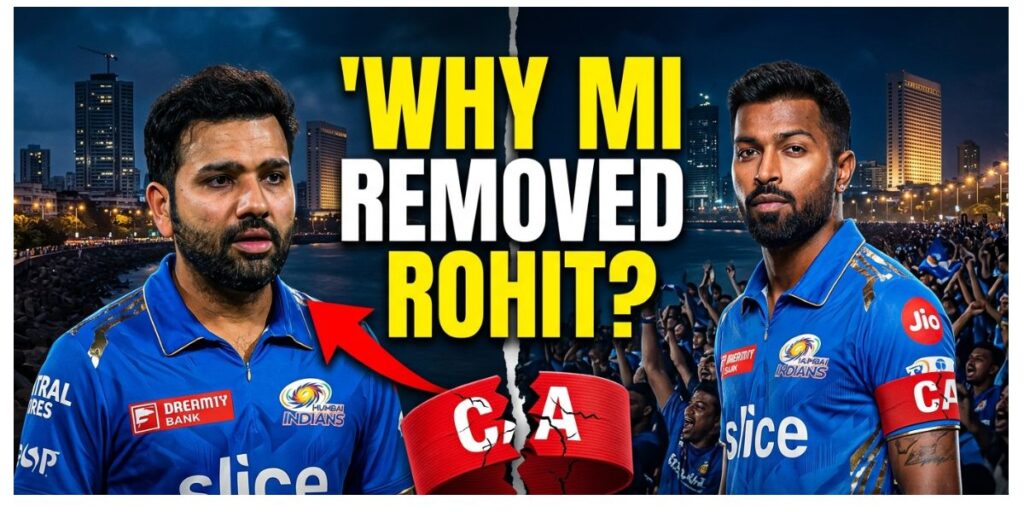
The announcement hit like a thunderbolt.In late 2023, ahead of the IPL 2024 auction and season,Mumbai Indians dropped a bombshell: Rohit Sharma was no longer the captain.Hardik Pandya, the explosive all-rounder brought back from Gujarat Titans in a blockbuster trade,was handed the leadership reins.or a franchise that Rohit had guided to five IPL titles and turned into a blue-and-gold dynasty, this wasn’t just a captaincy change – it felt like the end of an era.
Millions of fans across India and the world were stunned.Social media exploded with heartbreak,memes,and anger.But behind the headlines lay a calculated cold-eyed business decision rooted in modern T20 cricket’s brutal realities. Let’s unpack the full story, the real reasons, Rohit’s own words, and what this seismic shift means for Mumbai Indians heading into IPL 2026.
Rohit Sharma’s Untouchable Legacy: The Man Who Built MI’s Empire
Before diving into the “why,” it’s impossible to ignore what Rohit Sharma represented for Mumbai Indians.Joining the franchise in 2011 after a trade from Deccan Chargers, Rohit evolved from a middle-order talent into a T20 legend. As captain from 2013, he delivered five trophies – 2013, 2015, 2017, 2019, and 2020 – making MI the most successful team in IPL history alongside Chennai Super Kings.
Rohit wasn’t just winning;he was redefining leadership. Calm under pressure,a master of rotations, and a mentor who backed young guns like Jasprit Bumrah and Suryakumar Yadav he built a culture of excellence.Off the field, his swashbuckling batting – over 7,000 IPL runs,record sixes by an Indian – made him the face of the franchise.For loyal MI supporters,Rohit wasn’t a player. He was family.The “Hitman” symbolized consistency in a league defined by chaos.
The Moment Everything Changed: The 2024 Captaincy Bombshell
The transition was announced quietly but executed decisively before the 2024 season. Mumbai Indians’ management, led by coach Mark Boucher at the time, confirmed Hardik Pandya as the new skipper. Rohit was relieved of captaincy duties entirely – no vice-captain role either. It wasn’t a sudden sacking in the middle of a season; it was a pre-planned move during the off-season.
Hardik, who had captained Gujarat Titans to two IPL finals (winning one in their debut year), was seen as the perfect bridge. The move came alongside a massive trade that brought the all-rounder back to his “home” franchise for a reported ₹15 crore. But the decision ignited instant controversy. Fans felt betrayed. How could a five-time champion be sidelined so abruptly?
The Real Reasons Behind Rohit Sharma’s Captaincy Removal
This wasn’t one dramatic fight or ego clash. Multiple layers – strategic, cricketing, and long-term – drove the call. Here’s the unfiltered breakdown:
1.Long-Term Leadership Transition and Franchise Planning
MI’s management was thinking beyond one season.At 36 (turning 37 during IPL 2024),Rohit’s peak as a leader was shifting. Retention rules in IPL auctions made it risky to bank on an older star for the next cycle.Hardik, at 30 and injury-resilient under MI’s medical setup (proven with Bumrah), offered a younger,dynamic core. It was about building the “next dynasty” while Rohit could still deliver as a pure batter.
2. Relieving the Captaincy Burden to Unlock Rohit the Batter
Coach Mark Boucher was crystal clear: this was a “purely cricketing decision.” Rohit had shouldered captaincy for India across formats plus MI,leading to fatigue. Boucher explained they wanted Rohit to “enjoy his batting” without the extra mental load of team meetings, press conferences, and on-field decisions.Recent IPL seasons had shown dips in consistency – a common issue for senior players juggling dual leadership roles. Removing the armband was designed to free him up and extract his best as a player.
3. Performance and Form Concerns in Recent Seasons
Rohit’s IPL numbers had plateaued. While he remained explosive internationally,T20 franchise cricket demanded peak agility and output every match. MI saw value in experimenting with new combinations.The Impact Player rule (introduced in 2023) further allowed flexible roles – opening, mentoring from the dugout, or even strategic substitutions – without traditional captaincy pressure.
4. Fitness, Workload Management, and Tactical Flexibility
Modern T20 demands explosive fielding and multi-dimensional players.Reports highlighted minor niggles and the need to manage Rohit’s workload.Using him strategically (sometimes as impact sub) helped preserve his body for high-stakes games. It wasn’t disrespect – it was data-driven T20 science prioritizing a fitter, faster XI.
5. Post-2024 Reality Check and Franchise Reset
IPL 2024 turned into a nightmare for MI. Under new captain Hardik, the team won just four matches and finished at the bottom. Fan backlash, boos for Hardik, and internal adjustments amplified the struggles. The captaincy change became a lightning rod, but management stood firm: it was part of a broader rebuild. By 2025 and into 2026, the focus shifted to stability around players like Suryakumar Yadav and Bumrah.
Rohit Sharma’s Mature Response: Class in Adversity
Rohit handled it like a champion.In interviews, he simply said,“I was the captain,now I’m not. Things have changed.” No bitterness,no drama.He accepted the role of senior statesman and continued contributing – opening the batting, mentoring youngsters,and delivering in big moments. His maturity silenced critics and earned respect across the cricketing world.Even after leading India to T20 World Cup glory in 2024 and Champions Trophy success later, Rohit stayed committed to MI.
Is Rohit Still Crucial for Mumbai Indians? Absolutely.
Fast forward to IPL 2026: Rohit remains a cornerstone. As opener alongside the likes of Ryan Rickelton, he brings experience, big-hitting, and calm presence. Recent seasons showed flashes of his old magic, even if injuries (like the recent hamstring issue in 2026) test his availability. He’s not just a player – he’s a mentor shaping the next generation. MI’s management knows his value in pressure chases and playoffs. The “removal” was never about discarding him; it was about redefining his role for longevity.
Mumbai Indians’ Future in IPL 2026
MI is in full transition mode.Hardik Pandya’s captaincy has brought energy and all-round balance, but the 2024 scars linger. The franchise is betting on youth, depth, and data – classic MI style. Suryakumar Yadav as vice-captain, Bumrah’s leadership in bowling, and Rohit’s quiet guidance form a new core.
For fans, it’s bittersweet.The emotional cost was real – loyalty runs deep in cricket. But IPL is ruthless business Successful franchises like MI evolve or perish. The move highlights key lessons: captaincy isn’t a lifetime job, T20 cricket rewards adaptability,and legacy isn’t erased by one decision.
Will this new era deliver a sixth title? Early 2026 signs are mixed, with MI navigating tough starts and injuries. But Rohit’s presence ensures stability. If he stays fit and fires, the Hitman can still script comebacks.
Coclusion
Strategic Masterstroke or Emotional Gamble?
Looking back, Mumbai Indians’ decision was a smart,forward-thinking play – not personal, but professional.It combined future-proofing, player optimization, and tactical realism. Critics called it ruthless; supporters of the rebuild called it necessary. The truth lies somewhere in between.
From a fan’s lens, it stung.Rohit deserved a fairer farewell, perhaps a smoother handover.Yet his legacy as MI’s greatest captain remains untouched.The real story isn’t about removal – it’s about evolution. Cricket waits for no one,not even icons.
The chapter isn’t closed.Can Rohit silence doubters with one more explosive IPL run?Can Hardik lead MI back to glory? As IPL 2026 unfolds, one thing is certain: Rohit Sharma’s bond with Mumbai Indians will outlast any captaincy armband.The Hitman’s story – and MI’s dynasty – is still being written.