

writer by finbuzzindia/22/03/2026 11:49 AM Published
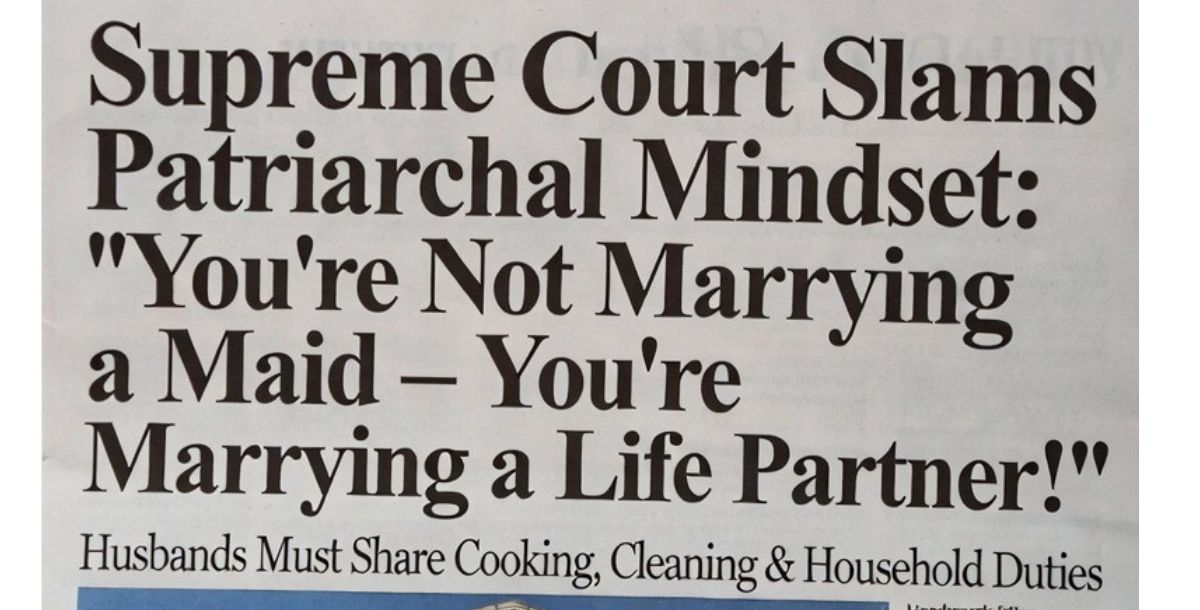
a powerful observation that is resonating across India’s social and legal landscape, the Supreme Court has declared that a wife cannot be treated as a domestic servant. Husbands must equally participate in household responsibilities such as cooking, cleaning, and washing. A wife’s refusal to perform these chores does not amount to “cruelty” under matrimonial law.
The remarks came during a divorce hearing on March 20, 2026, before a bench comprising Justices Vikram Nath and Sandeep Mehta. The apex court emphasised that modern marriages are partnerships between equals, not arrangements where one spouse shoulders all domestic burdens.
You’re not marrying a maid, you’re marrying a life partner,” Justice Sandeep Mehta remarked pointedly. Justice Vikram Nath added, “You have to contribute in this cooking, washing,etc.Today’s times are different. You have to equally participate in all these cooking, cleaning, washing, everything.
The ruling sends a clear message: outdated patriarchal expectations have no place in today’s egalitarian society.
The Case That Sparked the Landmark Observation
The dispute involves a couple married in 2017 who have an eight-year-old son. The husband, a government school teacher, approached the Supreme Court after lower courts differed on whether his wife’s alleged refusal to handle household duties constituted cruelty.
According to the husband’s petition, his wife’s behaviour changed drastically within a week of marriage. He accused her of mistreating him and his parents, using abusive and improper language, and refusing to cook for the family. He also claimed she failed to invite him and his family to their child’s cradle ceremony.
The wife, a lecturer and financially independent professional, strongly denied the allegations. She asserted that she had moved to her parents’ home during childbirth with her husband’s and in-laws’ full consent. She further accused the husband and his family of demanding cash and gold from her parents and pressuring her to surrender her salary.
The Family Court initially granted the husband a divorce on grounds of cruelty. However, the Karnataka High Court set aside that order, ruling in the wife’s favour. Aggrieved, the husband approached the Supreme Court.
Earlier, the apex court had referred the matter for mediation, but those efforts failed. The couple has been living separately since 2019. On Friday, the bench directed both parties to appear in person at the next hearing for further proceedings. Notably, the wife has not sought any alimony or maintenance.
What the Supreme Court Actually Said: A Shift in Legal Thinking
The Supreme Court made it crystal clear that a wife skipping household chores cannot be labelled as cruelty in contemporary India.Justice Nath observed that the High Court was right in its assessment and stressed that both partners must share domestic responsibilities. The court highlighted how societal norms have evolved dramatically. In earlier generations, women were often expected to manage the entire home while men focused solely on earning. But today, with both spouses working especially in educated, dual-income households this expectation is unrealistic and unfair.
The bench’s observation aligns with the constitutional guarantee of equality under Article 14 and the spirit of the Hindu Marriage Act, 1955. Section 13(1)(ia) defines cruelty as conduct that causes reasonable apprehension of harm to the spouse’s health or safety. However, the Supreme Court has repeatedly clarified that “cruelty” must be grave and not merely differences arising from normal marital adjustments.
By stating explicitly that times have changed,the court has reinforced that marriage is a partnership of equals. A wife’s professional career and personal choices cannot be weaponised against her in divorce proceedings.
Why This Judgment Matters for Modern Indian Marriages
India is witnessing a massive shift in gender roles. According to various studies, the number of working women has risen sharply, particularly in urban and semi-urban areas. Dual-income families are now the norm rather than the exception. Yet, household chores remain disproportionately shouldered by women a reality the Supreme Court has now directly challenged.
This observation is not just about one couple. It reflects a broader judicial recognition that matrimonial disputes must be viewed through the lens of equality, not outdated stereotypes. Legal experts see this as a progressive step that could influence thousands of pending divorce cases across family courts.
Advocates point out that similar progressive views have appeared in earlier Supreme Court judgments. For instance, the court has previously held that mental cruelty includes sustained harassment and that financial independence of women strengthens their position in matrimonial disputes. This latest remark builds on that foundation, explicitly extending equality into the kitchen and daily household management.
For working couples, the message is empowering. A lecturer-wife who also contributes financially should not be expected to single-handedly run the home. Conversely, a teacher-husband must step up and share the load whether it’s preparing meals or sharing childcare responsibilities.
Allegations and Counter-Allegations: The Human Story Behind the Headlines
The case reveals the painful realities many couples face. The husband claimed his wife’s refusal to cook and manage the home created an unbearable environment. The wife, on the other hand, painted a picture of financial exploitation and lack of support during a critical life event like childbirth.
The Supreme Court has carefully avoided passing final judgment on the specific facts at this stage. Instead, it has focused on the larger principle: domestic duties cannot be the sole basis for claiming cruelty when both partners are educated professionals.
The presence of an eight-year-old child adds another layer of complexity. Courts are increasingly mindful of the child’s welfare in such cases, often encouraging mediation or counselling before granting divorce. Here, since mediation failed, the personal appearance of both parties suggests the court wants to assess the situation directly.
Legal Experts Welcome the Progressive Stance
While the judgment is an oral observation and not a detailed written order yet, lawyers across the country have welcomed it. Senior advocates describe it as a “much-needed reality check” for Indian society.
One prominent family lawyer noted, “This observation will discourage frivolous cruelty allegations based solely on household chores. It promotes the idea that marriage is a 50-50 partnership in every sense—financial, emotional, and domestic.”
Women’s rights groups have also applauded the remarks, saying they reinforce the dignity of working women who often face double burdens.
What This Means for Couples Across India
The Supreme Court’s message is loud and clear: equality begins at home. Husbands can no longer expect wives to manage the entire household while pursuing their careers. Shared responsibilities are no longer optional they are essential for a healthy marriage.
For young couples entering matrimony, this serves as timely advice. Pre-marital counselling should now include discussions on dividing household chores fairly. Apps, shared calendars, and open communication about domestic duties are becoming as important as financial planning.
The judgment also highlights the importance of mutual respect. A wife who contributes financially and professionally deserves equal participation from her partner in running the home. Treating marriage as a master-servant relationship belongs to the past.
As the case proceeds to the next hearing with both parties appearing in person, the Supreme Court continues to guide Indian family law toward greater gender parity. In doing so, it upholds the constitutional vision of equality while acknowledging the realities of modern life.
This is not merely a divorce case it is a milestone in redefining what marriage means in 21st-century India. A wife is a life partner, not a maid. And the sooner society internalises this truth, the stronger our families will become.

Leave a Reply