

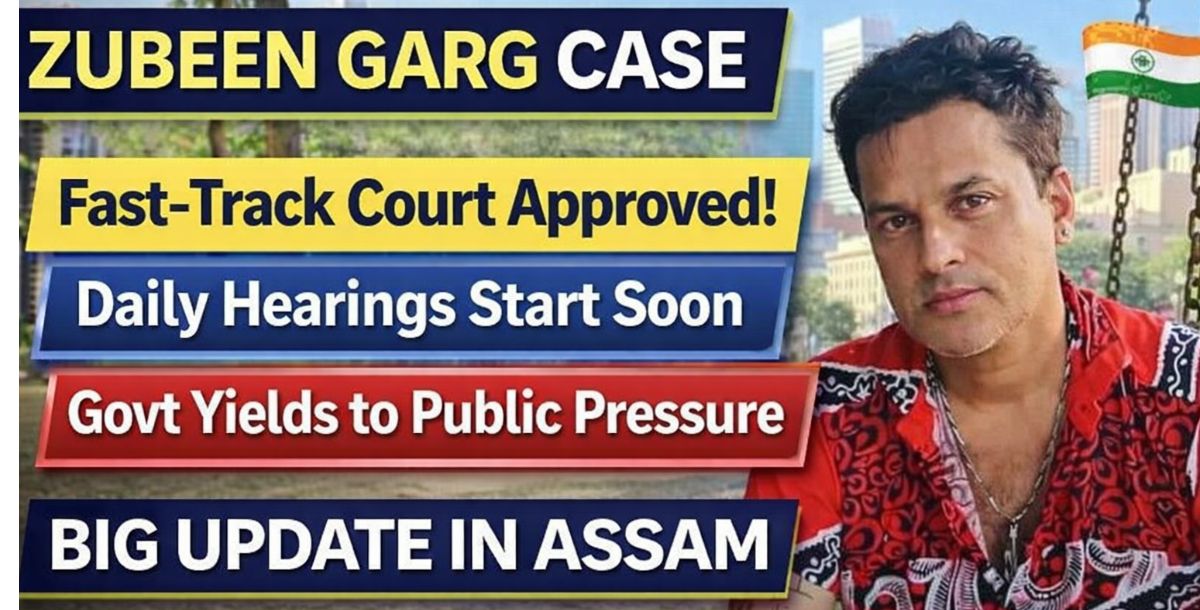
decisive move that has stirred conversations across Assam, the government has fast-tracked the high-profile Zubeen Garg case, aiming to restore public confidence in the justice system. At a time when delays in sensitive cases often spark frustration, this development signals urgency, accountability, and a clear message: justice must not wait.
Chief Minister Himanta Biswa Sarma confirmed that a dedicated fast-track court will now handle the Zubeen Garg case, ensuring daily hearings and a time-bound legal process. The decision comes after months of public scrutiny and growing demand for transparency.
Fast-Track Court Approved
The establishment of a fast-track court marks a turning point in the Zubeen Garg case. Unlike regular courts, these special courts are designed to avoid long adjournments and procedural delays.According to officials, the Gauhati High Court has approved the appointment of a special judge to preside over the matter.
Smt. Sharmila Bhuyan, currently serving as District Judge in Baksa, will oversee the proceedings.Daily hearings are expected to begin soon an uncommon but impactful step that could significantly shorten the trial timeline.
The Zubeen Garg case has evolved into more than just a legal proceeding it has become a test of how swiftly and fairly the system can respond under public pressure.
For months, concerns have been raised about delays. In high-profile cases, time is critical. Evidence can weaken, witnesses may become unavailable, and public trust can erode.By accelerating the Zubeen Garg case, authorities are attempting to address these risks head-on. The timing of this move reflects both legal necessity and public sentiment.
Government’s Message: Speed with Accountability
Chief Minister Himanta Biswa Sarma described the fast-track decision as a “significant step” toward timely justice. He also acknowledged the role of Chief Justice Ashutosh Kumar in facilitating the process.
The government’s stance is clear: the Zubeen Garg case must proceed without unnecessary delays while maintaining fairness.Fast-track courts are typically reserved for cases where urgency is critical. Their success depends on disciplined scheduling, efficient evidence handling, and uninterrupted hearings.
Public Reaction: Hope, Relief, and Caution
Across Assam, the response to the fast-tracking of the Zubeen Garg case has been largely positive.Many see this as a long-overdue step toward clarity and closure. Social discussions reflect a mix of hope and cautious optimism.
Legal experts, however, stress that while speed is important, due process cannot be compromised. A rushed trial without thorough examination could raise new concerns.The expectation now is not just a quick outcome but a fair and transparent on
Procedural preparations for the fast-track court are already underway. Once operational, hearings in the Zubeen Garg case are expected to take place on a day-to-day basis.This means
- Minimal adjournments
- Faster examination of witnesses
- Continuous legal arguments
executed efficiently, the Zubeen Garg case could reach a conclusion significantly sooner than under normal court timelines.
Challenges That Could Shape the Outcome
Despite the promise of speed, the Zubeen Garg case still faces practical challenges.Handling evidence quickly without errors will be critical. Coordinating witness appearances on tight schedules can also prove difficult.
Ensuring equal legal representation for all parties is another key factor. Fast-tracking should not tilt the balance of fairness.Authorities will need to strike a careful balance between urgency and accuracy.
The Zubeen Garg case is now being closely watched beyond its immediate legal implications. It represents a broader shift toward faster judicial processes in high-visibility cases.
successful, this approach could set a precedent for handling similar cases in the future—not just in Assam, but across India.It also raises an important question: can fast-track courts become a sustainable solution for reducing case backlogs?
FAQs
1.What is a fast-track court?
A fast-track court is a special judicial setup designed to hear cases quickly, often through daily hearings.
2.Who is presiding over the Zubeen Garg case?
District Judge Sharmila Bhuyan from Baksa has been appointed to lead the trial.
3.Why was the Zubeen Garg case fast-tracked?
To address public concerns about delays and ensure a timely, transparent legal process.
4.When will hearings begin?
Dates are expected to be announced soon after procedural arrangements are completed.
5.Will the fast-track court ensure a quick verdict?
It increases the likelihood, but the final timeline depends on evidence and legal proceedings.
Conclusion
The fast-tracking of the Zubeen Garg case marks a critical moment for Assam’s justice system. With daily hearings and a dedicated court, the path toward resolution appears clearer and faster.But the real test lies ahead.
As proceedings begin, the focus will not only be on speed but on fairness, transparency, and credibility. For many, the outcome of the Zubeen Garg case will shape how justice is perceived in the state for years to come.

Leave a Reply