Introduction
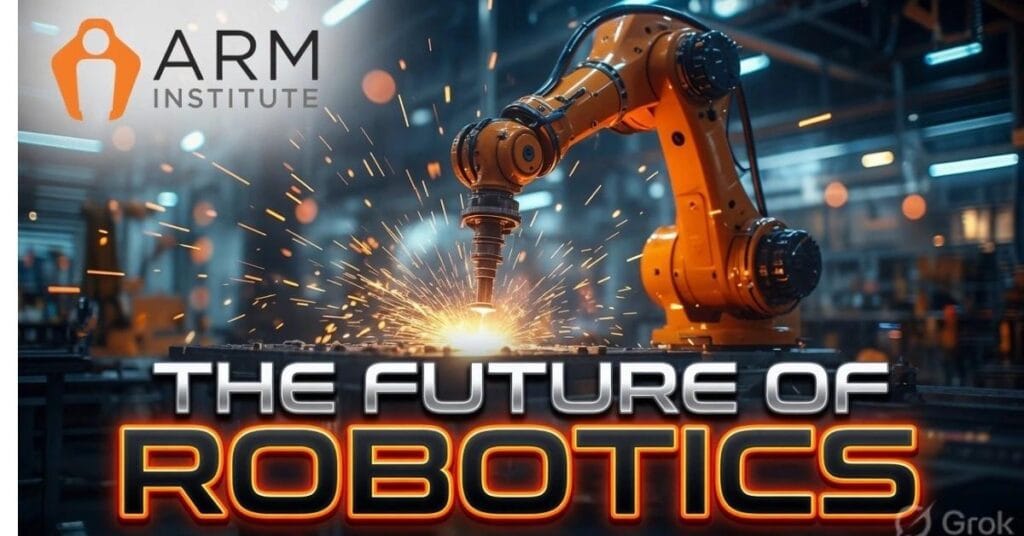
Why Advanced Robotics Manufacturing Is the Defining Industrial Shift of the 21st Century.The factory floor is no longer what it used to be. Gone are the days of repetitive manual labor with no room for precision at scale. Today, a new era of intelligent, sensor-driven machines is rewriting the rules of production — and at the center of that transformation stands the Advanced Robotics Manufacturing Institute, widely known as ARMI or the ARM Institute.
Whether you are a manufacturing executive evaluating your next capital investment, a robotics engineer searching for where cutting-edge research is being done, or a policy maker concerned with national industrial competitiveness, ARMI represents one of the most consequential programs in modern American manufacturing history.
This guide answers the most pressing questions surrounding ARMI and advanced robotics manufacturing: What exactly is the ARM Institute? Who are the Big 4 in robotics? Which country leads the world in robotics deployment? Which IIT offers AI and robotics? And is robotics still a viable career field — or is it fading out?
Let us go deep.
What Is the Advanced Robotics Manufacturing Institute (ARMI)?
The Advanced Robotics Manufacturing Institute, branded as the ARM Institute, is a public-private Manufacturing USA institute headquartered in Pittsburgh, Pennsylvania. It was established in 2017 through a landmark $253 million investment, with the U.S. Department of Defense contributing approximately $80 million and the remainder sourced from over 300 member organizations spanning industry, academia, and government.
ARM Institute’s core mission is clear: create and then deploy robotic technology that elevates American manufacturing competitiveness. It operates as a national hub — a connector between breakthrough robotics research emerging from universities and the real-world implementation demands of factories across the United States.
ARMI’s Strategic Pillars
ARMI does not simply fund research and move on. Its approach is built on three deeply integrated pillars:
1. Technology Development ARM funds collaborative R&D projects where industry partners, national labs, and universities co-develop robotic solutions. Projects range from unstructured environment manipulation to human-robot collaboration in defense manufacturing scenarios.
2. Workforce Education and Training ARMI runs a robust national workforce development program. This includes apprenticeship frameworks, community college curricula in robotics, and online learning pathways — ensuring that American workers are trained to operate alongside the robots being deployed.
3. Ecosystem Building By uniting over 300 member organizations — including Carnegie Mellon University, Boeing, Caterpillar, Siemens, and the Department of Defense — ARMI creates a collaborative national ecosystem rather than siloed innovation.
Who Are the Big 4 in Robotics?
When industry professionals refer to the Big 4 in robotics, they are talking about the four dominant global industrial robot manufacturers that command the majority of the world market. These companies collectively represent hundreds of billions of dollars in deployed robotics infrastructure across factories worldwide.
1. FANUC (Japan)
Founded in 1956, FANUC is arguably the most recognized industrial robotics company on the planet. With over 700,000 robots deployed globally, FANUC specializes in CNC systems, robotic arms, and factory automation systems. Its signature yellow robots are ubiquitous in automotive manufacturing. FANUC’s operating margin consistently exceeds 20%, making it one of the most profitable robotics companies in history.
2. KUKA (Germany / China)
KUKA was a German engineering crown jewel before being acquired by China’s Midea Group in 2016 for approximately $5 billion — a deal that sparked geopolitical conversation across Europe and the U.S. KUKA robots are widely used in automotive assembly, aerospace fabrication, and electronics manufacturing. The company is known for its orange robotic arms and highly sophisticated motion control software.
3. ABB (Switzerland)
ABB is a Swiss-Swedish multinational operating across power, automation, and robotics. Its robotics and discrete automation division is one of the most advanced in the world, producing collaborative robots (cobots), painting robots, and logistics automation systems. ABB has been aggressive in deploying AI-enabled robotics for flexible manufacturing environments.
4. Yaskawa (Japan)
Yaskawa’s Motoman brand of industrial robots has earned a reputation for reliability in welding, handling, and assembly operations. The company focuses heavily on motion control and has been expanding its cobot lineup to meet growing demand for human-robot collaboration in smaller manufacturing environments.
Together, FANUC, KUKA, ABB, and Yaskawa dominate over 60% of global industrial robot installations, making them the undisputed Big 4 in robotics manufacturing.
Which Country Is Number 1 in Robotics?
The answer depends slightly on how you define “number 1” — but by nearly every major metric, South Korea and Japan compete for the top position, with China rapidly ascending.
Robot Density: South Korea Leads
The International Federation of Robotics (IFR) measures robot density as the number of industrial robots per 10,000 manufacturing workers. By this metric, South Korea is the global leader, with approximately 1,000 robots per 10,000 workers — driven largely by its massive semiconductor and electronics manufacturing sectors (Samsung, LG, SK Hynix).
Total Robot Installations: China Dominates by Volume
China surpassed Japan and the United States in total robot installations and has been the world’s largest robot market by volume since 2013. In 2023, China installed over 290,000 industrial robots in a single year — more than the rest of the world combined. This is directly connected to China’s “Made in China 2025” industrial policy, which prioritized robotics as a strategic sector.
Technology Leadership: Japan and the USA
When it comes to robotics technology development, Japan remains the leader in industrial robot manufacturing through its Big 4 presence (FANUC, Yaskawa), while the United States leads in research-stage robotics, particularly in AI-integrated robotics, autonomous systems, and soft robotics — areas where institutions like ARMI, MIT’s CSAIL, Stanford’s AI Lab, and Carnegie Mellon’s Robotics Institute set the global standard.
So the full picture: South Korea leads in robot density, China leads in volume deployment, Japan leads in industrial robot manufacturing, and the United States leads in foundational robotics research and AI integration.
Which IIT Has AI and Robotics?
India’s prestigious Indian Institutes of Technology (IITs) have been aggressively expanding into artificial intelligence and robotics as these fields become central to modern engineering. Several IITs now offer dedicated programs, research centers, and interdisciplinary labs in AI and robotics.
IIT Bombay
IIT Bombay’s Systems and Control Engineering department has a long-standing robotics research program. The institute also operates an Interdisciplinary Programme in Systems and Control, covering robot kinematics, motion planning, and autonomous systems.
IIT Delhi
IIT Delhi houses a strong AI and robotics research group within its Electrical Engineering and Computer Science departments. Its Bharti School of Telecommunication and affiliated AI labs have produced significant work in computer vision, manipulation, and human-robot interaction.
IIT Kanpur
Often considered one of India’s top engineering schools for research depth, IIT Kanpur has active robotics labs focusing on drone systems, surgical robotics, and autonomous vehicles. The Department of Mechanical Engineering and Department of Electrical Engineering both have robotics-focused faculty.
IIT Madras
IIT Madras operates one of the most comprehensive AI research programs in India through its Robert Bosch Centre for Data Science and AI (RBCDSAI). It also has active robotics research in underwater vehicles, legged robots, and manufacturing automation.
IIT Hyderabad
One of the newer IITs, IIT Hyderabad has moved swiftly to establish itself in AI and robotics. It offers an M.Tech in AI and has active labs in machine learning, computer vision, and robot learning — areas directly relevant to advanced manufacturing robotics.
For students targeting AI and robotics at the postgraduate level, IIT Bombay, IIT Delhi, IIT Kanpur, and IIT Madras are consistently the top four destinations within India’s IIT system.
Robotics a Dead Field?
This is one of the most commonly searched questions about robotics — and the answer is an unambiguous no. Robotics is not a dead field. In fact, it is arguably one of the fastest-growing and most in-demand engineering disciplines on the planet right now.
The global robotics market was valued at approximately $62 billion in 2023 and is projected to reach $165 billion by 2030, growing at a compound annual growth rate (CAGR) of over 14%. This is not the trajectory of a dying field.
Why the Misconception Exists
The “robotics is dying” idea tends to surface in two contexts. First, some undergraduate robotics programs have been merged into broader engineering or AI programs — which creates the perception that robotics as a standalone discipline is shrinking. In reality, robotics content has expanded; it is simply being embedded across more disciplines.
Second, some early-career robotics professionals found that pure hardware robotics roles were harder to find than software engineering positions. This confused slower hiring in hardware startups with broader industry decline.
Where Robotics Jobs Are Booming
The hottest areas in robotics employment right now include:
- Collaborative robotics (cobots) for SME manufacturing
- Surgical and medical robotics (Da Vinci system, orthopedic robots)
- Warehouse and logistics automation (Amazon Robotics, Symbotic, Boston Dynamics)
- Agricultural robotics (autonomous harvesting, crop monitoring)
- Defense robotics (autonomous systems, EOD robots)
- Space robotics (NASA Artemis program, private sector lunar missions)
Institutions like ARMI exist precisely because the demand for advanced robotics talent in manufacturing has outpaced supply. The ARM Institute’s workforce development programs are actively creating pipelines to fill tens of thousands of projected robotics jobs in American manufacturing through 2030.
Robotics is not dead. It is compounding.
ARMI’s Role in Reshaping American Manufacturing Competitiveness
To understand why ARMI matters at a strategic level, consider the context it was born into. In 2017, the United States was running a massive manufacturing trade deficit. Automation adoption in U.S. factories lagged behind South Korea, Germany, and Japan. And China’s manufacturing capacity was growing at a pace that threatened American industrial leadership across dozens of sectors.
ARMI was created as a direct policy response.
By funding collaborative robotics projects that specifically target the challenges of American manufacturers — particularly small and medium-sized manufacturers (SMMs) who cannot afford the R&D budgets of Boeing or Caterpillar — ARMI democratizes access to advanced robotics technology.
Its project portfolio has included work in:
- Robotic welding in shipbuilding — addressing the severe skilled welder shortage in defense manufacturing
- Human-robot collaboration in aircraft assembly — enabling robots to work alongside humans in confined spaces with precision
- Flexible robotics for electronics assembly — reducing dependence on overseas production for circuit boards and components
- AI-driven quality inspection — using machine vision and deep learning to perform defect detection faster and more accurately than human inspectors
Each of these project areas directly addresses a real bottleneck in American manufacturing competitiveness.
The ARM Institute’s Membership Model: Why 300+ Organizations Are Invested
One of ARMI’s structural innovations is its consortium membership model. Rather than operating as a traditional government research lab or a single-company R&D center, ARM Institute brings together a diverse coalition of stakeholders who all benefit from shared investment in robotics technology.
Members include:
- Defense contractors (Boeing, Raytheon, Lockheed Martin) who need advanced robotics for complex assembly
- Automotive manufacturers who require flexible automation for EV production lines
- Universities and research institutes (Carnegie Mellon, Georgia Tech, Penn State) that contribute research capacity
- Robotics companies (both large OEMs and startups) that gain access to real manufacturing problems and deployment partners
- Community colleges that design robotics training curricula aligned with what industry actually needs
- Government agencies (DoD, DoE, NIST) that use ARMI as a policy implementation vehicle
This model creates a flywheel effect: more members mean more diverse problems to solve, which attracts more research talent, which produces better technology, which draws more industry members.
Advanced Robotics UW: The University of Washington Connection
The University of Washington (UW) in Seattle operates one of the most respected advanced robotics programs in the United States. UW’s Paul G. Allen School of Computer Science & Engineering and its Department of Mechanical Engineering jointly house robotics research that spans soft robotics, robot learning, surgical robotics, and human-robot interaction.
UW’s proximity to major technology companies — Microsoft, Amazon, Boeing — gives its robotics research a direct pipeline to real-world deployment. The university’s robotics faculty regularly collaborate with ARM Institute member organizations, and UW researchers have contributed to ARMI-funded project consortiums.
For graduate students specifically interested in robotics for manufacturing, UW’s combination of deep AI expertise and strong industry relationships makes it one of the most strategically positioned universities in the country.
Conclusion
The Advanced Robotics Manufacturing Institute is not simply a research program. It is a national infrastructure investment — an acknowledgment that the future of American manufacturing competitiveness runs directly through robotics technology.
As the Big 4 — FANUC, KUKA, ABB, and Yaskawa — continue to push the boundaries of what industrial robots can do, and as countries like South Korea, China, and Germany invest aggressively in automation density, the United States needs institutions like ARMI to ensure that American manufacturers — particularly the small and mid-sized ones — are not left behind.
Robotics is not a dead field. It is the field that will define which countries lead in manufacturing, defense, healthcare, agriculture, and logistics over the next 50 years. And ARMI, through its $253 million public-private investment, its 300+ member consortium, and its dual focus on technology development and workforce training, is one of the most important mechanisms the United States has built to win that race.
For engineers, executives, investors, and policy makers, understanding ARMI is not optional. It is foundational.
Frequently Asked Questions
What does ARMI stand for?
ARMI stands for Advanced Robotics for Manufacturing Institute. It is also known as the ARM Institute and is part of the Manufacturing USA network.
Where is the ARM Institute located?
The ARM Institute is headquartered in Pittsburgh, Pennsylvania — a city with deep manufacturing heritage and a world-class robotics research ecosystem anchored by Carnegie Mellon University.
Who funds ARMI?
ARMI was initially funded by a $253 million public-private investment, with approximately $80 million from the U.S. Department of Defense and the remainder from over 300 member organizations in industry and academia.
Who are the Big 4 in robotics?
The Big 4 in industrial robotics are FANUC (Japan), KUKA (Germany/China), ABB (Switzerland), and Yaskawa (Japan).
Which country is number 1 in robotics?
South Korea has the highest robot density per worker. China leads in total robot installations. Japan leads in industrial robot manufacturing. The United States leads in AI-integrated robotics research.
Is robotics a good career in 2025?
Yes. The global robotics market is projected to reach $165 billion by 2030. Demand for robotics engineers, particularly those with AI and machine learning expertise, significantly exceeds supply across manufacturing, healthcare, logistics, and defense sectors.

Sanjoy Gorh – Founder & Editor, FinBuzz India
Sanjoy Gorh is the founder and editor of FinBuzz India (finbuzzindia.com), an independent digital news platform delivering accurate, clear, and timely news to readers across Assam, Northeast India, and beyond.
Driven by a deep passion for digital journalism, Sanjoy launched FinBuzz India with a clear mission: to give grassroots stories the attention they deserve and bring local voices to a national stage. Hailing from Assam, he brings hands-on, on-ground experience in news reporting, content creation, and digital media management.
His editorial focus spans Assam local news, Northeast India developments, government schemes and exam updates, finance, technology and AI, business and startups, sports, and national affairs — always with an emphasis on making important topics simple, relevant, and accessible to everyday readers.
At the heart of his work lies an unwavering commitment to factual, unbiased reporting. Sanjoy believes journalism’s greatest responsibility is building reader trust, and every story published on FinBuzz India reflects that belief.
With a vision to grow FinBuzz India into the most trusted digital news voice of Northeast India, Sanjoy continues to raise the bar, one story at a time.
Connect with Sanjoy: [Twitter/Xhttps://x.com/amolgorh84648?s=11 ] | [https://www.linkedin.com/in/finbuzz-india-6b0a00307?utm_source=share_via&utm_content=profile&utm_medium=member_ios]