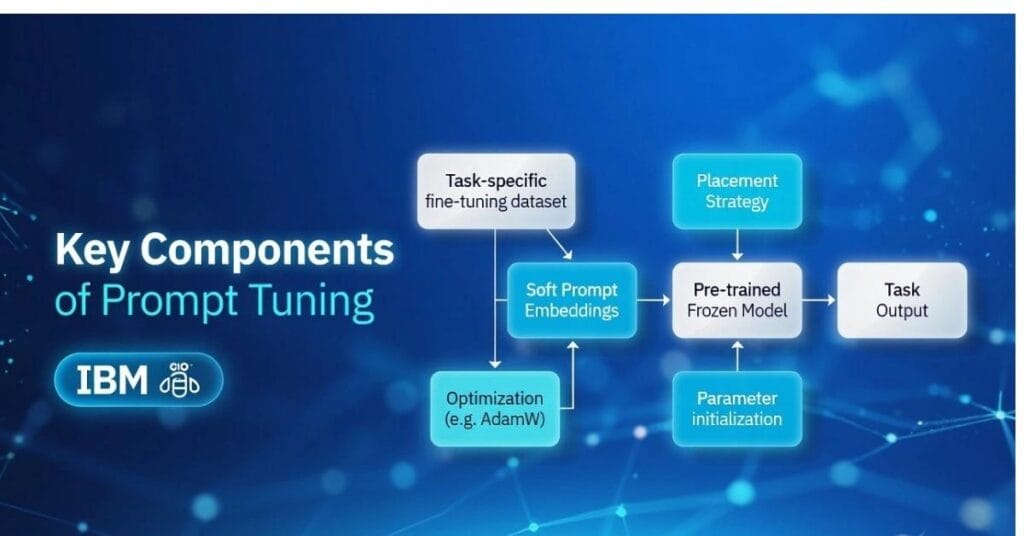
Prompt tuning is a parameter-efficient fine-tuning (PEFT) technique that trains a small set of learnable “soft prompt” tokens — continuous vectors prepended to a frozen language model’s input — to adapt that model to a specific downstream task, without ever modifying the model’s billions of underlying weights.
In plain English: instead of rewriting the entire brain of a large language model (LLM) to make it better at your task, prompt tuning teaches a tiny set of “magic words” (in embedding space, not human-readable text) that steer the frozen model in exactly the right direction.
This concept was formally introduced in Google’s landmark 2021 paper “The Power of Scale for Parameter-Efficient Prompt Tuning“ by Brian Lester, Rami Al-Rfou, and Noah Constant. The paper demonstrated that as LLMs scale beyond 10 billion parameters, prompt tuning matches the performance of full model fine-tuning — at a fraction of the cost.
Prompt Tuning vs Fine-Tuning: The Critical Difference
This is the most searched question in the space, and for good reason. Understanding it unlocks your entire AI optimization strategy.
| Dimension | Fine-Tuning | Prompt Tuning |
|---|---|---|
| Parameters modified | All (billions) | Only prompt tokens (~thousands) |
| Storage per task | Full model copy | Tiny prompt file (~KB) |
| Compute cost | Very high | Very low |
| Model weights | Updated | Frozen |
| Catastrophic forgetting risk | High | Near zero |
| Multi-task switching | Requires separate models | Swap prompt files |
| Performance at scale (>10B params) | Excellent | Matches fine-tuning |
The economic case is staggering. Fine-tuning GPT-scale models costs tens of thousands of dollars and weeks of compute. Prompt tuning for the same model and task can cost under $100 and complete in hours.
For enterprises managing dozens of task-specific models, prompt tuning means one shared backbone model with swappable prompt files — instead of dozens of fully fine-tuned model copies eating storage and serving infrastructure.
Prompt Tuning vs Prompt Engineering: Two Completely Different Things
Developers frequently confuse these. Here is the definitive distinction:
Prompt Engineering is a manual, human-written process. You craft human-readable text instructions — “You are a helpful assistant. Summarize the following document in three bullet points.” — and iterate until the model responds well. No training is involved. No gradients. No parameters updated. It is art and craft.
Prompt Tuning is a machine learning process. You initialize a set of continuous embedding vectors (soft tokens), run gradient descent against a labeled dataset, and let the optimizer discover the mathematically optimal token values. The resulting prompt is not human-readable — it lives in the model’s high-dimensional embedding space. It is science and engineering.
Prompt engineering is free but limited by human intuition and the model’s base behavior. Prompt tuning requires labeled data and a training run but achieves consistently higher and more reproducible task performance.
Soft Prompt Tuning: How It Works Under the Hood
Soft prompt tuning is the dominant form of prompt tuning. Here is the full technical mechanism:
Step 1: Initialization
You define a sequence of k learnable prompt tokens (typically k = 1 to 100). Each token is a vector of dimension equal to the model’s embedding size (e.g., 768 for BERT-base, 4096 for LLaMA-2-7B). These vectors are initialized either randomly, from vocabulary embeddings, or from a class-label description.
Step 2: Concatenation
At inference time, the soft prompt vectors are prepended to the embedded input sequence. The combined sequence is:
[prompt_token_1, prompt_token_2, ..., prompt_token_k, input_token_1, ..., input_token_n]The model’s transformer layers process this full sequence normally. From the model’s perspective, it simply received a longer input.
Step 3: Frozen Backbone, Gradient Flow to Prompt Only
During the training forward pass, the model generates predictions. Loss is computed against the labeled targets. During backpropagation, gradients are blocked from flowing into the frozen model weights — they only update the soft prompt token vectors. The model itself never changes.
Step 4: Convergence
After sufficient training steps, the soft prompt encodes — in high-dimensional geometry — the task-specific signal that directs the frozen model. The resulting prompt vectors are saved (kilobytes of data) and deployed.
Hard Prompt Tuning vs Soft Prompt Tuning
Hard prompt tuning works with discrete, human-readable tokens. Optimization methods include reinforcement learning, evolutionary search, or AutoPrompt’s gradient-guided token replacement. Hard prompts are interpretable but constrained — the search space is limited to the vocabulary, and gradients cannot be directly applied.
Soft prompt tuning operates in continuous embedding space, making it fully differentiable and optimizable with standard gradient descent. It achieves far better performance but produces prompts no human can read.
For regulated industries needing explainability, hard prompt tuning offers a middle ground. For pure performance, soft prompt tuning wins every time.
Visual Prompt Tuning (VPT): Extending the Paradigm to Vision
Visual prompt tuning, introduced in the 2022 paper “Visual Prompt Tuning” by Jia et al. from Cornell Tech, applies the soft prompt tuning concept to vision transformers (ViTs).
In VPT, learnable prompt tokens are prepended to the sequence of patch embeddings at one or more transformer layers. Two variants exist:
- VPT-Shallow: Prompts are only added to the first transformer layer’s input.
- VPT-Deep: Prompts are added to the input of every transformer layer, giving the model continuous task-specific guidance throughout its full depth.
VPT-Deep consistently outperforms VPT-Shallow and, on VTAB-1K benchmarks, surpasses full fine-tuning on 19 out of 24 tasks — while training fewer than 1% of the model’s parameters. This result was paradigm-shifting for the computer vision community and triggered a wave of follow-on research into efficient vision adaptation.
Visual prompt tuning is now widely used for adapting foundation vision models (CLIP, DINOv2, SAM) to specialized domains like medical imaging, satellite analysis, and industrial inspection — domains where labeled data is scarce and retraining massive models is impractical.
Instruction Tuning vs Prompt Tuning: Clarifying the Confusion
Instruction tuning is a form of supervised fine-tuning where the model is trained on a large, diverse set of instruction-following examples. It modifies the model weights. The goal is to make the model generally better at following instructions across all tasks.
Prompt tuning does not modify model weights. It trains a task-specific soft prompt for one target task or domain.
They are complementary: instruction-tuned models like Flan-T5 or GPT-4 are excellent base models for prompt tuning, because their instruction-following capability means soft prompts can more precisely direct behavior.
LoRA vs Prompt Tuning: When to Choose Which
LoRA (Low-Rank Adaptation) is another PEFT technique. It injects low-rank trainable weight matrices into the attention layers of the model. Unlike prompt tuning, LoRA does modify the model’s computation — it adds trainable parameters inside the model.
Choose Prompt Tuning when:
- You need maximum modularity (swap tasks by swapping prompt files, one backbone)
- You have very limited compute budget
- The base model is extremely large (>10B parameters)
- You need zero catastrophic forgetting risk
Choose LoRA when:
- The model is smaller (under 7B) where prompt tuning underperforms
- You need to adapt the model’s core representational capacity
- You want better low-data-regime performance
In practice, many production systems combine both: LoRA for a domain-adapted backbone, with prompt tuning for task-specific variants on top.
Multitask Prompt Tuning
Multitask prompt tuning (MPT) tackles a key challenge: when you have many tasks, training a separate prompt for each is wasteful. MPT learns a shared prompt representation that generalizes across related tasks, then applies a lightweight task-specific decomposition.
The 2023 paper “Multitask Prompt Tuning Enables Parameter-Efficient Transfer Learning” showed that MPT dramatically outperforms single-task prompt tuning, especially in low-resource settings — matching or exceeding full fine-tuning performance while training only 0.035% of model parameters.
This is critical for enterprise NLP platforms serving legal, financial, medical, and operational teams simultaneously from one model.
Auto Prompt Tuning: Letting Machines Write Their Own Prompts
Auto prompt tuning uses automated search or optimization to discover optimal prompt formulations without human design. Methods include:
- AutoPrompt: Gradient-guided search that iteratively replaces prompt tokens with vocabulary tokens that maximize task performance.
- RLPrompt: Uses reinforcement learning to search the discrete token space, training a policy network to select prompt tokens.
- OPRO (Optimization by PROmpting): Uses an LLM as the optimizer itself — meta-prompting the model to iteratively refine prompts based on observed performance on training examples.
OPRO, introduced by Google DeepMind in 2023, is particularly exciting. It requires no gradient access to the target model and can optimize prompts for black-box APIs like GPT-4. The optimizer model reads past prompt-performance pairs and proposes new prompts, closing the loop between evaluation and improvement.
GraphRAG Prompt Tuning: The Emerging Frontier
GraphRAG (Graph-based Retrieval-Augmented Generation) introduces graph structure as a retrieval mechanism, connecting entities, relationships, and communities across a knowledge corpus. Microsoft’s GraphRAG system, open-sourced in 2024, includes a built-in prompt tuning module that automatically generates domain-adapted prompts from your corpus.
The GraphRAG prompt tuning pipeline:
- Samples representative text chunks from your corpus
- Uses an LLM to extract entity/relation examples specific to your domain
- Generates customized prompts for entity extraction, summarization, and community detection tuned to your corpus’s vocabulary and structure
This replaces the generic prompts in base GraphRAG with prompts calibrated to your specific data — dramatically improving extraction quality for specialized domains like legal contracts, scientific literature, or financial filings.
Few-Shot Prompt Tuning: Maximum Leverage from Minimum Data
Standard prompt tuning requires a reasonably sized labeled dataset. Few-shot prompt tuning adapts the technique to the extremely low-data regime — sometimes as few as 16 to 32 examples per class.
Methods include:
- DART (Differentiable Prompt Making for Vision-Language Models): Adapts prompt tuning to work robustly with very few examples.
- PET (Pattern-Exploiting Training): Combines cloze-style hard prompts with soft prompt initialization to extract maximum signal from minimal labels.
- SoftPrompt with meta-learning initialization: Meta-trains prompt initialization across many tasks so new-task adaptation requires minimal data.
Few-shot prompt tuning is especially valuable in healthcare (rare conditions, limited annotated records), legal (jurisdiction-specific precedents), and industrial QA (proprietary defect taxonomies with few examples per defect type).
Prompt Tuning: A Step-by-Step Implementation Example
Here is a concrete implementation using Hugging Face PEFT for sentiment classification:
from transformers import AutoModelForSeq2SeqLM, AutoTokenizer
from peft import PromptTuningConfig, PromptTuningInit, get_peft_model, TaskType

# 1. Load frozen base model
model_name = "google/flan-t5-large"
model = AutoModelForSeq2SeqLM.from_pretrained(model_name)
tokenizer = AutoTokenizer.from_pretrained(model_name)

# 2. Configure soft prompt tuning
peft_config = PromptTuningConfig(
    task_type=TaskType.SEQ_2_SEQ_LM,
    prompt_tuning_init=PromptTuningInit.TEXT,
    num_virtual_tokens=20,          # 20 soft prompt tokens
    prompt_tuning_init_text="Classify the sentiment of this review as positive or negative:",
    tokenizer_name_or_path=model_name,
)

# 3. Wrap model — only prompt parameters are trainable
model = get_peft_model(model, peft_config)
model.print_trainable_parameters()
# Output: trainable params: 40,960 || all params: 783,195,136 || trainable%: 0.005

# 4. Train with standard Trainer — gradients only flow to prompt
# (standard Hugging Face Trainer loop)
The result: 0.005% of parameters trained. Inference is identical to the base model with the prompt prepended. Task switching is a file swap.
Key Takeaways: When to Use Prompt Tuning
Prompt tuning is the right choice when:
- You use large foundation models (7B+ parameters) as your backbone
- You need multi-task flexibility without maintaining multiple full model copies
- Your compute budget is constrained but your base model is already strong
- You need fast iteration — train a new prompt in hours, not weeks
- Catastrophic forgetting is unacceptable — your base model’s general capability must be preserved
It is not ideal when your base model is small (under 1B parameters), your task requires fundamental representational changes, or you have essentially unlimited compute and data.
Conclusion
Prompt tuning represents a fundamental shift in how we adapt large language models. It decouples the expensive process of training capable general models from the comparatively cheap process of specializing them — enabling an ecosystem where one powerful backbone model serves dozens of specialized applications, each steered by a tiny learned prompt.
From soft prompt tuning to visual prompt tuning, from few-shot adaptation to auto-optimized prompts for black-box APIs, the technique is versatile, efficient, and increasingly essential for any organization deploying AI at scale.
The research trajectory is clear: as foundation models grow larger and more capable, prompt tuning’s relative advantage over full fine-tuning increases. Investing in prompt tuning infrastructure today is not just a cost optimization — it is a strategic positioning for the economics of the next decade of AI deployment.

Sanjoy Gorh – Founder & Editor, FinBuzz India
Sanjoy Gorh is the founder and editor of FinBuzz India (finbuzzindia.com), an independent digital news platform delivering accurate, clear, and timely news to readers across Assam, Northeast India, and beyond.
Driven by a deep passion for digital journalism, Sanjoy launched FinBuzz India with a clear mission: to give grassroots stories the attention they deserve and bring local voices to a national stage. Hailing from Assam, he brings hands-on, on-ground experience in news reporting, content creation, and digital media management.
His editorial focus spans Assam local news, Northeast India developments, government schemes and exam updates, finance, technology and AI, business and startups, sports, and national affairs — always with an emphasis on making important topics simple, relevant, and accessible to everyday readers.
At the heart of his work lies an unwavering commitment to factual, unbiased reporting. Sanjoy believes journalism’s greatest responsibility is building reader trust, and every story published on FinBuzz India reflects that belief.
With a vision to grow FinBuzz India into the most trusted digital news voice of Northeast India, Sanjoy continues to raise the bar, one story at a time.
Connect with Sanjoy: [Twitter/Xhttps://x.com/amolgorh84648?s=11 ] | [https://www.linkedin.com/in/finbuzz-india-6b0a00307?utm_source=share_via&utm_content=profile&utm_medium=member_ios]