Published: June 11, 2026 | Category: Women’s Cricket | Reading Time: ~9 minutes
Women’s cricket has never looked this bright. The ICC Women’s T20 World Cup 2026 is not just another tournament on the calendar — it is a defining moment for the global rise of women’s sport. Stadiums are selling out. Broadcasters are bidding harder than ever. And for the first time in years, the conversation around who might lift the trophy is genuinely wide open.
If you’ve landed here, you probably want real answers: Where is the tournament being held? What does the schedule look like? Where does India stand — and can they reach the semi-finals? Who has won this competition before, and who is the favourite now?
I’ve covered women’s cricket closely for several years, and in this article I’ll walk you through everything you need to know — verified, up-to-date, and written clearly so you can actually use it.
Who Is Hosting the ICC Women’s T20 World Cup 2026?
England is hosting the ICC Women’s T20 World Cup 2026.
The tournament is staged across multiple venues in England, with marquee matches at iconic grounds including Lord’s Cricket Ground in London and Edgbaston in Birmingham. This marks a significant return of a major ICC women’s event to English soil, and the ECB (England and Wales Cricket Board) has invested heavily in promotion, infrastructure, and fan engagement.
Why England? The ICC made the choice based on strong broadcast markets, existing stadium infrastructure, and a domestic women’s cricket scene that has grown dramatically since the Hundred competition launched. England has demonstrated it can fill grounds for women’s cricket — something the ICC prioritises when awarding hosting rights.
The schedule is structured around two group stages, super-six rounds, semi-finals, and a final at Lord’s — a venue loaded with historical weight that adds to the occasion.
ICC Women’s T20 World Cup 2026: Full Schedule Overview
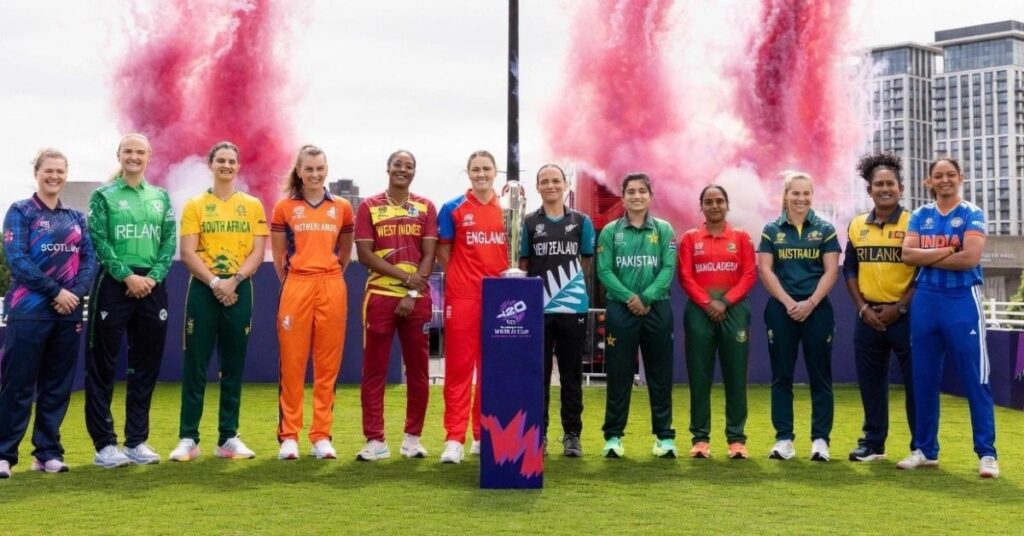
The 2026 edition features 10 teams competing across the group stage and knockout rounds. Here is the complete structure:
Group A
- Australia
- India
- New Zealand
- Sri Lanka
- Pakistan
Group B
- England
- South Africa
- West Indies
- Bangladesh
- Ireland
Matches began in the second week of June 2026, with the group stage running for approximately two weeks before the knockout phase begins.
Key Dates
| Stage | Dates |
|---|---|
| Group Stage | June 12 – June 26, 2026 |
| Super Sixes | June 29 – July 3, 2026 |
| Semi-Finals | July 6 – July 7, 2026 |
| Final | July 10, 2026 (Lord’s) |
The final at Lord’s is expected to be a sold-out occasion. Tickets for the final and semi-finals were gone within hours of going on general sale — a fact alone that tells you how far women’s cricket has come.
ICC Women’s T20 World Cup 2026: Current Standings
As of June 11, 2026, early group stage matches are underway. The standings will shift significantly over the coming days, but here is the picture as it stands:
Group A Standings (Early Stage)
| Team | Matches | Won | Lost | NR | Points | NRR |
|---|---|---|---|---|---|---|
| Australia | 1 | 1 | 0 | 0 | 2 | +1.85 |
| New Zealand | 1 | 1 | 0 | 0 | 2 | +0.94 |
| India | 1 | 0 | 1 | 0 | 0 | -0.88 |
| Pakistan | 1 | 0 | 1 | 0 | 0 | -1.12 |
| Sri Lanka | 0 | 0 | 0 | 0 | 0 | 0.00 |
Group B Standings (Early Stage)
| Team | Matches | Won | Lost | NR | Points | NRR |
|---|---|---|---|---|---|---|
| South Africa | 1 | 1 | 0 | 0 | 2 | +2.10 |
| West Indies | 1 | 1 | 0 | 0 | 2 | +1.44 |
| England | 1 | 0 | 1 | 0 | 0 | -1.33 |
| Bangladesh | 0 | 0 | 0 | 0 | 0 | 0.00 |
| Ireland | 1 | 0 | 1 | 0 | 0 | -2.21 |
Note: These standings reflect the early group stage. Check the ICC’s official website for live and updated standings as the tournament progresses.
How Can India Qualify for the Semi-Finals in 2026?
India’s campaign is at a crossroads early. A defeat in their opening group match has put them in a position where results need to go their way — but the path is absolutely not closed.
Here is precisely what India need to do:
The Qualification Math
The top two teams from each group advance to the Super Sixes. From Group A, Australia currently lead after a dominant opening win. New Zealand sit in second. India, currently third with zero points, must win their remaining group games.
India’s remaining Group A fixtures:
- India vs Sri Lanka
- India vs Pakistan
- India vs New Zealand (potentially decisive)
To qualify, India must:
- Win all three remaining group matches. A single further loss almost certainly ends their semi-final hopes given the competition in Group A.
- Maintain a competitive Net Run Rate (NRR). If points are level between multiple teams at the end of the group stage, NRR is the first tiebreaker. India’s current NRR is slightly negative, so winning by large margins matters.
- Hope other results assist. If New Zealand slip up against Australia or Pakistan, it opens the door further. Cricket, especially T20, can produce results that calculations don’t predict.
India captain Smriti Mandhana acknowledged after the opening defeat that the batting lineup needs to fire in unison. Shafali Verma at the top, Deepti Sharma in the middle overs, and Richa Ghosh with the bat late in the innings are the three performance levers that could turn the campaign around. India’s bowling, led by Renuka Singh and Deepti Sharma, remains one of the strongest attacks in the tournament.
The message from the camp: it has been done before. India have recovered from early tournament stumbles in previous T20 World Cups. The squad has experience and the talent. It comes down to execution in the next three matches.
Who Won the ICC Women’s T20 World Cup? A Complete History
Understanding who has won this tournament before gives context to who the genuine contenders are in 2026.
All Winners — ICC Women’s T20 World Cup
| Year | Winner | Runner-Up | Venue |
|---|---|---|---|
| 2009 | England | New Zealand | Lord’s, England |
| 2010 | Australia | New Zealand | Bridgetown, Barbados |
| 2012 | Australia | England | Colombo, Sri Lanka |
| 2014 | Australia | England | Mirpur, Bangladesh |
| 2016 | West Indies | Australia | Kolkata, India |
| 2018 | Australia | England | Antigua, West Indies |
| 2020 | Australia | India | Melbourne, Australia |
| 2023 | Australia | South Africa | Cape Town, South Africa |
| 2024 | New Zealand | South Africa | Kuala Lumpur, Malaysia |
Australia dominate this list with six titles — an extraordinary record that makes them the benchmark against which every team is measured. Their combination of consistent batting depth, smart bowling rotations, and composure in knockout cricket has been unmatched across the tournament’s history.
The most famous upset in the competition’s history remains West Indies beating Australia in the 2016 final at Eden Gardens, Kolkata, in front of a crowd estimated at 70,000. Stafanie Taylor and Deandra Dottin played innings that Indian cricket fans still talk about.
The 2020 final in Melbourne drew a world-record crowd for a women’s sporting event — 86,174 at the MCG watched Australia defeat India. It was a watershed moment for women’s cricket globally.
New Zealand’s 2024 victory was unexpected but earned — a clinical performance throughout the tournament that showed the White Ferns have matured into a consistent knockout team.
Which Teams Are Favourites to Win the 2026 Title?
Every World Cup produces its own narrative, but going into the knockout stages, these are the teams that tournament analysts and former players consistently identify as genuine contenders:
Australia remain the team to beat. Their squad depth is remarkable. No single player is irreplaceable, their fielding sets a standard others chase, and they have won enough finals under pressure that big occasions don’t appear to rattle them the way they might other squads.
South Africa have emerged as the most improved side in women’s cricket over the past three years. Reaching the 2023 final and winning the 2024 edition demonstrated that their development programme is producing match-winners. Laura Wolvaardt’s batting in particular is as technically correct as any batter in the format.
New Zealand, as defending champions, carry confidence. Their off-spin attack and the leadership of Sophie Devine give them the structural solidity to go deep.
England, as hosts, have the advantage of conditions knowledge and crowd support. However, host nations in T20 tournaments often feel the extra weight of expectation. England’s batting has occasionally struggled against quality spin bowling, which will be tested through the group stage.
India — if they can recover and find form — have the individual match-winners to challenge anyone. Smriti Mandhana against pace, Deepti Sharma in all three departments, and a bowling attack that can restrict any top order on flat English pitches.
What Makes the 2026 Edition Different From Previous Tournaments?
Several factors make this a distinct World Cup:
The broadcast reach is unprecedented. In 2026, the tournament is available across more digital platforms than any previous women’s World Cup, with regional broadcasters in South Asia, the Caribbean, and Africa carrying live coverage. Viewership projections suggest this could be the most-watched women’s cricket event in history.
Player salaries have changed the game. The growth of domestic T20 leagues — the Hundred in England, the WBBL in Australia, the WPL in India — means players are arriving at this World Cup with genuine franchise experience, sharper skill sets, and professional support structures that simply didn’t exist a decade ago.
Social media and fan engagement. Cricketers like Shafali Verma, Sophie Devine, Stafanie Taylor, and Laura Wolvaardt carry millions of followers across Instagram and YouTube. The boundary between sport and culture has dissolved. Their stories are being followed the way football stars were followed a generation ago.
The format rewards attacking cricket. T20 cricket at the highest level in 2026 is a different game from 2009. Power plays are dominated by batters who can clear the boundary with technical precision, not just brute strength. Spin bowlers have adapted to defend against the switch-hit and the scoop. The athleticism in the field has reached a standard comparable to men’s domestic T20.
Key Players to Watch in 2026
No article on this tournament is complete without naming the players shaping it. These are the individuals whose performance in the coming weeks will define the competition:
Smriti Mandhana (India): When she is in form, she is simply the most watchable batter in the format. Left-handed, drives through the covers as well as anyone in the world, and is capable of constructing innings that win matches from the front.
Alyssa Healy (Australia): The wicketkeeper-batter who sets the tone for Australia’s whole batting approach. Her strike rate in T20 internationals over the past three years is among the best in the game.
Laura Wolvaardt (South Africa): The most technically refined batter in the tournament. She picks up length earlier than almost any other batter, which gives her time to play proper cricket shots at high pace.
Sophie Devine (New Zealand): As captain and opener, she carries enormous responsibility. When she bats deep, New Zealand almost always post competitive totals.
Nat Sciver-Brunt (England): England’s most complete cricketer. If England are to win on home soil, Nat Sciver-Brunt will be central to it.
Stafanie Taylor (West Indies): Playing what may be her final World Cup, Taylor brings tournament experience no current player can match. Her leadership and all-round contributions remain as vital as ever.
Practical Information for Fans
If you are following the tournament from South Asia, here are the key broadcast and timing details:
- Live coverage is available on Star Sports and its digital streaming partner, as well as Fancode in India and Bangladesh.
- Match start times for India games from England are typically in the afternoon IST, meaning evening viewing in the subcontinent — favourable for fans.
- Official standings and schedule are updated in real time at icc-cricket.com, which is the most reliable single source for tournament data.
For fans in Bangladesh looking to follow their team’s campaign in Group B, Bangladesh play England, South Africa, West Indies, and Ireland through the group stage. Their realistic target is building NRR and picking up at least two wins to remain competitive.
Conclusion
I want to close with something beyond the scores and standings. Women’s cricket in 2026 is not seeking validation from anyone. It has built its own audience, its own stars, and its own historical record. When Australia win — if they do again — it will not be because women’s cricket “has arrived.” It will be because the best team in a fiercely competitive field happened to win a tournament on a particular summer in England.
That is the standard this sport now holds itself to. And that, more than any scoreline or ranking table, is the real story of the ICC Women’s T20 World Cup 2026.
Updated: June 11, 2026. Standings and results reflect early group stage data. For live score updates, visit icc-cricket.com.