
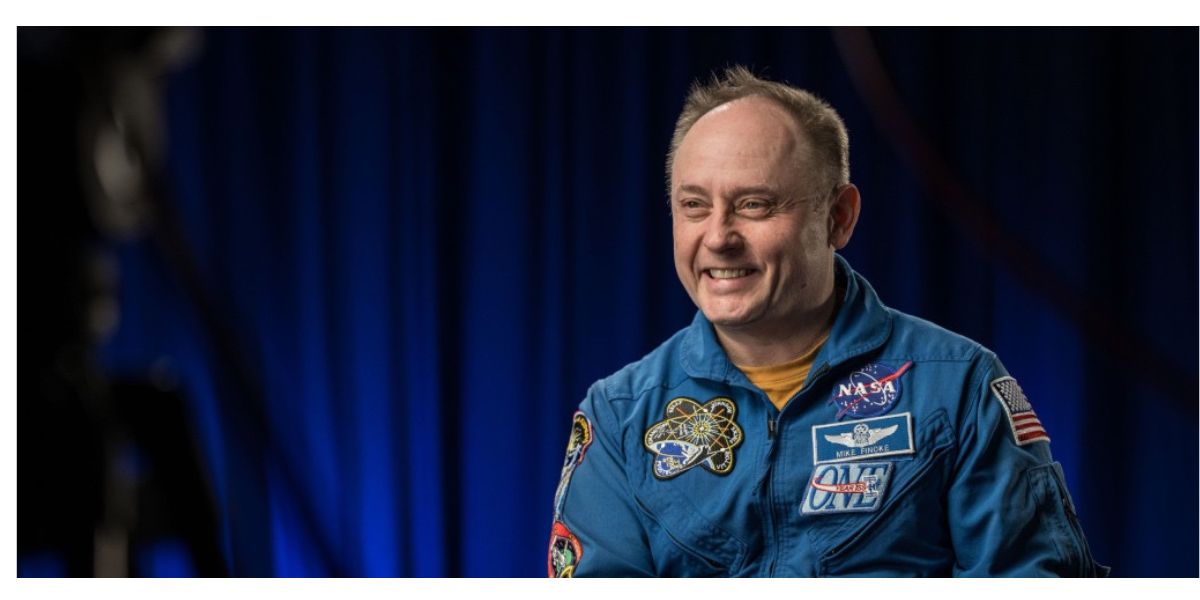
Imagine floating weightlessly 400 kilometers above Earth,the blue planet spinning below, while you sway to the rhythmic beats of Bihu the heartbeat of Assam.That’s exactly what NASA astronaut Mike Fincke did more than two decades ago,and in April 2026,during the joyous Rongali Bihu celebrations back home, that heartwarming video has exploded across social media once again.
The clip shows Fincke, a veteran of four spaceflights, grinning ear-to-ear as he performs traditional Bihu steps in microgravity. A vibrant red-and-white gamosa—the iconic Assamese scarf symbolizing respect and warmth—floats gracefully around his neck. No official NASA event, just a personal tribute from a man deeply connected to Assam. Yet this simple, joyful moment has become a global symbol of cultural pride, reminding us that traditions don’t stop at the atmosphere. 
Who Is Mike Fincke, Assam’s Beloved “Son-in-Law”?
Colonel Mike Fincke isn’t just any astronaut. With over 549 days in space across multiple missions, he’s one of NASA’s most experienced spacefarers.
Who Is Mike Fincke, Assam’s Beloved “Son-in-Law”?
Colonel Mike Fincke isn’t just any astronaut.With over 549 days in space across multiple missions, he’s one of NASA’s most experienced spacefarers.But to millions in Assam and the Assamese diaspora, he’s family—fondly called “Assam’s son-in-law.”
Fincke is married to Renita Saikia Fincke,an Assamese-American engineer who also worked at NASA. Their love story bridges continents and cultures.Renita’s roots run deep in Assam, and Mike has embraced them wholeheartedly.During his 2004 Expedition 9 mission aboard the International Space Station (ISS),he surprised the world by dancing Bihu to honor his wife’s heritage.He even carried a gamosa into orbit as a personal token.
Fast-forward to 2025: Fincke returned to space on NASA’s SpaceX Crew-11 mission.Reports suggest he once again packed a gamosa, quietly continuing the tradition. Though a medical issue led to an early return in early 2026, his past gesture continues to inspire.The 2004 video resurfaced amid Rongali Bihu 2026 festivities, spreading like wildfire on platforms like Instagram, Facebook, and YouTube.
What Makes Rongali Bihu So Special?
Rongali Bihu, also known as Bohag Bihu, marks the Assamese New Year and the arrival of spring. Celebrated in mid-April, it’s a festival of renewal, harvest, and unbridled joy. Families come together for Bihu dances—energetic, synchronized steps set to folk songs praising nature, love, and community. Women in colorful mekhela chadors and men in dhoti-kurta with gamosas perform under open skies, accompanied by dhol, pepa (buffalo horn), and gogona (bamboo instrument).
It’s more than a festival—it’s Assam’s soul. The gamosa, a simple yet sacred cotton cloth with red borders, is exchanged as a token of love and respect.Homes are cleaned, traditional sweets like pitha are prepared, and the air fills with the scent of bamboo shoots and mustard fields.For the Assamese community worldwide,seeing their culture celebrated 400 km up in space feels like a personal victory.
The Magic of Bihu in Zero Gravity
Picture this: Inside the ISS’s Harmony module, Fincke pushes off a wall and floats freely. As Bihu music plays in the background, he mimics the classic steps—arms swinging, feet tapping, body twisting—with effortless grace. In zero gravity, every move becomes a slow-motion ballet. The gamosa drifts like a flag of Assam in the void
Astronauts often face isolation, but cultural rituals keep them grounded—literally and emotionally. Fincke’s dance wasn’t scripted; it was spontaneous love for his wife’s culture. He later shared how carrying personal items from home helps combat the psychological challenges of long-duration spaceflight.
Life on the ISS is a blend of science and humanity. Crews from 15+ nations live in harmony, sharing meals, experiments, and yes—festivals. From Diwali lights to Christmas trees, space has hosted countless Earth traditions. Bihu’s inclusion feels especially poetic: a harvest festival thriving in a place with no soil, only stars.
Why This Viral Moment Resonates So Deeply in 2026
Social media has turned this 22-year-old clip into a 2026 phenomenon. During Rongali Bihu, when Assam pulses with music, dance, and mela (fairs), users flooded timelines with pride: “Bihu in space—Assam’s son-in-law making us proud!” Hashtags like #BihuInSpace, #AssamesePride, and #RongaliBihu2026 trended globally.
For the Assamese diaspora in the US, UK, and beyond, it’s validation. Regional cultures often fade in the global noise, but this proves heritage travels far. It also humanizes space exploration. NASA missions aren’t just about rockets—they’re about people carrying stories from home.
Experts note astronauts like Fincke promote unity. “Space belongs to
Experts note astronauts like Fincke promote unity. “Space belongs to all humanity,” says one cultural anthropologist. This gesture shows diversity strengthens discovery.
Culture, Science, and Connection
This isn’t isolated. Astronauts have celebrated Holi with colored powders (carefully contained), Eid prayers facing Mecca, and even Lunar New Year dumplings. These moments remind us: while science pushes boundaries, culture keeps us human.
For Assam, a state rich in tea gardens, wildlife (one-horned rhinos!), and vibrant traditions, this spotlight boosts tourism and global awareness. Youngsters in Guwahati or rural villages now dream bigger—maybe one day an Assamese astronaut will dance Bihu on the Moon.
Technically, the ISS orbits at 28,000 km/h, experiencing 16 sunrises daily. Microgravity lets dancers “float” through steps impossible on Earth. Fincke’s video proves joy has no gravity.
Fun Facts About Bihu and Space Celebrations
- Bihu’s ancient roots: Dates back over 2,000 years, tied to agrarian cycles.
- Gamosa symbolism: The red borders represent energy; white purity.
- ISS cultural tokens: Astronauts bring flags, photos, even soil from hometowns (within limits).
- Fincke’s record: He’s performed spacewalks, commanded the ISS, and holds the U.S. record for most time in space at one point.
FAQs:
1.Is this a new 2026 video?
No—it’s the beloved 2004 clip from Expedition 9, resurfacing during Rongali Bihu 2026. Fincke did carry a gamosa on his recent mission, but the dance footage is archival. 
2.Did NASA officially celebrate Bihu?
Not formally. It was Fincke’s personal gesture, typical of how astronauts honor family and heritage informally.
3.Who is Renita Saikia Fincke?
An accomplished engineer with Assamese roots. She and Mike have two children with Assamese-inspired names, strengthening the cultural bridge.
4.Can astronauts dance freely in space?
Yes! Zero gravity makes movement fluid and fun, though they must stay safe and coordinated with mission schedules.
5.How has the Assamese community reacted?
With overwhelming pride. From Guwahati to global forums, it’s hailed as a “historic moment” blending tradition and innovation.
A Proud Milestone for Assam and Humanity
As Rongali Bihu 2026 lights up Assam with bonfires, songs, and dances, Mike Fincke’s zero-gravity Bihu reminds us: culture knows no borders. Whether on paddy fields or orbiting Earth, the spirit of joy, community, and heritage endures.In an era of division, this viral gem unites us. It shows space exploration isn’t cold science—it’s warm, human, and wonderfully diverse. For every Assamese heart beating faster at the sight of that floating gamosa, it’s proof that traditions can soar higher than rockets.
Next time you see Bihu dancers twirling on Earth, remember: somewhere up there, an astronaut once danced right alongside them in spirit. Joi Aai Axom—long live Assam, and long live the human spirit that reaches for the stars while staying rooted in home.