
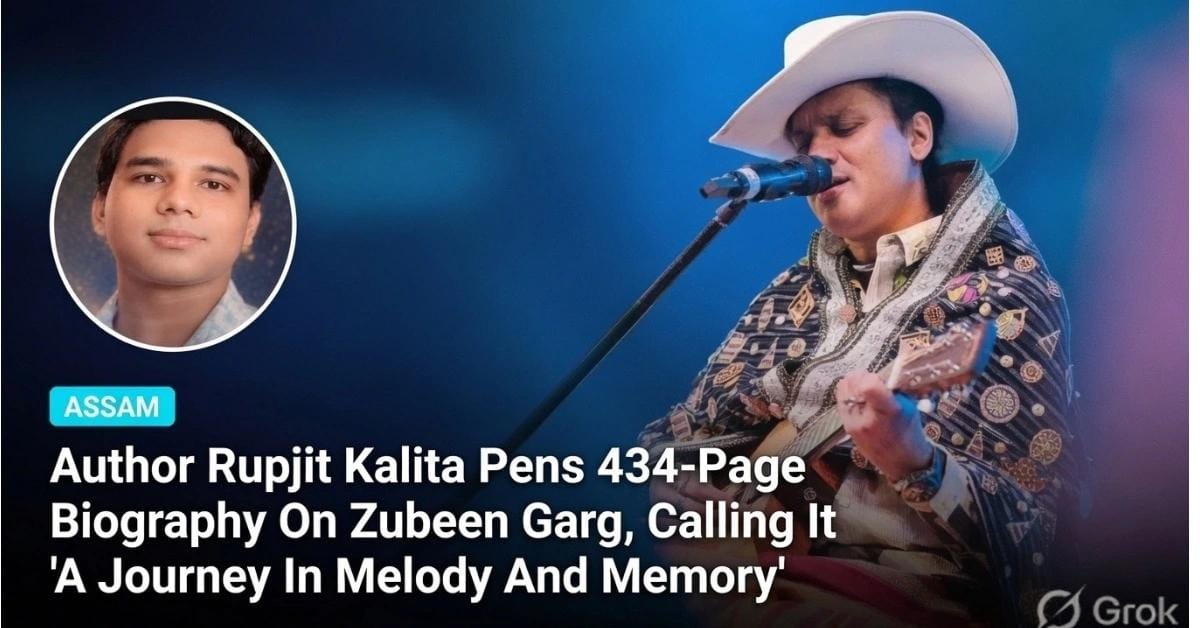
The title alone signals that this will not be a conventional biography. Zubeen Garg: Humming Chrysanthemum in Moonlit Eternity is rich with poetic intent from its very name — a chrysanthemum humming in moonlight suggests something quietly beautiful, persistent, and eternally blooming. That is precisely how Rupjit Kalita has approached his subject: not as a celebrity profile, but as a meditation on music, memory, and meaning.
Across 434 pages, Kalita takes readers on a detailed journey through Zubeen Garg’s artistic evolution — from his early roots in Assam’s folk traditions and Bihu music to his meteoric rise as a playback singer, composer, and cultural ambassador for the entire Northeast. The biography weaves personal reflections, cultural insights, and philosophical observations into a narrative that is as much about Assam as it is about one man.
Book at a Glance
- TitleZubeen Garg: Humming Chrysanthemum in Moonlit Eternity
- AuthorRupjit Kalita
- Pages434
- GenreBiography / Cultural Literature
- SubjectZubeen Garg — Singer, Composer, Cultural Icon
- Published2026, Dibrugarh, Assam
- LanguageAssamese / English
- AudienceMusic lovers, literature readers, Assam culture enthusiasts
What makes this biography particularly significant is its refusal to reduce Zubeen Garg to a list of albums and awards. Kalita is interested in the emotional and social impact of Garg’s work — how a single Bihu song can carry a homesick student through a night far from home, or how a folk melody can stitch together communities fractured by time and distance. This is the real story the author sets out to tell.
Who Is Rupjit Kalita? The Author Behind the Biography
Rupjit Kalita is not a newcomer to the Assamese literary scene, though his recognition has grown significantly in recent years. Known for his symbolic storytelling and a literary style that blends imagination with philosophical depth, Kalita has carved a distinct voice in contemporary Assamese writing.
His previous works include Visions and Verses: A Fusion of Imagination, Fiction, and Poetry and Elysian Sights and Sonnets — both of which revealed a writer drawn to the intersection of art and emotion, of the tangible world and the interior life. Those who have followed his writing say he brings to prose what Zubeen Garg brings to music: a quality of feeling that transcends the medium.
“A journey in melody and memory — that is how I would describe this book. Zubeen Garg’s life is not just the story of a singer. It is the story of a people, a land, and a language that refuses to be silent.”— Rupjit Kalita, Author
This deep alignment between author and subject is part of what makes the biography so compelling. Kalita does not approach Zubeen Garg from the outside, as a journalist cataloguing facts. He approaches him the way a fellow artist might — with reverence, curiosity, and the desire to understand what lies behind the music.
Zubeen Garg: Why This Moment Demands a Biography
Zubeen Garg is one of those rare artists whose cultural footprint far exceeds what any chart or streaming number can measure. Born in Assam, his musical journey spans decades, encompassing Bihu folk songs, Bollywood playback singing, Assamese film compositions, and social anthems that gave voice to Northeast India at moments when that voice was urgently needed.
He has sung in languages beyond Assamese — including Hindi, Bodo, Karbi, and Bengali — becoming a living bridge between the many communities that make up the Northeast. His concerts are not just performances; they are communal gatherings. His songs play at funerals and festivals alike, carrying the kind of emotional weight that belongs to the great folk traditions of the world.
Why Zubeen Garg Matters: With a career spanning over three decades, Zubeen Garg has released more than 200 albums and sung in over 10 languages. He is widely regarded as the cultural ambassador of Assam and the larger Northeast region, with a fanbase that extends from the Brahmaputra valley to Assamese communities living across India and abroad.
Yet, despite his cultural stature, no comprehensive biographical account of Zubeen Garg’s life and artistry had been published before this. Kalita’s book fills that gap — and does so with the literary seriousness the subject deserves.
What Separates This Book from Ordinary Music Writing
One of the most important qualities of any successful biography is the sense that the author has truly lived with the subject — not merely researched him. From what Kalita has shared about his approach, it is clear that this book was written from a place of genuine emotional engagement, not detached academic observation.
Kalita’s previous works demonstrate a writer who thinks deeply about art’s relationship with the human condition. He does not write about music the way a music critic might — cataloguing influences and analysing chord progressions. He writes about what music does to people. What it heals. What it remembers. What it refuses to let go of.
This is the sensibility he brings to Humming Chrysanthemum in Moonlit Eternity. The result, by all indications, is a biography that reads as much as a literary work as a cultural document — something that will be valuable both for those who know Zubeen Garg’s every song and for those who are encountering his story for the first time.
A Significant Contribution to Assamese and Northeast Indian Literature
The publication of this biography arrives at a moment when regional literature and regional cultural heritage are receiving increased national and international attention. Across India, readers and scholars are increasingly recognising that the stories most worth telling are not always the ones centred in metropolitan India — and that Northeast India, with its extraordinary diversity of language, tradition, and artistic expression, has produced cultural figures whose lives deserve full and serious literary treatment.
Rupjit Kalita’s biography of Zubeen Garg is exactly that kind of treatment. At 434 pages, it signals an ambition that goes beyond mere documentation. It signals a conviction that Zubeen Garg’s life and work are worthy of the same depth of literary attention that major biographies in any language might afford their subjects.
Why This Book Matters for Northeast India
- Cultural RecordFirst comprehensive biography of Zubeen Garg in book form
- Literary AchievementAdds to the growing canon of Northeast Indian cultural literature
- Regional PrideCelebrates an Assamese icon through an Assamese author’s lens
- Wider ReachExpected to attract readers across India and the global Assamese diaspora
- Academic ValueA research resource for students of Assamese music and culture
For Assam’s literary community, the book is a landmark. For music lovers, it is an invitation to listen to Zubeen Garg’s songs differently — with a richer understanding of the life and world from which they came. For anyone who has ever felt moved by a melody and wondered what lay behind it, this biography offers what few books can: the full human story.
The Legacy of Zubeen Garg Through Kalita’s Lens
What will readers take away from Zubeen Garg: Humming Chrysanthemum in Moonlit Eternity? Perhaps most importantly, they will take away the sense that great art is never created in a vacuum. Zubeen Garg’s music did not emerge from nowhere. It emerged from a specific land, a specific people, and a specific set of experiences that shaped not only what he sang but why he sang it.
Rupjit Kalita understands this. And in understanding it, he has written not just a biography of a singer, but a love letter to Assam — its rivers and plains, its festivals and sorrows, its extraordinary capacity to turn ordinary human experience into something that sings.
As Assamese literature continues to find wider audiences and as interest in Northeast India’s cultural heritage grows across the country and beyond, this biography stands as a reminder of what regional literature, at its best, can do: it can make the world feel the weight and wonder of a place it had perhaps never fully imagined before.
The chrysanthemum is humming still. And thanks to Rupjit Kalita, we now know the full story of the voice behind the melody.