
Writer by finbuzzindia 12.05.2026 Time 8.30 AM Published
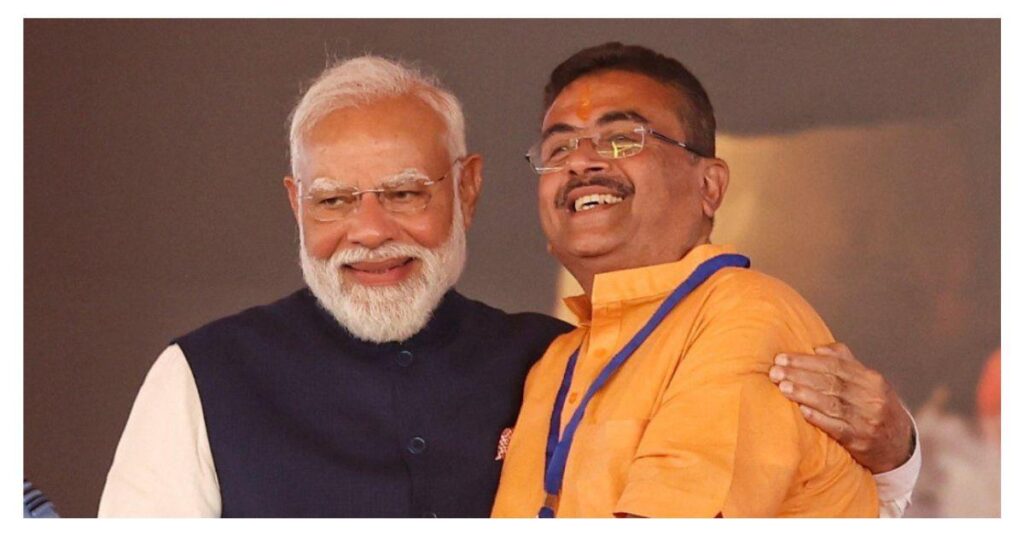
Chief Minister Suvendu Adhikari First West Bengal Cabinet Decisions 2026.the streets of Kolkata; they have become a roar within the halls of Nabanna. On May 11, 2026, West Bengal entered a new era. Following a high-stakes election that captured the nation’s attention, the newly formed Cabinet held its first session. This wasn’t merely a meeting of bureaucrats it was a promise kept to millions of hopeful hearts. Within a single afternoon, six landmark decisions were signed, from regional isolation to national integration. From healthcare for the poorest to the security of our national borders, these policies are designed to breathe new life into the “Sonar Bangla” dream.
The Architects of Reform
The faces leading this transformation are a strategic mix of seasoned veterans and visionary reformers. Chief Minister Suvendu Adhikari led the session, flanked by key Cabinet members including Dilip Ghosh, Agnimitra Paul, and Nisith Pramanik. These leaders represent a new administrative philosophy one that seeks to bridge the long-standing gap between the State and the Central Government. By appointing individuals with deep grassroots connections to portfolios like Rural Development and Women’s Welfare, the administration is signaling that governance will now happen on the ground, not just behind closed doors. This leadership team is focused on dismantling “party-first” politics in favor of “people-first” service.
The 6 Landmark Mandates
The heart of this legislative burst are six transformative actions. First, the adoption of Ayushman Bharat, providing ₹5 lakh health cover to every needy family. Second, the immediate land transfer to the BSF for border fencing. Third, a 5-year age limit extension for state government job aspirants, offering a second chance to a “lost generation.” Fourth, the implementation of the Bharatiya Nyaya Sanhita (BNS) and the 2026 Census. Fifth justice initiative for 321 families affected by political strife. Finally, the total removal of barriers for Central schemes like PM Vishwakarma and PM Ujjwala 3.0, ensuring Bengal’s artisans and farmers get their due.
A Timeline of Action
Timing is everything in politics, and this Cabinet chose “Immediate.” The meeting took place on May 11, 2026, less than 24 hours after the new government took their oaths of office. This rapid deployment was intended to show that the “honeymoon period” would be spent working, not celebrating. Deadlines have been set with military precision: the BSF has been given a 45-day window to complete the border fencing, and the health scheme transition is slated for immediate effect. By choosing to act on Day One, the administration has set a high-velocity tone for the next five years of governance in West Bengal.
From Nabanna to the Borderlands
While the pens moved in the high-rise offices of Nabanna (Howrah), the impact is felt in the farthest corners of the state. The “Where” of this story stretches from the tea gardens of Darjeeling to the coastal villages of the Sundarbans. The border security measures specifically target the sensitive India-Bangladesh frontier, aiming to transform these regions from “vulnerable zones” into “secure gateways.” In rural districts like Purulia and Bankura, the rollout of Central agricultural and gas schemes will modernize kitchens and farms that have waited years for these benefits. Every district headquarters is now being re-aligned to work in tandem with national goals.
The Philosophy of ‘Asol Poribortan’
Why now? Because for over a decade, West Bengal sat at a crossroads between regional pride and national progress. The “Why” behind these decisions is to ensure that the people of Bengal are no longer “scheme-deprived.” By integrating with federal programs, the state saves its own exchequer billions while providing better services to its citizens. These moves are designed to fix a broken administrative link, ensuring that a farmer in Midnapore receives the same benefits as a farmer in Gujarat. Ultimately, these decisions are about justice—justice for the youth who missed job opportunities and justice for families who felt neglected by the previous regime.
Key Details & Strategy
- Health Integration: Merging state health cards with the national PM-JAY system to ensure “One Nation, One Health Card” portability.
- Infrastructure: A focus on “Zero Obstruction” for highway and rail projects that were previously stalled due to land acquisition hurdles.
- The Census Factor: Using the 2026 Census to redraw constituencies and ensure fair representation for all communities.
Quotes
The message is clear—this is a Government ‘Of the People, By the People, For the People,’ not For the Party. The era of ‘Asol Poribortan’ has begun.” — Chief Minister Suvendu Adhikari
The Road to the 2026 Mandate
To understand the weight of these decisions, one must look at the years leading up to the 2026 election. West Bengal has historically been a state of intense political passion, but it often faced criticism for “administrative friction” with the Union Government. Many Central welfare schemes were either renamed or rejected, leading to a complex web of litigation and public confusion. The 2026 election was fought on the platform of “Double Engine Growth”—the idea that a state and center working in harmony can achieve double the results. The current Cabinet decisions are the first practical application of this electoral theory.
- Economic Relief: Millions of families will immediately save on out-of-pocket medical expenses through Ayushman Bharat.
- Youth Empowerment: The 5-year age relaxation acts as a “reset button” for thousands of educated youth whose careers were stalled.
- National Security: A fully fenced border will significantly reduce illegal infiltration and cattle smuggling, boosting local law and order.
- Artisan Support: Under PM Vishwakarma, traditional craftsmen in Bengal will finally get access to collateral-free loans and modern toolkits.
FAQ
Q1: Will the Swasthya Sathi card still work?
A: The government aims to integrate and upgrade existing beneficiaries into the Ayushman Bharat framework to provide wider, national-level coverage.
Q2: Who is eligible for the 5-year age relaxation in jobs?
A: This applies to all general and reserved category aspirants for State Government positions, specifically to compensate for the recruitment gap in previous years.
Q3: How will the 45-day border fencing be possible?
A: By providing immediate land clearances and administrative support to the BSF, removing the legal hurdles that held up the project for years.
Conclusion
The first Cabinet meeting of May 2026 will likely be remembered as the day West Bengal chose to sync its heartbeat with the rest of India. While the road ahead is long and full of challenges, the speed and clarity of these first six decisions have provided a much-needed sense of stability. Governance is not just about making rules; it’s about making a difference in the life of the person standing last in the queue. With healthcare, security, and jobs now prioritized, the people of Bengal can finally look toward a future where their potential is matched by their government’s performance. The “Poribortan” is no longer a slogan it’s an action plan.