By a Cricket Analyst | May 30, 2026 | IPL 2026 Qualifier 2
There are moments in sport that transcend the scoreboard. IPL 2026 Qualifier 2 between Rajasthan Royals and Gujarat Titans on May 29, 2026, delivered one of them — and it had nothing to do with the final result.
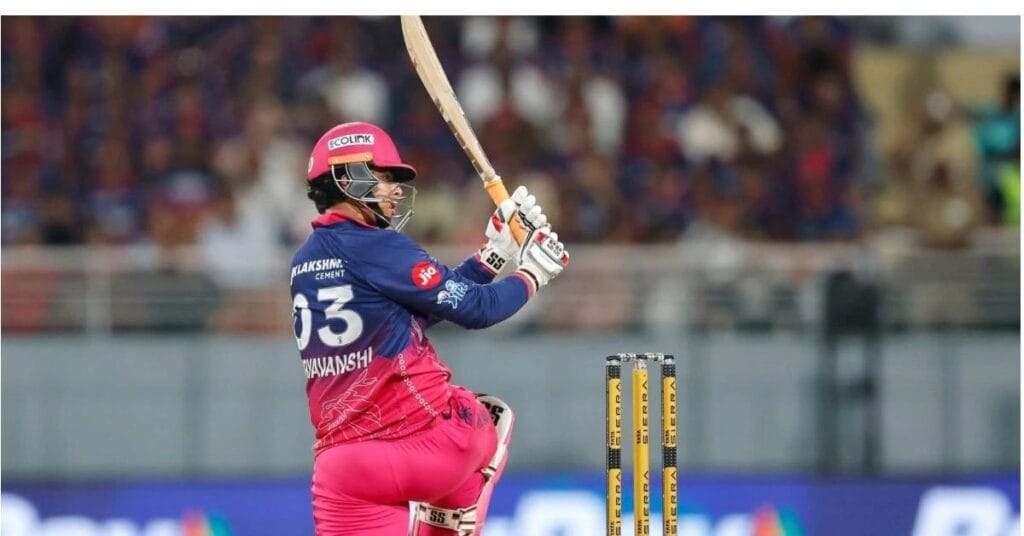
A 15-year-old boy stood alone at the crease in New Chandigarh, India’s best fast bowlers hurling short-pitched deliveries at his body, a bouncer crashing into his helmet, and yet — he kept swinging. He kept fighting. He scored 96 off 47 balls while his senior teammates crumbled around him.
And watching from afar, a former India pace bowler couldn’t stay silent.
Irfan Pathan’s post-match tweet was four lines long.Irfan Pathan Vaibhav Suryavanshi bodyline bowling But those four lines started a conversation about cricket, childhood, ethics, and what we owe to the extraordinary young people we put on the biggest stages in sport.
What Actually Happened in Qualifier 2 — The Full Picture
To understand why Pathan spoke up, you first need to understand what Vaibhav Suryavanshi walked into on that Friday night.
Rajasthan Royals lost the toss and were asked to bat. The innings fell apart almost immediately. Yashasvi Jaiswal was dismissed for just 1 run, and Dhruv Jurel followed for 7. Within the powerplay, RR were reduced to a precarious 9 for 2 — a nightmare start in a knockout game.
Into this wreckage walked Suryavanshi. Fifteen years old. Playing in an IPL Qualifier 2. With the season on the line.
He didn’t flinch.
Suryavanshi rebuilt the innings alongside Ravindra Jadeja, who contributed a vital 45 off 35 balls before being forced to retire hurt due to an elbow injury. After Jadeja’s departure, the middle order collapsed again — Riyan Parag managed just 11, Dasun Shanaka barely contributed, and others offered little resistance. Suryavanshi, meanwhile, was at the other end doing the impossible: keeping Rajasthan alive almost entirely by himself.
He smashed 8 fours and 7 sixes. His strike rate exceeded 204. He struck a straight six off a 153 km/h back-of-a-length delivery from Kagiso Rabada — the kind of shot that makes experienced coaches shake their heads in disbelief. With Donovan Ferreira providing a late cameo of 38 off just 11 balls, RR reached 214 for 6. A total that, without Suryavanshi, might have been closer to 150.
But in the 14th over, something happened that shifted the conversation entirely.
The Helmet Blow That Changed the Tone
Gujarat Titans’ pace trio of Kagiso Rabada, Mohammed Siraj, and Prasidh Krishna had adopted a clear strategy: target Suryavanshi’s body. On a used pitch, they consistently bowled short-pitched deliveries angled into the teenager’s body, denying him room to free his arms and attempting to unsettle his rhythm through physical intimidation.
In the 14th over, Rabada’s bouncer found Suryavanshi’s helmet. The mandatory concussion protocol was activated, and the youngster underwent a medical assessment before being cleared to continue. A moment later, Siraj continued the bodyline approach in the 15th over — and Suryavanshi responded by pulling him for a six.
He finished on 96, out off another short delivery from Rabada, caught at deep third man. Two runs short of a century. For the second consecutive match — he had scored 97 in the Eliminator against Sunrisers Hyderabad just days before.
Gujarat chased down 215 with seven wickets and eight balls to spare. Rajasthan Royals were eliminated. Suryavanshi was reportedly in tears in the dressing room.
Irfan Pathan’s Words — Why They Matter
Hours after the match, Irfan Pathan Vaibhav Suryavanshi bodyline bowling posted on X (formerly Twitter):
“Body line bowling to stop 15 years old Vaibhav Suryavanshi doesn’t fit well with me. I know he is playing against the big boys but the father in me doesn’t agree with that.”
These are not the words of someone who doesn’t understand cricket. Pathan is a former India all-rounder who swung the ball at pace, who played Test cricket, who knows better than most that short-pitched bowling is a legitimate weapon at the highest level. He wasn’t questioning whether the tactic was legal. He wasn’t claiming it was against the rules.
He was saying something more human: that there is a difference between what is permitted and what feels right.
Pathan’s statement matters for several reasons.
First, it comes from a place of genuine experience. As a pace bowler himself, he has used the short ball as a weapon. He understands the tactical logic behind targeting a young, aggressive batter with bouncers — make him uncomfortable, disrupt his timing, test his technique against deliveries angled into the ribs. He gets it. And yet he still objected.
Second, his framing — “the father in me” — speaks to something that cricket’s rulebook simply cannot capture. Suryavanshi is not just a cricketer. He is a child. A 15-year-old. Whatever his talent, whatever records he has broken, he is still a minor, still developing, still at an age where most of his contemporaries are preparing for school exams rather than facing 150 km/h bouncers in playoff cricket before a crowd of thousands.
Third, Pathan’s comment opened a legitimate debate: does the professional cricket environment have a responsibility to accommodate the age of its youngest participants, even when those participants have chosen — and been selected — to compete at the highest level?
R. Ashwin’s Fury: “Nobody Gave Suryavanshi Any Support”
Irfan Pathan was not the only former India cricketer to weigh in. Ravichandran Ashwin, speaking on his YouTube show Ash Ki Baat, delivered one of the most passionate responses of any cricketer to Suryavanshi’s performance.
“Main mayoos hoon,” Ashwin said — “I am sad.”
He described Suryavanshi’s innings as something that defied easy description: “He has played so well throughout IPL 2026, scoring almost 800 runs. But for me, the high point was the innings he played today. In fact, incredible isn’t even enough to describe what Vaibhav Sooryavanshi produced today.”
But Ashwin’s real anger was directed not at Gujarat Titans — but at Rajasthan Royals’ own senior players. He systematically went through the batting card and was unsparing in his verdict.
“To be honest, I’d say Rajasthan Royals were never in the game from start to finish,” Ashwin said. “Yashasvi Jaiswal got out, Dhruv Jurel got out the way he did, Riyan Parag got out… Dasun Shanaka scored maybe three runs off nine balls, during which he left two balls alone. ‘Well left’ in a T20 — would you believe it? Jofra Archer came in at number six… nobody gave Sooryavanshi any support.”
He added: “He was the lone person standing between an RR defeat and a victory. He was fighting out there all by himself. And after the 10th over, he didn’t even get the strike for two or three overs. Incredible, just incredible.”
This is a damning indictment of a team that, despite having international players in its ranks, essentially left a 15-year-old to carry a playoff campaign alone.
The Bodyline Debate: Is It Ethical? Is It Cricket?
The term “bodyline” carries enormous historical weight in cricket. It originally referred to England’s controversial Ashes strategy of the 1930s, where Harold Larwood bowled persistently short and fast at the bodies of Australian batsmen, particularly Don Bradman. It sparked a diplomatic crisis between England and Australia, a formal complaint from Cricket Australia’s predecessors, and eventually a change in the Laws of Cricket.
Today, bodyline bowling is governed by rules around short-pitched deliveries and bouncers — there are limits on how many can be bowled per over, and bowling with intent to intimidate carries its own distinctions under the Spirit of Cricket. But it remains entirely legal within these parameters.
What GT deployed against Suryavanshi was within the laws. Rabada, Siraj, and Prasidh Krishna are professional cricketers in a high-stakes playoff match. Suryavanshi has voluntarily entered this arena and, by any measure, has proven he belongs there. He was not a victim in the traditional sense — he fought back, he hit sixes, he made 96.
And yet — Irfan Pathan’s discomfort resonates with many fans and observers because it points to a gap between the letter of the law and the spirit of the game. The Spirit of Cricket, as outlined by the MCC, calls on participants to play with “respect for opponents” and to conduct the game within its “traditions.” It does not specifically address age. But when a professional bowling attack coordinates a sustained physical assault against a 15-year-old — even one who hits back brilliantly — many feel that something about the optics sits uneasily.
There is also a safeguarding dimension. At 15, Suryavanshi is a minor in every legal and moral sense. The sport’s governing bodies, teams, and franchises carry a duty of care toward participants of his age that goes beyond simply following the rules.
Vaibhav Suryavanshi: The Extraordinary Journey to This Moment
To fully appreciate what Pathan was defending, you need to know just how extraordinary this teenager is — and how rapidly he has ascended.
Suryavanshi made his first-class debut at just 12 years old. He scored a century against Australia in an Under-19 Youth Test. He was signed by Rajasthan Royals at the IPL 2025 auction for ₹1.1 crore, becoming the youngest player ever signed for the league.
In IPL 2025, he debuted at 14 years and 23 days — the youngest debutant in IPL history. In just his third IPL appearance, he smashed 101 off 38 balls against Gujarat Titans, the fastest century by an Indian in IPL history, and the second-fastest overall, behind only Chris Gayle’s 30-ball hundred in 2013. He finished his debut IPL season with 252 runs at a strike rate of 206.56.
In IPL 2026, he elevated his game further. By the time of Qualifier 2, he had accumulated close to 800 runs in the season — a staggering return for any batter, let alone one who was 15 years old. In the Eliminator against Sunrisers Hyderabad just days before Qualifier 2, he had scored 97 off 29 balls — one of the most destructive innings in IPL playoff history.
And then came 96 off 47 against Gujarat in Qualifier 2. Carrying a collapsing team. Under physical assault. Alone.
When Suryavanshi was dismissed for 96 and Rajasthan were eventually beaten by seven wickets, he reportedly broke down in the dressing room. He was 15. He had done everything asked of him — and then some. He had given his team 214 runs largely on the back of his own brilliance. And it still wasn’t enough.
The image of a 15-year-old in tears after leaving everything on the field is both inspiring and heartbreaking. It is also a reminder that behind the records, the sixes, and the viral clips, there is a child navigating emotions and pressures that most adults never face.
What This Moment Tells Us About Indian Cricket
Vaibhav Suryavanshi’s journey, and the conversation it has sparked around him in IPL 2026, tells us several important things about Indian cricket.
First, the talent pipeline is genuinely extraordinary. India has long been known for producing prodigious young batters, but Suryavanshi represents something truly generational. The speed at which he has adapted to professional cricket, the mental strength he has shown under pressure, and the quality of his strokeplay against the world’s best fast bowlers place him in a very rare category.
Second, the support systems need examination. Ashwin’s criticism of RR’s senior batting lineup was pointed and fair. A 15-year-old should not be the primary match-winner in a playoff knockout. That is not a reflection on Suryavanshi’s ability — it is a reflection of a team structure that placed too much burden on one very young pair of shoulders.
Third, the ethics of young talent in high-pressure environments demand ongoing conversation. Pathan’s tweet was not a complaint in isolation. It was a prompt. When do the protections we extend to young people — in law, in social norms, in sporting governance — apply on a cricket field? There are no easy answers, but the question deserves more than a simple “he chose to be here.”
Fourth, Suryavanshi’s trajectory is almost certainly bound for the Indian senior team. Rajasthan Royals’ own Director of High Performance, Zubin Bharucha, has already urged selectors to fast-track him, comparing the situation to Sachin Tendulkar’s early career. With nearly 800 IPL 2026 runs, two consecutive near-centuries in playoff conditions, and a temperament that has never wavered, it is difficult to argue against that call.
Where Do We Draw the Line?
Irfan Pathan’s reaction was emotional. It was human. And it was right — not because bodyline bowling is illegal, but because sport, at its best, involves more than legality.
The greatest players in cricket history — Tendulkar, Lara, Kallis, Ponting — were all once young men learning how to survive and thrive against opponents who played hard. They were all tested, challenged, and sometimes knocked down. That is how greatness develops.
But they were, at their youngest first-class levels, generally 16 or 17. They were not 15. And they were not being sustained targeted with back-of-a-length deliveries at 150 km/h in playoff cricket while their own team’s batting order disintegrated around them.
What makes Pathan’s voice particularly credible here is that it is not naive. He is not calling for Suryavanshi to be protected from hard cricket. He is not suggesting Gujarat Titans cheated. He is simply saying: when I watch a 15-year-old’s helmet get struck by a bouncer while he’s single-handedly saving his team’s season, something in me — the cricketer and the father — doesn’t feel right about it.
That is not weakness. That is wisdom.
Cricket has always balanced aggression with respect. The two are not opposites. You can bowl hard, bowl fast, bowl short — and still carry within you an awareness of the broader human context in which you are competing. That awareness is what Pathan was asking for. And judging by the response from fans and fellow cricketers alike, it is an awareness that resonates far beyond one tweet.
Conclusion
Vaibhav Suryavanshi walked off the field in New Chandigarh on May 29, 2026 with 96 runs, a tear-streaked face, and the knowledge that he had done everything he possibly could.
He did not need protecting that night. He proved — again — that he belongs at the highest level of the game. Two near-centuries in consecutive playoff matches is not luck; it is a statement of exceptional talent and character.
But the conversation Irfan Pathan started is one worth having beyond this single match and this single season. What do we owe to the extraordinary young people who enter professional sport at ages that would have seemed impossible even a decade ago? How do we balance the fierce demands of competitive cricket with the basic human responsibility to not lose sight of the child inside the cricketer?
There are no simple answers. But the fact that a former India fast bowler — someone who knows what it takes to compete and to intimidate — felt compelled to speak up suggests that the question matters.
Suryavanshi will almost certainly play Test cricket for India. He will almost certainly be one of the defining batters of his generation. He will face bouncers, bodyline tactics, and hostile bowling attacks for the next fifteen years.
But he will also, for at least a little while longer, be 15. And some of the people watching — Irfan Pathan among them — think that still deserves to mean something.
This article covers the IPL 2026 Qualifier 2 played on May 29, 2026, between Rajasthan Royals and Gujarat Titans at New Chandigarh. All match statistics and quotes are sourced from post-match reports and verified social media posts.