
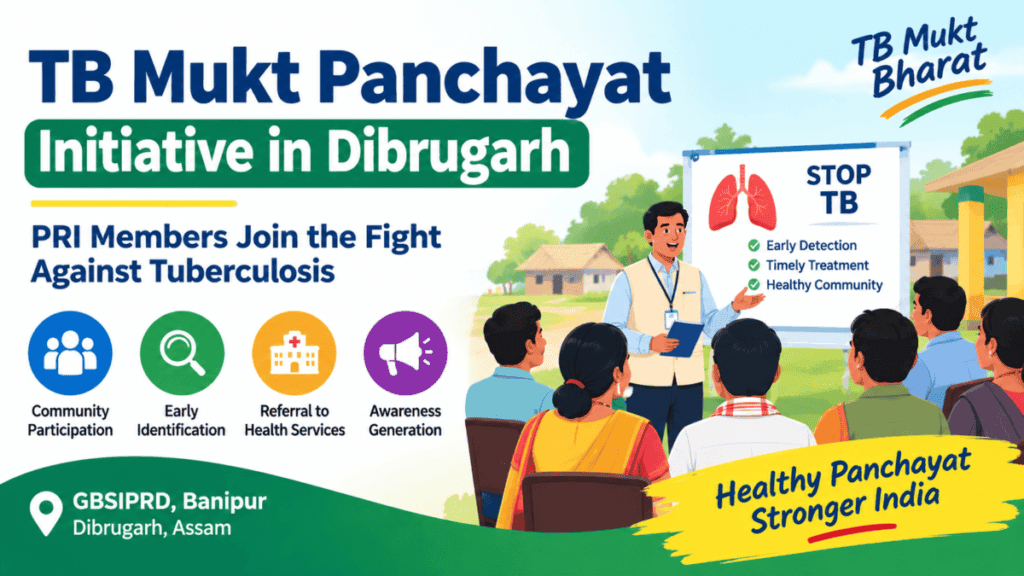
An orientation programme for Panchayati Raj Institution (PRI) members on the TB Mukt Panchayat Initiative was conducted by the National TB Elimination Programme (NTEP), Dibrugarh, at the Extension Centre of the Golap Borbora State Institute of Panchayat and Rural Development (GBSIPRD), Banipur, Dibrugarh, Assam.
The programme focused on increasing the participation of local elected representatives in India’s efforts to eliminate tuberculosis (TB). According to the information shared about the event, the session highlighted community participation, early identification and referral of presumptive TB cases, awareness generation and the broader goal of making Panchayats TB-free.
The initiative is part of a wider national approach in which Panchayati Raj Institutions are being brought into TB-related community engagement. The Central Tuberculosis Division provides a TB Mukt Panchayat Handbook and a dedicated Panchayat training module, showing that PRI engagement is an established component of the national TB programme.
What Is the TB Mukt Panchayat Initiative?
The TB Mukt Panchayat Initiative aims to involve Panchayats in creating greater awareness about tuberculosis and supporting local action against the disease.
The initiative was formally launched nationally in 2023 as a collaborative effort involving the National TB Elimination Programme and the Ministry of Panchayati Raj. The India TB Report describes the initiative as an effort to empower PRIs and make TB elimination a community-level responsibility.
A Panchayat can help connect communities with the public health system. This is particularly important in rural areas, where awareness, stigma, accessibility and delays in seeking care can affect TB detection and treatment.
Role of PRI Members in TB Elimination
PRI members are not expected to diagnose tuberculosis. Their role is primarily related to community mobilisation, awareness and linkage with health services.
Their activities can include:
- spreading accurate information about TB;
- encouraging people with possible symptoms to seek testing;
- helping communities understand the importance of early diagnosis;
- supporting referral of presumptive TB cases to health facilities;
- addressing misinformation and stigma;
- encouraging treatment adherence;
- supporting community-level TB activities;
- helping include TB-related activities in local development planning.
The official TB Mukt Panchayat Handbook specifically recommends incorporating TB-related activities into Panchayat Development Plans and conducting community awareness on symptoms, prevention, stigma reduction, treatment adherence, diagnostic facilities and government benefits.
Why Early Identification Matters
One of the major themes of the Dibrugarh orientation was early identification and referral of presumptive TB cases.
The term “presumptive TB” is important. It refers to a person who may have symptoms or other features that warrant TB evaluation. It does not mean that a PRI representative has diagnosed TB.
The appropriate pathway is:
Awareness → identification of possible symptoms → referral → medical testing → diagnosis → treatment → follow-up
This community-level link can help reduce delays in reaching diagnostic services.
India’s current TB elimination strategy also places considerable emphasis on finding cases earlier. The 2026 TB Mukt Bharat Abhiyaan campaign document describes village-level vulnerability mapping and systematic screening of high-risk populations, followed by diagnostic testing and treatment.
Community Participation Is Central to TB Elimination
TB is not only a medical issue. Social and economic factors can also affect people’s ability to seek and complete treatment.
The Central Tuberculosis Division’s 2026 guidance on the Ni-kshay Mitra Initiative notes the links between TB, undernutrition, poverty, stigma and social vulnerability. It also emphasises community participation and social support alongside medical care.
This makes local institutions such as Panchayats important partners.
A Panchayat is already connected with households, community organisations and local development activities. When PRI members understand the TB programme, they can help communicate reliable information and encourage people to use available health services.
TB Mukt Panchayat Is More Than an Awareness Campaign
The TB Mukt Panchayat framework includes a structured process rather than simply holding awareness meetings.
The official handbook describes introductory meetings, preparation of Panchayats, inclusion of TB activities in Panchayat plans, community awareness, quarterly monitoring and submission of claims for TB Mukt Panchayat status. It also provides for assessment involving Panchayat and health-system representatives.
Therefore, the success of a TB Mukt Panchayat programme should ultimately be measured through continuing activities and health indicators, not simply by the number of people attending an orientation.
Useful indicators can include community awareness, referral of presumptive cases, completion of diagnostic evaluation, TB notifications, treatment initiation and treatment support.
Dibrugarh Programme Highlights Grassroots Action
The Dibrugarh orientation demonstrates how the national TB elimination strategy can be connected with local governance.
The event brought together the NTEP, Dibrugarh, and PRI representatives in a rural-development training environment at GBSIPRD, Banipur. Its focus on awareness, early identification and referral reflects the broader national emphasis on community engagement.
The Central TB Division’s Assam page also lists community engagement and awareness activities among TB-related work in the state.
However, the available information about the Dibrugarh orientation does not provide outcome figures such as the number of PRI members trained, people subsequently screened, TB cases detected or Panchayats achieving TB Mukt status. Therefore, those outcomes should not be assumed from the event announcement alone.
Building a TB-Free Community
A TB-free Panchayat requires continuous cooperation between the community, Panchayati Raj Institutions and the health system.
The basic approach can be summarised as:
Inform → Identify → Refer → Diagnose → Treat → Support → Monitor
Each stage has a role. Community awareness can encourage people to seek care. Health facilities provide diagnosis and treatment. Panchayats and community groups can help maintain awareness and social support.
The national TB programme itself describes TB elimination as requiring broad participation across government and society. The 2026 TB Mukt Bharat campaign reported substantial involvement of elected representatives and Panchayats in community activities.
Conclusion
The TB Mukt Panchayat Initiative in Dibrugarh represents an important grassroots component of India’s National TB Elimination Programme. The orientation of PRI members is intended to strengthen community participation, improve awareness, encourage early identification and support timely referral of people who may have TB.
For Panchayats, the objective is not to replace medical services but to create a stronger connection between communities and the health system.
The long-term impact will depend on sustained implementation, accurate information, timely diagnosis, treatment support and regular monitoring at Panchayat level.
The Dibrugarh programme therefore provides a useful example of how local governance and public health can work together toward the broader goal of a TB Mukt Bharat.