By a Cricket Analyst | Updated: June 2026 | Reading Time: 9 Minutes
There are cricketers who arrive. And then there are cricketers who announce themselves — loudly, unmistakably, with the kind of jaw-dropping ability that makes veteran commentators reach for superlatives they’ve been saving for a decade.
Vaibhav Suryavanshi is the second kind.
At an age when most teenagers are worrying about school exams, this 14-year-old from Bihar has already played IPL cricket, worn India A colours, and forced conversations about fast-tracking him into the senior national setup. He hits the ball so cleanly, so instinctively, that even seasoned bowlers have looked genuinely rattled.
But recently, cricket got a reminder that inside the extraordinary talent is still a teenager. In Dambulla, Sri Lanka, during a Tri-Nation India A series, Suryavanshi was involved in a heated on-field altercation — and it raised a question that needs a real, honest answer: Is Vaibhav Suryavanshi being protected the way a 14-year-old playing adult professional cricket deserves to be?
This article will answer every question you came here with — how he is so good, who he is, what happened in Sri Lanka, and what needs to happen next. Let’s go deep.
Who Is Vaibhav Suryavanshi? The Complete Answer
Vaibhav Suryavanshi was born on March 27, 2011, in Samastipur, Bihar — a state not historically known for producing elite cricketers. His father, Sanjiv Kumar Suryavanshi, was a local cricket coach, and from the time Vaibhav could hold a bat, it was clear this was not going to be an ordinary story.
He grew up training under his father at the Samastipur cricket ground with a discipline that would embarrass many adult professionals. Early videos of him as a nine and ten-year-old show a batter with near-perfect head position, a still base, and an instinctive ability to read the line of the ball before the bowler had even completed their action. These are not things coaches easily teach — they are things that separate the generational talents from the merely gifted.
By the time he was 12, he was already being talked about in Bihar cricket circles as something unprecedented. He entered the national consciousness at 13, became one of the youngest players ever picked up at an IPL auction when Rajasthan Royals signed him for ₹1.1 crore in the 2024 IPL auction — a moment that genuinely stunned the cricketing world. He hadn’t even sat his secondary school exams.
How Is Vaibhav Suryavanshi So Good? A Genuine Answer
This is the question everyone is asking. Let’s answer it properly — not with vague praise, but with actual analysis.
1. His technique is built for modern cricket, not inherited from a past era
Many young batters in India develop with a coaching framework shaped by Test match orthodoxy — high elbow, play straight, wait for the bad ball. Vaibhav’s game looks different. His stance is slightly open, his backlift is compact but loaded with power, and he plays with a high-risk, high-reward philosophy that looks chaotic until you slow it down and realise every shot has intent, timing, and a clear plan behind it.
2. He has extraordinary hand-eye coordination for his age
Cricket coaches who have worked with him talk about his ability to adjust in the final microseconds of a delivery — something called “late adjustment.” Most batters at club level can’t do this. International batters spend years developing it. Vaibhav appears to have been born with a version of it already installed.
3. His father built the foundation early — and correctly
Sanjiv Kumar’s approach was to let Vaibhav play his natural game rather than forcing technical adjustments that might kill the instinct. There’s a critical lesson here for coaches working with young talent across India: over-coaching kills natural brilliance. The willingness to trust what the player sees, not just what the textbook says, is part of why Vaibhav still bats the way he does.
4. He is mentally fearless in a way teenagers rarely are
Watch him face fast bowling. He doesn’t flinch. He doesn’t shuffle back towards leg stump. He gets into position early and commits. Fear of the ball is one of the biggest barriers for young batters facing professional-speed bowling. Vaibhav appears to have genuinely conquered it — or perhaps never had it to begin with.
5. He trains obsessively
There is no shortcut to this part of the answer. His father has spoken in interviews about the hours Vaibhav puts in — before school, after school, on weekends. Elite junior talent without elite work ethic burns out or gets overtaken. Vaibhav combines both the raw gift and the relentless commitment.
The Sri Lanka Incident: What Actually Happened and Why It Matters
In June 2025, during the Tri-Nation A series in Dambulla, Sri Lanka, India A faced a Super Over decider. They needed 17 runs to win and failed to chase it down — a rare and painful failure for a team carrying significant pride.
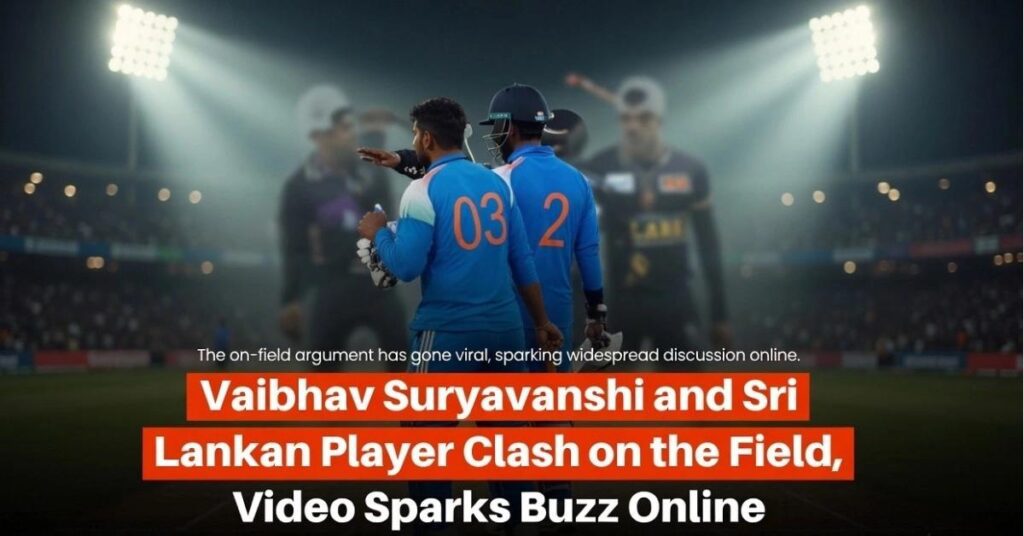
In the aftermath, as players crossed, a heated exchange broke out between Vaibhav Suryavanshi and Sri Lankan player Vishen Halambage. The exchange escalated, and Vaibhav — by multiple accounts — pushed the opposition player. The moment was captured on broadcast cameras and shared widely.
The phrase that circulated on Sri Lankan social media, reportedly from the exchange: “Match over… now go home.”
It’s easy to write this off as competitive fire. It’s also easy to condemn it as poor discipline. Neither response is quite honest enough.
The Response Nobody Is Giving: Cricket Is Not a Contact Sport — But That’s Not the Whole Story
Here is the truth that most cricket media isn’t saying clearly: Vaibhav Suryavanshi is 14 years old, competing in adult professional cricket, and nobody around him appears to have given him adequate preparation for exactly this kind of moment.
Every youngster needs a voice of reason before they need a cheerleader. He needs someone — a senior player, a manager, a mentor — whose job is not to celebrate his cover drives, but to sit down with him before a high-pressure match and say: regardless of what happens on this field, regardless of what opposition players say to you, there is a line you do not cross.
That conversation appears not to have happened — or not to have landed.
Let’s be precise about what occurred: India A lost a Super Over in a tri-series. Emotions ran high. An opposition player said something provocative enough that a highly competitive teenager reacted physically. This is not excusable — but it is completely understandable when you understand the environment.
Here is what the incident reveals:
Vaibhav is fiercely competitive. The same fire that makes him hit sixes off fast bowling is the same fire that made him react in Dambulla. That competitiveness is an asset. It is also something that, untamed at age 14, creates exactly this kind of moment.
He is emotionally still a child, even if his cricket is not. When we accelerate a talented teenager into adult professional environments, we cannot accelerate their emotional development at the same speed. The brain of a 14-year-old — particularly the parts that regulate impulse control and emotional response under stress — is not the same as an adult’s. This is neuroscience, not excuse-making.
The system around him has a responsibility. Board of Control for Cricket in India (BCCI), Rajasthan Royals, India A management — everyone who benefits from Vaibhav’s extraordinary talent has an equal obligation to protect and guide him. A 14-year-old should not be managing the pressure of international competition, social media scrutiny, and opposition sledging without a robust support structure.
Who Is “Chapri Player”? Clearing Up the Nickname
If you’ve searched “Chapri player cricket” and landed here — that nickname has been used informally on Indian social media to describe an aggressive, fearless street-cricket style of play. It is sometimes applied to Vaibhav’s batting approach, which carries that raw, uninhibited quality that formal coaching academies don’t always produce.
In the context of the Sri Lanka incident, the label has been used online both affectionately and critically — reflecting the complex reaction to a teenager who plays cricket like he has nothing to lose, because at 14, he genuinely doesn’t yet understand what there is to lose.
What Makes Vaibhav Suryavanshi Different From Other Young Indian Cricketers
India has produced remarkable young talent across generations. Sachin Tendulkar debuted at 16. Prithvi Shaw broke records at under-16 level. Shafali Verma made her India senior debut at 15. But even within this tradition, Suryavanshi stands apart in specific ways:
He plays with no template. Most young Indian batters are coached to a certain pattern — get in, build an innings, accelerate. Vaibhav attacks from ball one in a way that resembles T20 batting instincts applied across all formats. This is increasingly valuable in modern cricket.
His shot selection under pressure is unusually mature. Watch him in the IPL footage from 2024 — he doesn’t just slog. He selects. He assesses the field. Then he executes. That decision-making layer is what separates the sloggers from the players who will last at elite level.
He has not buckled under the weight of attention. Most teenagers would be overwhelmed by an IPL auction bidding war at age 13. Vaibhav appeared to process it and return, largely unfazed, to playing cricket. The Sri Lanka incident is the first public sign that the pressure is finding cracks — and it’s worth noting, that only happened after a competitive loss in a high-pressure knockout moment.
FAQ
Q1.How is Vaibhav Suryavanshi so good?
A combination of rare natural hand-eye coordination, an open and attacking technique built for modern cricket, exceptional early coaching from his father that preserved his instinct rather than suppressing it, and an obsessive training ethic. He is also mentally fearless under pressure in a way most adult batters spend years trying to achieve.
Q2.Who is the 14-year-old Indian cricketer everyone is talking about?
Vaibhav Suryavanshi, born March 27, 2011, from Samastipur, Bihar. He became one of the youngest players ever signed in the IPL auction when Rajasthan Royals picked him up in 2024. He plays for India A and is regarded by many scouts and coaches as a once-in-a-generation batting prospect.
Q3.Who is the “Chapri player” in cricket?
The term has been applied informally to Vaibhav Suryavanshi on Indian social media, referencing his raw, fearless, street-cricket-influenced batting style that breaks from conventional coaching templates.
Q4.Who is Vaibhav Suryavanshi the cricket player?
He is a right-handed opening batter from Bihar who plays attacking cricket across formats. He gained national recognition through exceptional junior performances, an IPL contract at age 13, and selection for India A. He is widely considered one of the most exciting young batting prospects India has produced in a generation.
What Needs to Happen Next: A Genuine Recommendation
Vaibhav needs a dedicated mentorship structure. Not just coaches focusing on his pull shot or his footwork against spin. A senior figure — ideally a retired India cricketer with lived experience of high-pressure professional environments — who meets with him regularly and helps him develop the emotional tools to match his technical ones.
The BCCI and India A management need to be honest about the challenge. Putting a 14-year-old into adult competitive cricket and expecting adult emotional responses is unrealistic. The system needs to build in more protection, more preparation, and more pastoral support than would be given to a 22-year-old debutant.
Vaibhav himself — or those guiding him — needs to take the Sri Lanka incident seriously. Not as a scandal. Not as something to explain away. But as information: this is what happens when competitive fire meets unprocessed pressure in the body of a teenager. There are better ways to channel it.
The cricket media needs to resist making him a symbol before he’s fully formed. Every profile that calls him the “next Tendulkar” or “India’s future” adds another kilogram to the psychological weight this teenager carries. He is extraordinary. He is also 14. Both things can be true.
Conclusion
Vaibhav Suryavanshi will almost certainly play Test cricket for India. The talent is real, the work ethic is real, and the cricketing intelligence, already visible at 14, suggests a player who will only get better as his understanding of the game deepens.
But the boy who pushed an opposition player in Dambulla is also real. And that boy deserves exactly the same attention, care, and investment as the batter who hits sixes in the IPL.
India has a history of discovering extraordinary young talent and then — sometimes — watching it fray under the weight of expectation, media pressure, and systems that weren’t built for the person behind the performance.
With Vaibhav Suryavanshi, there is time to do this differently. There is time to build the complete cricketer and the supported human being simultaneously.
Every youngster needs that voice before they need a cheerleader. The question for Indian cricket right now is: who is playing that role for Vaibhav?